

Marais, Paris
Youcef Korichi
Alidade de Nuit
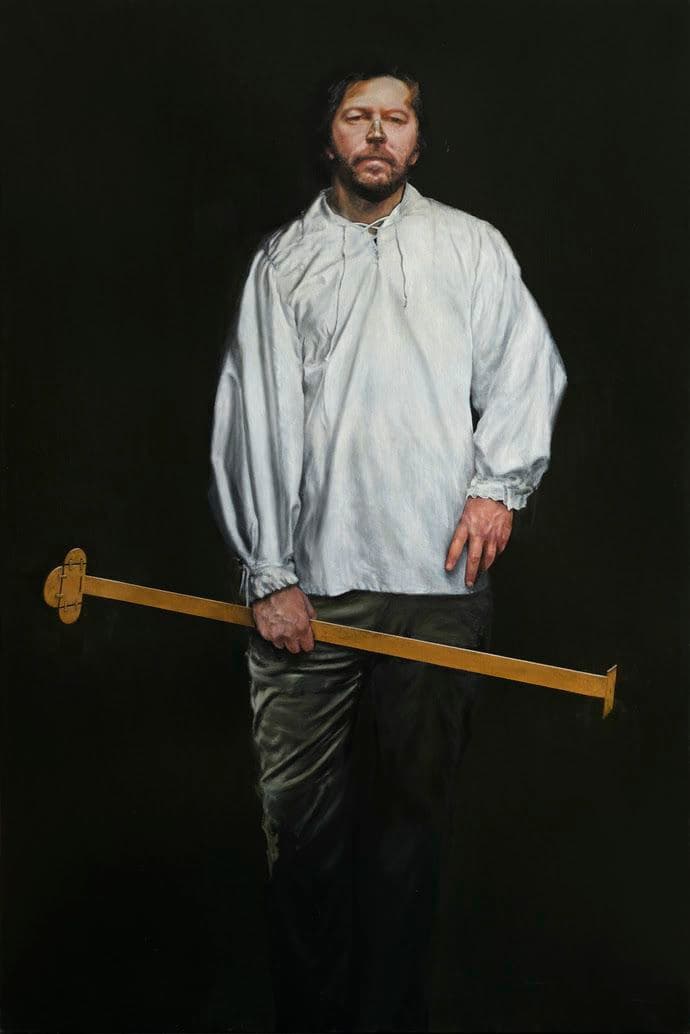
Suzanne Tarasieve‘What are we looking at?’ is the question that immediately comes to mind. Paintings, of course: three full- length portraits, two framed busts (one antique, one modern), others depicting donkeys, alidades (revolving rods affixed to ancient astronomical and surveying instruments, used to measure angles, equipped with a sighting pin, are featured in two paintings), and various devices (plumb lines, screws, brass sheets), as well as several more sculptures placed on the floor or hung on the wall and ceiling. There is a semblance of heterogeneity in the subjects, genres, and figures, with this strange extension toward objects that, like the small paintings depicting a simple ‘thing,’ seem to have emerged from the large-scale works to isolate a discreet element within the exhibition’s overarching narrative. We discern an overarching syntax, a discursive arrangement that Youcef Korichi might have composed like a musical score or a story—a painting multiplied and expanded within the gallery space. If we attempt to explain (from the Latin explicare: to unfold, to unroll), we’ll start with a name, a figure: the one that appears, albeit veiled and concealed, in a life-size triple portrait with a black background, borrowing as much from history painting—it could be the portrait of a king painted by Velázquez—as from the fantasy of a shifting identity in which parallel destinies collide. An appendage reveals the figure’s identity: this false nose is the one Tycho Brahe wore, it is said, after losing his own in a duel, at the age of 20, and thus less the nose of a farcical character than that of a wounded student, a brass prosthesis that still allowed him to have a face, while signaling its absence. And this would be like a first lesson: the artifact does not feign false appearances, while allowing the figure to retain its form, and the face its intentionality. A few words here about Tycho Brahe (1546–1601): a Danish astronomer who combined two models (geocentrism and heliocentrism), he observed the heavens both with the naked eye and using instruments revolutionary for his time—quadrants and sextants that he built himself—to achieve astronomical measurements of remarkable precision. Without abandoning the idea of the Earth’s fixed position within the solar system, he revealed the motion of the other planets around the sun: this hybrid model (geo- heliocentrism) put Kepler, who was his assistant, on the path toward the scientific revolution of the modern era. We certainly have a beginning here, which could be unpacked as follows: Youcef Korichi composes a fragmented portrait of Brahe, using sighting devices (alidades, pinnules) that dissect a character into facets that reflects both the scientist’s and the painter’s perspectives. These two realms of knowledge are complementary, resulting in a fragmented narrative that treads a fine line between knowledge and error, obscurity and revelation, truth and plausibility, fiction and objectification. Ultimately, only intention matters, that which directs the consciousness toward things. There is no more truth in art than in science, but rather two faces of a Janus with a brass nose. This does not, however, imply a questioning of the hermeneutic approach that permeates modern consciousness: there is no critique of science, nor any crisis of representation with postmodern overtones. Tycho is a tragic hero clad in the trappings of comedy, for he stands on the impossible precipice of a reconciliation between Aristotle and Copernicus; he is, at heart, the emblem of stubborn humility—the donkey, whose depictions then function as metaphors for these virtues. We traverse the night of conscience with before us the darkness of the world to decipher: the work of both astronomer and painter. While the viewer’s aim might then be to identify the iterations and paths leading from one object to another, they would not succeed in restoring the coherent narrative of a staged scene, but rather in discerning the fragments of a questioning in painting. That of an art that is unwaveringly fiction and a practical inquiry into the fictional, within the act of painting, blurring the deceptive boundary between truth and plausibility. The original question remains, active and joyful: what do we see? Brahe and Korichi aim into the night of things; the quality of what is seen is not overwhelming but clear: painting is a tribute, a reverence for the beauty of the visible. It is its delight, perhaps even its truth. —Yannick Mercoyrol