
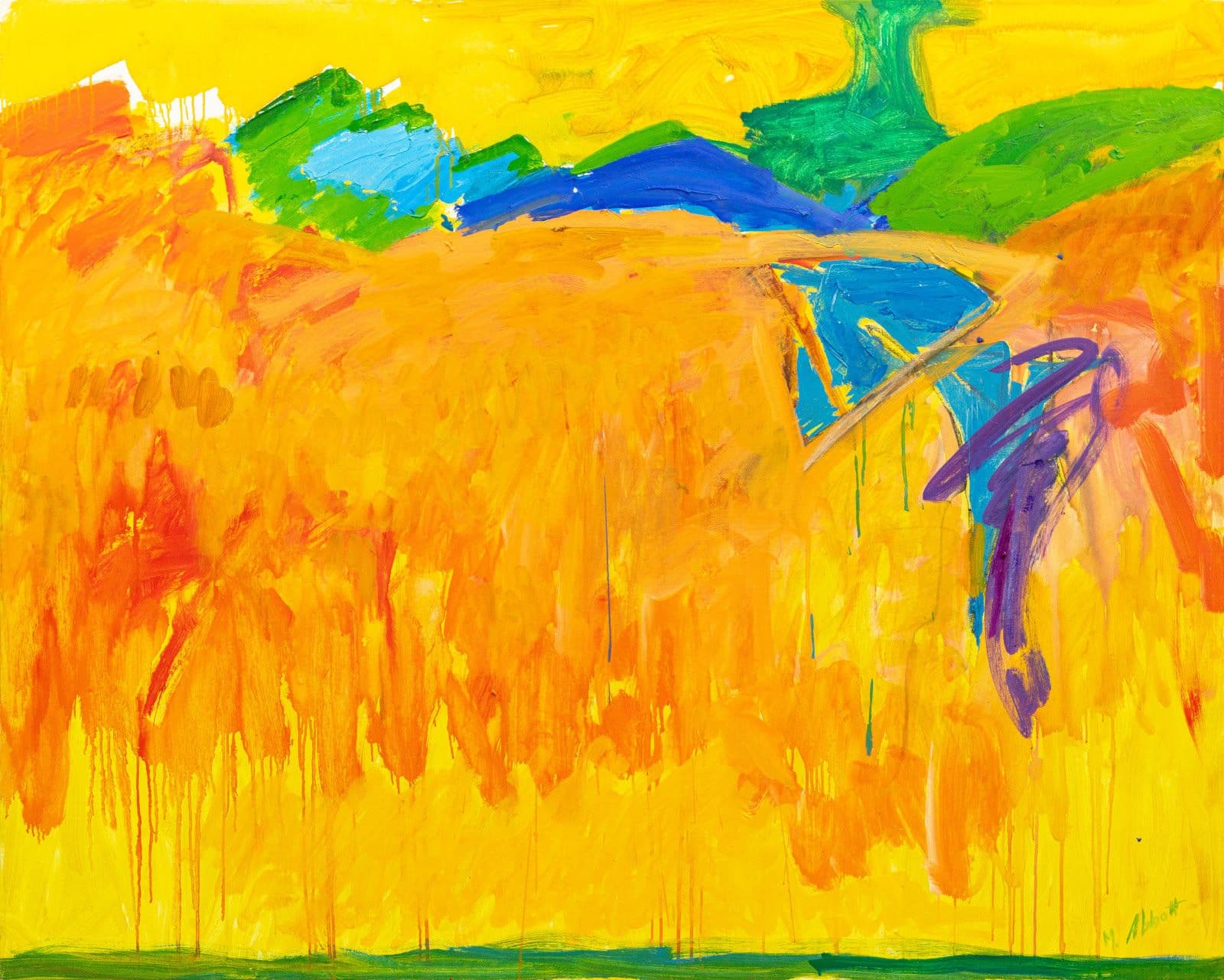
Chinatown, New York
Mary Abbott
To Draw Imagination
SchoelkopfMary Abbott: To Draw Imagination marks the first major survey exhibition addressing the full scope of Mary Abbott's painterly practice. Spanning 1940 to 2002, the works on view demonstrate Abbott's immense contributions to Abstract Expressionism, including her bold exploration of color, form, and media. As one of the few women invited to join The Club, which was a group of artists dedicated to shaping Abstract Expressionism, Abbott experimented with the conceptual and physical possibilities of her materials— including pastel, charcoal, collage, and oil paint — to express a deeply personal visual language of abstraction informed by the natural world, her travels, and her own lived experience throughout her long career. A leading figure in the Abstract Expressionist movement of the 1940s and 1950s, Mary Abbott's dynamic and emotive works have been celebrated for their bold exploration of color, form, and media. Alongside Elaine de Kooning and Joan Mitchell, Abbott pushed the boundaries of the Abstract Expressionist movement and painting itself, incorporating diverse materials and tools, such as oil, oil stick, charcoal, pastel, collage, and paw and handprints. Abbott parsed her own work as source material for new works and continually developed her own modes of creative expression throughout her oeuvre and into the early 2000s. Born and raised on New York's Upper East Side, Abbott was a young student of modernist George Grosz, but her early-career friendship with her neighbor David Hare, one of the founding members of the experimental Subjects of the Artist school in New York, introduced her to a new milieu in the New York School. After taking classes at the Corcoran Museum School of Art, Washington, D.C., and the Art Students League of New York, she settled in a studio in New York's East Village in the 1940s and studied under Robert Motherwell, Mark Rothko, and Barnett Newman. In the 1940s, while working in dialogue with artists such as Jackson Pollock and Willem de Kooning, Abbott developed her unique approach to Abstract Expressionism, centered on a vibrant color palette and experimentation with a broad range of techniques and media. Abbott began exhibiting her work publicly in the 1950s and was included in the Stable Gallery Annuals exhibitions, which would later be widely regarded as the public catalyst of Abstract Expressionism. Today, Abbott's work is included in highly regarded public collections, such as the Smithsonian American Art Museum in Washington, D.C., the Denver Art Museum, the National Gallery of Art in Washington, D.C., the Parrish Art Museum in Water Mill, New York, and Femmes Artistes du Musee de Mougins in Mougins, France. "Motherwell was in charge and he was OK but always trying to educate you...I preferred Barney Newman and Rothko...They were the ones I learned the most from. They taught us to draw imagination." —Mary Abbott "My paintings happen through a journey: dancing, seeing, waiting; destroying, discovering, doubting, guessing, finishing and reopening. I like the process of painting. The intensity of Living Nature through myself using my medium, paint, color and line. . . . All this comes from unconscious openings and very conscious decisions." —Mary Abbott quoted in American Abstract Expressionism of the 1950s, by Marika Herskovic (New York: New York School, 2003), 22.