
Marais, Paris
Harry Nuriev
Lèche-Vitrines
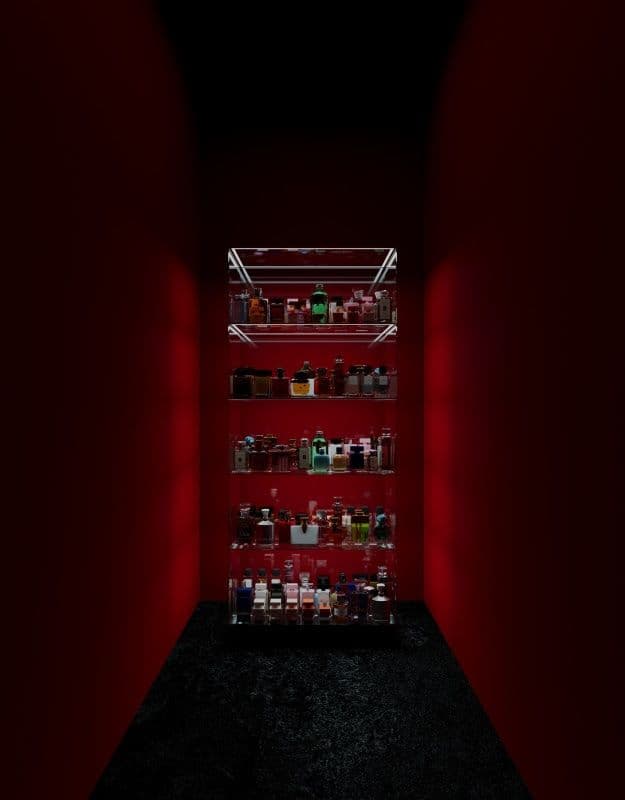
SultanaIt is a vitrine like many others – a jeweler’s, a pharmacist’s, or a souvenir shop’s. It gathers a series of used objects, abandoned by their owners: a perfume bottle with only a few drops left or an old half-empty shampoo bottle. These remnants, sometimes altered by the artist who transforms them into miniature sculptures, are exhibited in vitrines at the Sultana gallery. They form the first art installation by Harry Nuriev presented in Paris. With Lèche-Vitrines, Harry Nuriev offers perhaps one of his most enlightening installations on his concept of Transformism, the cornerstone of his work for several years. Transformation, in his hands, is above all an alchemy of objects: Harry Nuriev has previously repurposed computer keyboards to create mirror frames and transformed underwear into rugs. The most ordinary and contemporary objects from our lives are reassigned not only to a new use value but also to a new aesthetic and a newfound beauty. Harry Nuriev, in his own way, performs a genuine re-enchantment of the world, of matter itself, and of the forgotten and abandoned objects that surround us. This alchemical rearrangement of the world is also, and primarily, an act of refusal: a refusal of the relentless production of new objects, a refusal of the contemporary obsession with voracious consumption that depletes materials and exhausts the planet. The endless flow of consumption could thus give way to a world of permanence, where revitalization of what already exists replaces its constant, hysterical replacement. “What will remain of our world in fifty years?” he asks. “Will we still be able to produce new objects, to extract materials endlessly from the earth? Or will we have to make do with the used objects still available?” In response to this dystopian vision, Harry Nuriev proposes an ascetic and humanist answer: to make do with what remains, to initiate a transformation that is not merely about objects but about our relationship with objects – and therefore with the world. It should be noted that the perfumes, shampoos, and creams featured in the exhibition come from Harry Nuriev’s friends and close circle. For him, the re-enchantment of the world, its rearrangement, involves celebrating the community. The objects on display in the showcase are no longer mere marketing tools for consumerist exchanges but a celebration of human relationships. A perfume evokes the scent of a loved one; a day cream recalls the skin of a friend. Removed from its condition as a capitalist product, the object can once again embody something human: the DNA of humanity finds itself encapsulated in used liquids and the revitalized objects by Harry Nuriev. While Lèche-Vitrines explores the value of objects, Harry Nuriev is equally fascinated by another mechanism: the exhibition as medium. Harry Nuriev approaches exhibition making as a breaking in. Two years ago, he confessed to me that all his interventions were about “sabotaging” spaces, disrupting them by “inserting things that shouldn’t be there.” Such “things” can include a vitrine or used products that seemingly have no place in an art gallery. This mechanisms of displacement, transformation, and disruption of the exhibition space are fur- ther enriched at the Sultana gallery by another mechanism, specific to vitrines, and with a mise en abyme, the one of the art gallery as a pure commercial display. “They were no longer the cold windows she had seen in the early morning ; they seemed to be warm and vi- brating from the activity within. There was a crowd before them, groups of women pushing and squeezing, devouring the finery with longing, covetous eyes [...] But the furnace-like glow which the house exhaled came above all from the sale, the crush at the counters, that could be felt behind the walls. There was the continu- al roaring of the machine at work, the marshalling of the customers, bewildered amidst the piles of goods, and finally pushed along to the pay-desk. And all that went on in an orderly manner, with mechanical regularity, quite a nation of women passing through the force and logic of this wonderful commercial machine.” —Émile Zola, Au Bonheur des Dames When Émile Zola published Au Bonheur des Dames in 1883, dedicated to Le Bon Marché (renamed Au Bon- heur des Dames), vitrines had become a distinctive feature of newly created department stores and, more broad- ly, of Parisian streets. They embodied modernity. While large glass panes had been used since the 18th centu- ry to stage merchandise, it wasn’t until the mid-19th century that they became an integral element of Parisian commercial architecture. Haussmann’s extensive urban renewal projects during the Second Empire modernized the city, with the advent of protective sidewalks inviting leisurely strolls and public transport fostering mobil- ity. Since the early 19th century, technical advancements had made flat glass production possible—a necessary condition for showcases as we know them today. All the factors were in place for a new leisure activity to emerge: window shopping (a term that, since the 18th century, has referred to entertainment rather than free- dom or idleness, as in the Middle Ages). From its inception, the showcase was both a symptom and a tool of a burgeoning capitalist society and consumerism, serving their logic and “mechanics,” as Zola might say. How- ever, this “mechanics” was largely hidden by the showcase, which, behind its apparent transparency, mesmer- ized more than it revealed. Its aesthetics of spectacle were designed to make the consumer forget their role as a cog in the economic machinery. Window shopping had to be an entertaining experience. In reality, it was an exercise in frustration—and thus a creation of consumer desire, leveraging both the abundance of displays and the perceived rarity of products or bargains, reinforced by the invention of sales... by Le Bon Marché’s found- er himself. It was about carefully staged cognitive stimuli in a fleeting context of endless merchandise flow—a cornerstone of capitalism’s infinite supply logic. Merchandising thus revealed itself to be a science of dazzle. Harry Nuriev intentionally recreates this showcase mechanism in another space – one foreign to it: the art gallery. It is fascinating to notice, as Nuriev draws parallels between art galleries and store showcases, how the commercial activity of galleries structures partly the public space (galleries are open to everyone) and free time (wandering through them is now a weekend pastime in certain social circles). An artwork, often seen as a revelation of reality, might instead be a mere capitalist product, a distraction, a diversion from reality. Harry Nuriev seeks to disrupt this relentless mechanism. His installation is steeped in eeriness: we recognize the showcase and its products, but they are used items displayed in an art gallery. The showcase itself is engulfed in a menacing blackness. A symbol of modernity and capitalism, it is taking on water. “Whether as packaging, window or partition, glass is the basis of a transparency without transition: we see, but cannot touch. The message is universal and abstract. A shop display is at once magical and frustrating - the strategy of advertising in epitome.” —Jean Baudrillard, Le Système des objets This new era, embodied by the 19th-century vitrine, has already revealed its paradoxes: an era of both transparency and concealment. Until then, goods had been displayed on stalls or stored by craftsmen in their shops, but they were now presented directly to consumers, without any other intermediary. It was a time for trade liberalization. Haggling was replaced by displayed prices. Rationalization was in motion. The abolition of guilds and their strict regulations, following the French Revolution, paved the way for the proliferation of bazaars and department stores, which were allowed to combine different product categories. With Harry Nuriev, this logic reaches its limit, as it becomes possible to showcase used products and remnants. With the vitrine, the store is no longer a private, guild-dominated space but a public space, transparent and open. The vitrine was perhaps one of the earliest signs of the shift from an economy still “embedded” in society (a concept coined by economist Karl Polanyi in The Great Transformation, 1944) – that is, still secondary – to the phenomenon of economic “disembedding,” where market logic overtakes and structures the social sphere, influencing public space and free time. By disrupting the vitrine, undermining its mechanisms with used and altered objects, Harry Nuriev seems to invite a re-embedding: in his work, the human and social – embodied by the community that plays such a vital role in this installation – can once again prevail over economics and consumption. His first exhibition at the Sultana gallery thus becomes less a celebration or pure critique of merchandising and more a showcase for another possible life, where community takes center stage – a showcase for a utopia already in action: Transformism. —Thibaut Wychowanok Harry Nuriev (b. 1984, Paris, FR) is an artist, architect and furniture designer based in Paris. He is the founder and creative director of Crosby Studio, an interior and furniture design studio established in 2014. Nuriev’s creative practice spans a broad range, including immersive environments, virtual installations, public spaces and object design. All are created through the lens of “Transformism" - a movement Nuriev invented to describe practices that prioritize transformation and transformative experiences – the most accurate to describe his work and style. Nuriev pushes his passion for experimentation with innovative design for retail spaces and Web3 within the digital realm and draws his inspiration from the unexpected beauty of everyday objects we engage with. Through this process he aims to create extraordinary statements about today’s society based upon relevant, yet conventional items and moments. Nuriev takes people out of their comfort zone and draws their attention to new feelings and important matters. His reconstructive style merges art, design, architecture and fashion, breaking the boundaries between these traditionally separated fields. In this way, Nuriev challenges broader ideas about how we live and work. Harry Nuriev has been heralded as a pioneering voice in global minimalism by The New York Times Magazine, citing architecture and arts and crafts instinctive influence on his designs. He has given lectures and took part in several educational programs on design at among others Harvard University, the Pratt Institute and the Royal College of Art in London. Nuriev has done creative collaborations and projects with leading global brands and artists including Balenciaga, Nike, Dover Street Market, OMA, Liam Gillick, Valentino and many more.