
Chelsea, New York
Group Exhibition
New Voices: Design
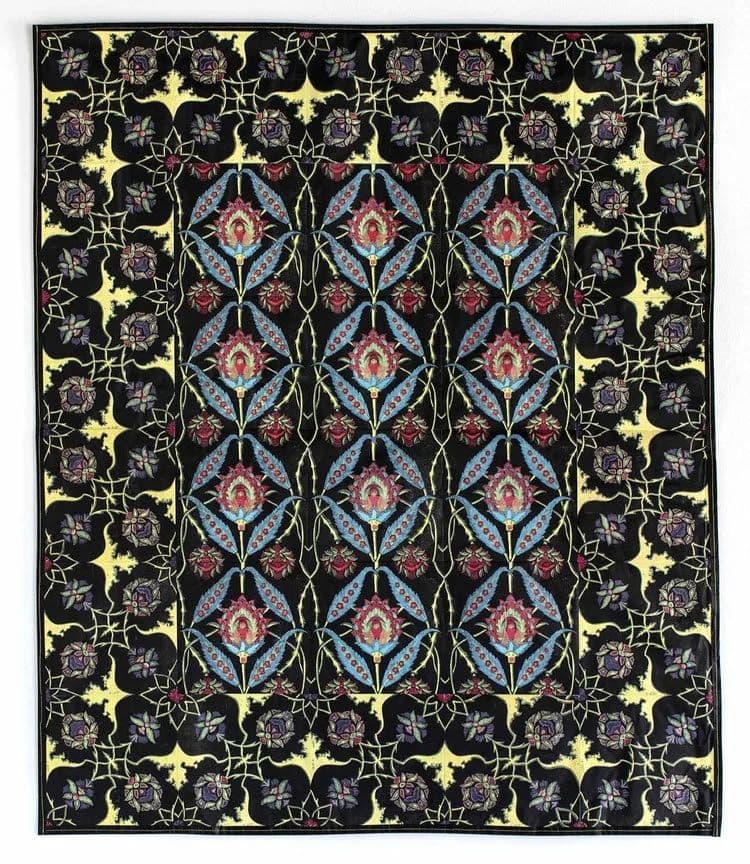
Print Center New YorkNoah Breuer, Zoran Dobric, Johannah Herr, Jazzmen Lee-Johnson, Michael Menchaca, Melih Meric, Anette Millington, Amy Yoes Print Center New York is excited to present New Voices: Design, the fourth iteration of its annual open call program thats showcasing work by the 2026 cohort. The program provides opportunities for emerging artists to present and develop their work through a group exhibition, artist-led public programming, focused conversation and community-building and individualized resources for professional and artistic development. New Voices: Design examines the historical legacy and contemporary application of pattern across a wide range of printmaking practices. It is curated by Andrew Raftery, Professor of Printmaking at Rhode Island School of Design, who was invited to lead this year’s New Voices selection process. Using design as a guiding framework, Raftery engaged with approximately 400 applications from across the United States in order to arrive at the final cohort of eight artists. In Zoran Dobric’s recent body of work, Crochet Chronicles, unique garments are modified with a screenprinted pattern on gold metallic emergency blankets. The image on the blanket is based on a cherished doily crocheted by the artist’s grandmother. Dobric’s use of the emergency blanket combined with the provenance of the doily are charged with meaning, reflecting the artist’s personal experience of displacement and his empathy for all refugees. Combining research into the natural world with her extensive experience in textile design, Anette Millington creates three-dimensional prints in which sculptural form and surface treatment bring to mind the textures and complex symmetries found in plants, animals and our own bodies. Flower Tongue (2024) uses the soft blends possible in digital printing on velvet, which is quilted and given regular geometric form by a metal skeleton to conjure the way flowers draw in the creatures that enable them to reproduce. The screenprinted elements on Amy Yoes’ new series Tidesweepings utilize multiple and interchangeable screens, printed in different colorways and layers. The primary visual element is the dot—the definitive unit of every commercial print since the end of the 19th century. Here, Yoes utilizes halftone dots, Ben-Day dots, the dot matrix and large patterns of small circles. These primary graphic abstractions are layered in the service of spatial and atmospheric effects, hinting at a shared language gained through a lifetime experience of printed images. Melih Meric’s works engage traditional Islamic pattern structures in their purest form. Positioning the single point as the generator of complexity within order, Meric’s research doubles as a spiritual quest to reconcile their Turkish identity and its inherited riches, embodied in Iznik patterns, with their personal history, a process described as ‘queering’ Islamic design. By making them into multi-layered woodblock prints stitched together as quilts, Meric introduces new materials and meanings that assert the edition as the ideal embodiment of the individual prints that comprise them. Noah Breuer’s recent work is based on his research into Carl Breuer and Sons, a textile factory operated by his family in Czechoslovakia before it was confiscated by the Nazis in 1939. Through his study of the factory archive at the Czech Textile Museum, Breuer retrieved something that had been forcibly taken from his family, finding a series of patterns that form the basis for the works in this exhibition. In his reanimation of these designs, a single word, ‘RETURN,’ is spelled out in Czech, English, Hebrew and American Sign Language, bridging linguistic divides. The historical resonance of design can be embodied in objects as well as patterns, which Jazzmen Lee-Johnson demonstrates with her installation, Go ‘Head, Fix You A Plate (2025), featuring a dining table and chairs replete with printed elements. Johnson references well-appointed dining rooms and specific style choices that are a point of pride for the women who have kept her family together for generations. Through patterns on upholstery, plates and napkins the artist explores memories of social gatherings and relatives, along with symbols conveying joy and sorrow. Johannah Herr’s work exploits seductive visual qualities in the service of a powerful cultural critique. Her installation I Have Seen the Future: White Flight Model Home (2022) grew from research into the 1964 New York World’s Fair and deep study of media, advertising and products of the period. Herr’s collages are installed on her ‘Exclusive Wallpaper,’ which is overprinted with transparent, shiny text revealing racially restrictive covenants written into deeds in post-WWII suburban neighborhoods. Herr’s critique of 1960s design and its underlying biases and prejudices lead one to question what is hidden in plain sight. In Michael Menchaca’s practice the protocols of contemporary design and its various technologies are inscribed in their visual style. Having refined and built computational tools that function as the building blocks of every image, whether screenprinted, digitally printed or part of a video animation, Menchaca’s digital ‘brushes’ form the basic vocabulary of their work—a vast ongoing archive of characters, images and patterns. Menchaca’s deep knowledge of the graphic language, layering and surface qualities of traditional printmaking informs the ways in which the artist inflects their work with material richness. These artists are united by their shared engagement with the history of pattern and its reverberations in the present through design, printmaking and culture. The exhibition is accompanied by an illustrated publication featuring a critical essay by Raftery contextualizing the cohort’s work, as well as a range of artist-led public programming throughout the summer. Noah Breuer is an American artist and Assistant Professor of Print Media at the University at Buffalo, SUNY. His practice occupies the intersection of traditional printmaking and 21st century digital technology, utilizing this hybrid approach to examine themes of family identity, labor and the Jewish diaspora. Breuer’s current research focuses on the cultural legacy of early 20th-century Jewish-owned textile printing companies in Czech Bohemia. Through what he describes as a ‘reclamation project,’ Breuer investigates his own family’s lost industrial history, resurrecting and reinterpreting archival designs to explore the tension between ancestral memory and contemporary artistic ownership. Zoran Dobric is a New York-based fashion and textile designer, artist and educator. Educated at Istituto Marangoni in Milan and holding an MA from the London College of Fashion, he is a Professor in the MFA Fashion Design program at the Fashion Institute of Technology. Dobric’s practice bridges digital innovation with artisanal fashion and printmaking techniques. His award-winning textiles, artworks and designs have been exhibited internationally and featured in global press, galleries and retail spaces. Across these works, often informed by his Croatian upbringing and Serbian heritage, he explores themes of identity, displacement, belonging and multiculturalism. Johannah Herr holds an MFA from Cranbrook and a BFA from Parsons. She has had solo shows at Shirley Fiterman Art Center, Gaa, Geary Contemporary, BRIC and Elijah Wheat Showroom and Red Ger Gallery. She is a Fulbright Scholar and participated in group shows at Museum of Craft and Design, San Francisco, CA, Museum Angewandte Kunst, Frankfurt, Germany, Weatherspoon Museum of Art, Greensboro, NC, Weisman Museum of Art, Minneapolis, MN and Pioneer Works, Brooklyn, NY. She attended residencies at Museum of Arts and Design, Dieu Donne, The Arctic Circle, Wassaic Project, IEA Alfred, Oxbow and Vermont Studio Center. Jazzmen Lee-Johnson is a visual artist, scholar, composer and curator. Her practice centers on the interplay of animation, printmaking, music, and dance, informed by a yearning to understand how our current circumstance is tethered to the past. Through her visual, sonic, and movement investigations across time and technology she disrupts and asserts ideas of history, body, liberation and otherness. She received her BFA in Film, Animation and Video at RISD, her MA in Public Humanities at Brown University and a heavy dose of education working with youth in Baltimore, Johannesburg, Providence and New York City. Michael Menchaca (b. 1985) is a Xicanx, Mexican-American, Queer multidisciplinary visual artist based in San Antonio, TX. They studied at Texas State University (BFA, Printmaking, 2011) and the Rhode Island School of Design (MFA, Printmaking, 2015). Menchaca creates artworks at the intersection of print media, painting, video sculpture, animation and new media installation. They have developed a digital lexicon of animal archetypes and narrative pattern designs, or their digital codex, to assist in mythologizing the interwoven logic of global apartheid projects including: European conquest, U.S. border imperialism, natural resource extraction, data colonialism and AI evangelism. Melih Meric (b. 1998, Istanbul/Turkey) is a printmaker and educator. They explore a spiritual journey through Islamic geometric abstraction. Using printmaking as their main medium, they create works that talk about diaspora, assimilation and a combination of Middle Eastern traditional practices. Their works combine traditional pattern making and a contemporary way of creating editions of prints. With a passion for pattern and paper, they use innovative methods of printmaking and textile arts to create stitched editions and embossed works on paper. They received their MFA in Print Media from Cranbrook Academy of Art, and BA from Bennington College in Printmaking. Their works have been exhibited in Michigan, Ohio, Kansas, Iowa, Wisconsin, Vermont, Texas and internationally in Germany, Australia, Netherlands, Austria, and Turkey. Melih is the recipient of the Individual Excellence in Visual Arts award 2025 by the Ohio Arts Council. Anette Millington, a New York-based artist, explores the psychological depth of decorative language in her woodblock prints and patterned fiber sculptures. Recent highlights include Infinite Forms: Facets, Fabric, and Fiber at the Museum of Mathematics, New York, NY, Paper Made II at the Fort Wayne Museum of Art, Fort Wayne, IN, Material Reasoning at the Center for Craft, Asheville, NC and a residency at the Center of Contemporary Printmaking, Norwalk, CT. Millington is an Assistant Professor at Parsons School of Design. She holds an MFA from the School of Visual Arts and a BFA from Massachusetts College of Art. Amy Yoes works in a multi-faceted way, alternately employing installation, photography, video, painting and sculpture. One of her largest projects, Hot Corners, was on view at Mass MoCA, North Adams, MA, from 2021 to 2025. Other recent projects include Correspondências, a solo exhibition at the Contemporary Sculpture Museum in Santo Tirso, Portugal and multiple Fire Projects, in which she builds complex sculptures that are burned in a choreographed blaze before a live audience. A lifelong interest in decorative language and architectural space permeates her work. Yoes’s ongoing research into craft, architecture and ornament has been furthered by travel and research opportunities. She teaches at the School of the Art Institute of Chicago.