

Hamptons, New York
Alan Ruiz
De Sol a Sol
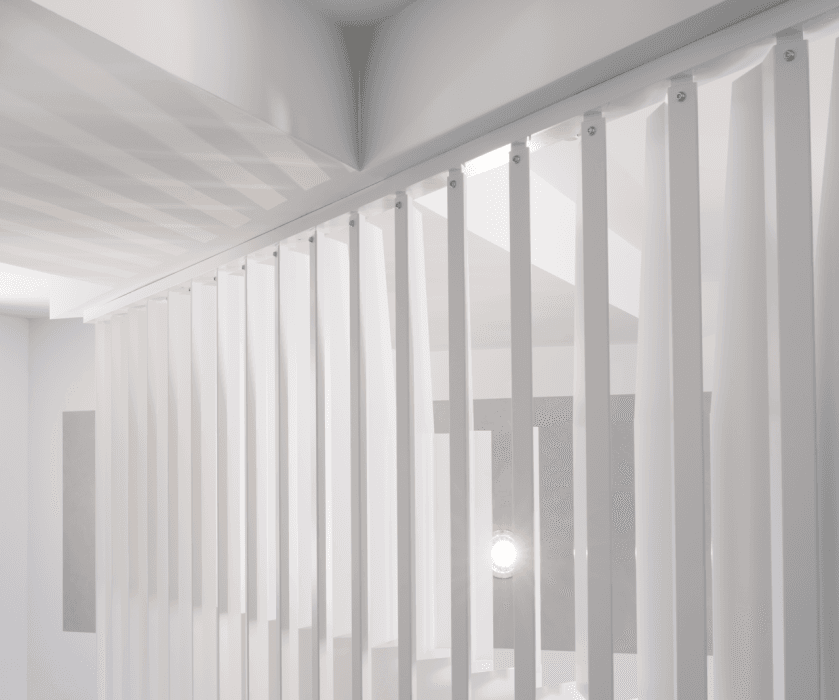
Dia BridgehamptonThroughout his research-driven practice, Alan Ruiz critically examines built environments to draw attention to their social, political, and psychological dimensions. By rigorously mining what is already present in industrial and institutional contexts—including archives and spatial conditions—Ruiz identifies systems that typify wider sociopolitical circumstances and power structures and how they manifest in daily life. The results of his investigations take the form of architectural interventions and abstract sculptures made with utilitarian materials like metal and glass. Dia Bridgehampton, the Dan Flavin Art Institute (DFAI), is a place of special interest for Ruiz, who was born in Mexico but raised on Long Island and has conducted extensive research on Flavin. In his commission for the space, titled De sol a sol (From Dawn to Dusk), he explores the labor behind the creation and maintenance of the DFAI in the context of local working conditions as well as labor’s broader histories in the United States, while considering daylight as a concept, a material, a resource, and a political force. On Long Island’s East End, where the population increases almost fourfold in the summer months, daylight governs and reinforces an array of social distinctions. The increased daylight hours bring seasonal residents and businesses to the area, who in turn necessitate more so-called day laborers, often immigrants, to service and maintain them. Similarly coveted by 20th-century industry, natural light was harnessed in factories attempting to increase worker productivity—resulting in fluorescent lighting in hues such as “daylight,” a color regularly used by Dan Flavin, including in untitled (to Jim Schaeufele) 2 (1972) in the nearby stairwell. Ruiz’s De sol a sol brings together four new works and a long-form essay by the artist—the latter a frequent accompaniment to his exhibitions—to filter and frame the sociopolitical aspects of the ephemeral, life-giving force of daylight. At the center of Ruiz’s commission is WS-H2AB (2026), an architecturally scaled, site-responsive sculpture comprising powder-coated metal “fins” with mirrored edges that reflect and refract sunlight, capturing its dual registers as a regulator of both the workday and leisure time. As it sweeps across the gallery, incoming light moves through and bounces off the work, casting shadows and sunbeams that shift throughout the day and seasons, achieving a full year’s rotation over the course of the exhibition. With its row of post-like forms, WS-H2AB resembles a fence, a common feature of the East End that demarcates private and public space. These fences and the properties they enclose are often tended to by laborers who live a great distance from their workplaces due to the lack of affordable housing nearby, commuting to and from the affluent area in an east–west path that traces the sun’s arc over the earth. The movement of shadows in Dia Bridgehampton’s gallery thus quietly indexes this activity. Further emphasizing different classes’ relationships with daylight, WS-H2AB mimics brise-soleil designs, an architectural solution to overheating due to direct sunlight popular in East End homes. Drawing attention to how this seemingly neutral force dictates the flow of activity in the area, Ruiz asks: Who bathes in the sun, and who labors in it? While WS-H2AB bears similarities to the work of Minimal artists like Donald Judd, Robert Morris, or Anne Truitt, whose sculptural practices explored embodied perception and attuned the viewer to the object and its spatial conditions, each post’s mirrored edge incorporates the spectator, thus implicating them in the work’s political undercurrents. This immediacy is in keeping with what Ruiz calls “radical formalism,” in which “the formal [artwork] can become a kind of seductive decoy, or switch, that offers a subversive tactic for political action through misdirection.” [1] Ruiz’s use of reflective surfaces also nods obliquely to Latin American kinetic and Op artists like Julio Le Parc or Jesús Rafael Soto, who used movement and optical effects to manipulate light, distorting space and destabilizing the viewer. De sol a sol is foundationally informed by Ruiz’s residency in Dia’s archives in 2025. After reviewing Flavin and architect Richard Gluckman’s floor plans to transform a church into a permanent site for the artist’s nine sculptures in fluorescent light (1963–81), now the DFAI, Ruiz designed the form and axis of WS-H2AB to mirror the architectural configuration for the works’ display. Long interested in the systems Flavin’s works both tap into and create, Ruiz observes that Flavin “seem[ed] to mistake the banality of electric lighting for its universality.” While daylight is uncontrollably ephemeral, Ruiz argues that Flavin’s works “[presume] the availability of electricity,” raising questions of access, maintenance, and even sustainability. [2] In short, they rely on labor for their upkeep, administered both by the art institution and the power suppliers. Flavin’s nine sculptures rely equally on the “site-situational” walls upstairs to render their colored fluorescents visible. [3] Downstairs, Ruiz builds on this relationship by installing a swimming-pool light, a commercially available object as ubiquitous on Long Island as fluorescent lights historically were in Manhattan offices. Glowing like an artificial sun yet inset into the gallery wall at a height approximating its location in a pool, Daybreakers (2026) switches on and off at varying intervals. Just as quickly as the image of the pool is conjured, so does one imagine its users: Who is swimming in the pool, and who is maintaining it? While most pool lights are programmed to come on at night, Daybreakers operates under a different system; it is triggered by data provided by a crowdsourcing website that reports Immigration and Customs Enforcement activity in the area. Each hour, the light pulses in accordance with the number of weekly sightings accumulated to that point. In this way, the work summons different historical forms of visual communication, operating like a lighthouse warning of an incoming storm, or like the lanterns that signaled a safe house on the Underground Railroad. For Ruiz, the switch between different light intensities implies a connection between illumination and danger, evoking the long history of deploying or withholding light to politicize and control bodies. Daybreakers thus suggests that such ephemeral, everyday conditions are not neutral but rather inherently political. Pushing formalism “towards its own radical ends,” the works in this exhibition function on many levels. As “vessels of collusion,” they draw the viewer in with their visual allure, yet they can also be seen through sociopolitical, economic, and historical lenses. [4] Encapsulating this multivalence are Job 58-4316 (1958/2026) and Relación de trabajadores inmigrantes (List of Immigrant Workers, 2026), two prints derived from archives of the Bracero Program, which brought over four million workers from Mexico to the U.S. on short-term contracts between 1942 and ’64 to address the World War II–induced labor shortage. While Relación de trabajadores inmigrantes points to how individual workers were classified according to agricultural specialization, Job 58-4316 is more idiosyncratic: The photograph may depict the burning sun, or it may be a reflection of the photographer’s camera flash. Like De sol a sol as a whole, this mysterious yet loaded image offers many readings. Ruiz challenges us to see them all as clear as day. —Humberto Moro and Emily Markert 1 - Alan Ruiz, “Radical Formalism,” Women and Performance: A Journal of Feminist Theory 26, no. 2–3 (2016), p. 236. 2 - Alan Ruiz, “Ambient Conditions of Everyday Life,” lecture, Chinati Foundation, October 9, 2021, Zoom recording, 49:39 min., https://chinati.org/chinati-weekend-2021/artists-talk-alan-ruiz/. 3 - Ruiz, “Ambient Conditions of Everyday Life”; in 1989, Flavin wrote, “I prefer to refer to my use of artificial light as situational,” and regularly used this language to describe his work’s relation to the space in which it was installed. Dan Flavin, “situational light and, well beyond it … (for Sabine),” in Dan Flavin: The Architecture of Light (Deutsche Guggenheim Berlin), 1999, p. 87. 4 - Ruiz, “Radical Formalism,” p. 236.