
Midcity, Los Angeles
Aya Takano
How Deep How Far We Can Go
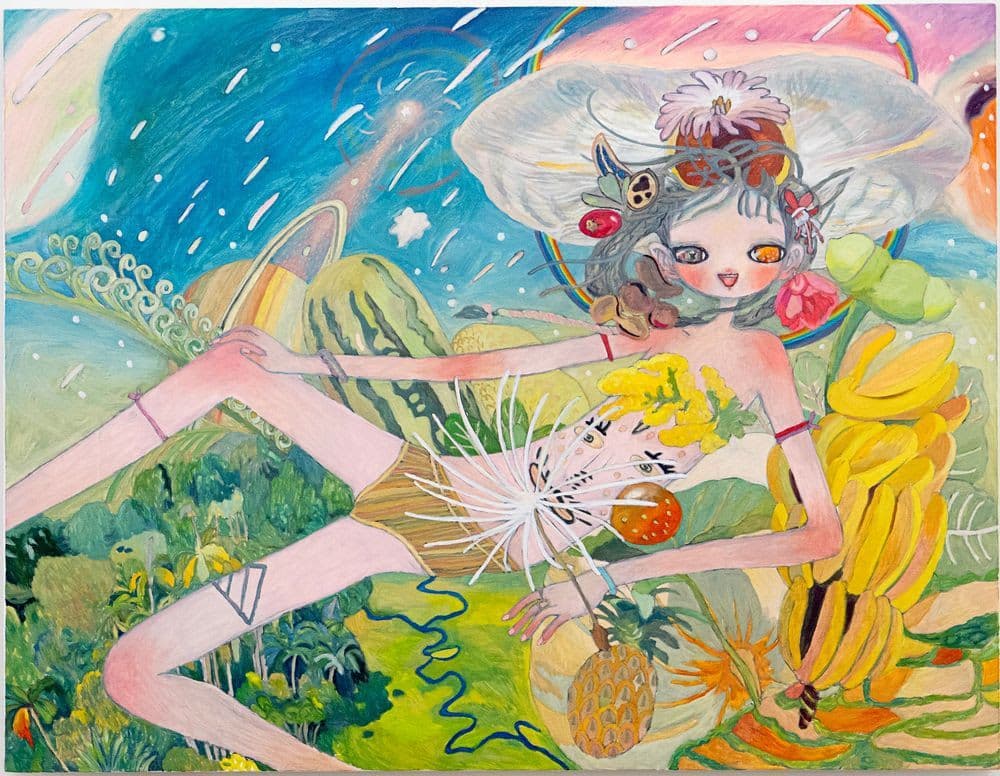
PerrotinPerrotin Los Angeles is pleased to present an exhibition by internationally acclaimed Japanese artist, Aya Takano; the artist’s eleventh solo exhibition with the gallery. Titled, how deep how far we can go, the exhibition brings together new paintings, drawings, and installations that explore memory, ancestral consciousness, and the timeless connection between all beings–human and non-human alike. An Immersive Journey into Time and Memory: the Deep Ecology of the Soul Renowned for her ethereal, otherworldly imagery, Takano has long been recognized as a central figure in the Superflat movement founded by Takashi Murakami. Yet her work transcends aesthetic affiliations: it vibrates with emotional urgency, spiritual depth, and radical tenderness. In, how deep how far we can go, she invites us on an inner pilgrimage reaching backward into prehistoric time and forward into mythic futures, tracing the pulse of life through DNA strands, fungi, extinct animals, and the luminous bodies of androgynous youth. “What I try to depict in my work is an invitation to a more organic, interconnected, and harmonious world,” Takano explains. “A place not centered around humans alone,” but one that honors “the radiance of all life.” From Circles to Cosmic Memory Born in Saitama, Japan, Takano’s earliest drawings—simple circles made at age three—already hinted at the cyclical, spiral-like patterns that would later emerge in her visual cosmology. Her Los Angeles exhibition builds upon this early fascination with shape, transformation, and biological interconnectedness. Visitors will encounter surreal dreamscapes filled with elemental and symbolic figures: towering Prototaxites, ancient fungal organisms; aircraft suspended in liminal skies; palm trees swaying beside archaic lifeforms. Through these fantastical tableaux, Takano constructs a subtle yet radical counter- narrative to the prevailing anthropocentric worldview. Her work offers a speculative ecology where all forms of life—from microbes in soil to ancestors encoded in our genes—coexist in a poetic matrix of memory and mutual care. In a drawing, two characters are shown reading Phoenix, the legendary manga by Osamu Tezuka—a visionary tale tracing the cyclical nature of life, death, and rebirth. This subtle homage is no coincidence: both artists weave together myth, memory, and speculative futures to question what it means to be alive. Like Tezuka’s Phoenix (火の鳥), which portrays humanity’s eternal quest for immortality and transcendence, Takano’s work invites viewers into a liminal space where time dissolves and all forms of life—plant, animal, human, microbial—are interconnected. “Within our bodies is embedded the entire history of life,” Takano says. “Our DNA holds the information and memories from the time we were plants, reptiles, or fish. If we can access this, we may be able to journey all the way back to a place that feels like the very source of life.” An Immersive Ritual for the Senses How deep how far we can go is more than an exhibition—it is a ritual space. Designed to awaken the five senses and reintroduce the body as a site of perception, it offers a reprieve from the disembodied logic of algorithm and data. Takano encourages audiences to engage not just intellectually, but physically and emotionally. Her dreamlike figures—elastic bodies, supple fingers, and dream-filled eyes—inhabit spaces where boundaries between human and non- human, male and female, child and adult, blur and recombine. Suddenly, animals are not wild beasts, but companions in a shared metamorphosis. Wolves, lions, and leopards are painted in profile like figures from a prehistoric fresco—not fierce or menacing, but soft, sentient, and noble. Takano’s brush lingers not on claws or fangs, but on fur and gaze. In one painting, a young woman clings to the neck of a rhinoceros whose armored back is not a shield, but a shelter. In another, a cobra engages in gentle conversation with a cat or squirrel; its red bifid tongue is not a threat but a speech act—an offering of friendship. Elsewhere, a bear sits at a table with two children, not as a toy, but as a full member of the family. It gazes in a different direction, subtly suggesting an alternate point of view, an alternative possibility. In all of these works, the imaginary becomes a tool for displacing normative perception and inviting unexpected forms of kinship. A Healing Space in a Time of Planetary Grief Set against the backdrop of intensifying climate crises—including the wildfires in Los Angeles—Takano’s exhibition is both timely and timeless. Following the 2011 Fukushima disaster and her own health struggles, the artist experienced a profound shift in worldview. No longer content with escapism, she turned toward “uncovering the secrets of the universe”—to offer healing, not just beauty. In Los Angeles, a city built on cinematic fantasy and mass dream production, Takano offers a counter-myth: not a utopia of spectacle, but a quiet, radiant world growing under the soil, within the cells, and in the hearts of all living beings. —Michaël Ferrier