
East, London
Stan Douglas
Birth of a Nation and The Enemy of All Mankind
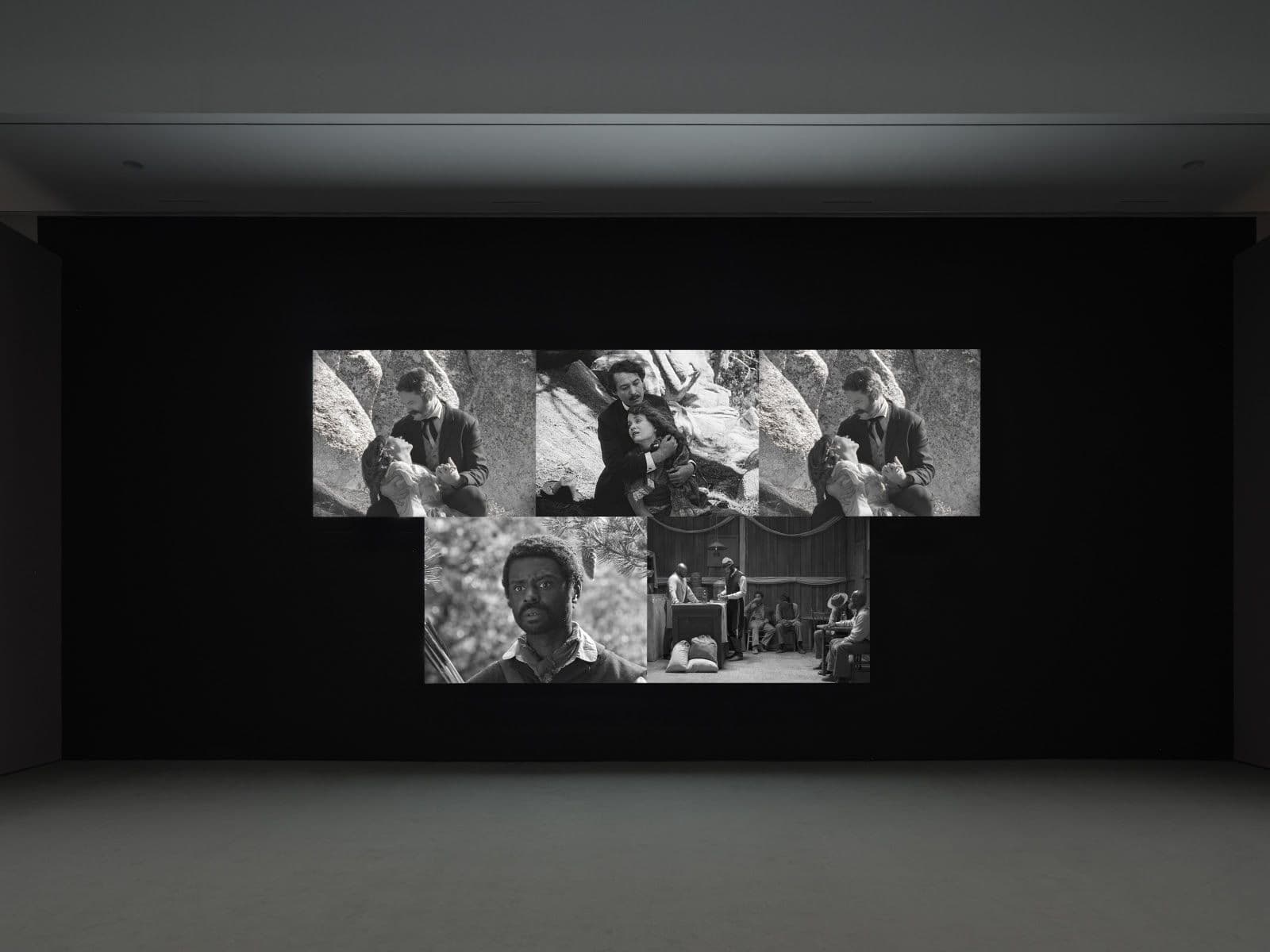
Victoria MiroVictoria Miro is delighted to present Stan Douglas' sixth solo exhibition with the gallery, which features the European premiere of the Canadian artist's multi-channel video installation, Birth of a Nation, and works from a new photographic series, The Enemy of All Mankind: Nine Scenes from John Gay's Polly. Since the late-1980s, Stan Douglas has examined complex intersections of narrative, fact and fiction while simultaneously scrutinising the media he employs, technology's role in image making and its influence on our understanding of reality. This exhibition marks the European premiere of Birth of a Nation, Douglas' new multi-channel video installation that confronts D.W. Griffith's controversial 1915 film The Birth of a Nation, a technically groundbreaking but deeply racist work that exalts white supremacy. Griffith's innovations, including the introduction of narrative crosscuts and a progressive use of techniques including close-ups and fade-outs, stand in stark contrast to his film's subject matter. Based on Thomas Dixon Jr.'s 1905 novel The Clansman: A Historical Romance of the Ku Klux Klan, Griffith's film is set during the American Civil War of the 1860s and into the subsequent Reconstruction period and was intended to redress any progress towards racial equality made between that time and its creation. Across the five screens of Birth of a Nation, Douglas focuses on a single narrative strand of Griffith's film involving the character Gus, a newly freed Black man, recently promoted to Confederate captain, who encounters a young white woman, Flora, alone in a forest. Gus - played in the 1915 film by a white actor in blackface - proposes marriage to Flora, who flees and falls to her death. Gus is then pursued and lynched by the Klan. Douglas presents Griffith's original sequence as one channel of the installation, accompanied by four others which feature a new, modified version, scripted and filmed by the artist. Two new Black characters are introduced: Sam and Tom, both also freedmen and Confederate captains. Gus, meanwhile, is reconfigured to become an amalgamation - a hallucination projected by the white characters whenever they encounter Sam or Tom. This blurring of identities, whereby the Black characters are collapsed into one perpetrator, echoes themes of racial perception and misidentification found across Douglas' work. Douglas' video installation is shown together with works from The Enemy of All Mankind: Nine Scenes from John Gay's Polly, a photographic series in which the artist stages scenes from the eighteenth-century comic opera Polly, written by English dramatist John Gay (1685-1732). A sequel to Gay's well-known The Beggar's Opera, which was later adapted by Bertolt Brecht as The Threepenny Opera, Polly satirises England's colonial ambitions and their destructive potential. Too pungent a satire for eighteenth-century England, the work was originally banned from performance and never staged during Gay's lifetime. Douglas, intrigued by the opera's stance regarding England's colonial presence, was especially interested in the ways in which Polly satirises imperial patriarchal hierarchies of race and class - as well as gender norms, which it depicts as performative. The plot follows the eponymous Polly Peachum as she journeys to the West Indies in search of her estranged husband, the highwayman Captain Macheath who, sentenced to transportation, has escaped and disguised himself as a Black pirate named Morano. The project arose out of Douglas' long-standing interest in Maroon societies, large groups of enslaved persons who escaped from chattel slavery and started new, self-governing, proto-democratic societies with distinct cultural and political systems of their own. The title, The Enemy of All Mankind, is derived from eighteenth-century admiralty law which, in relation to maritime pirates, permitted anyone to deal with them since they fell outside the legal protection of any nation. Douglas explores the potential of this proposition - namely a radically alternative way of living outside the restrictive laws that governed the colonial world and, to some extent, govern our world today. Birth of a Nation is commissioned by the Hartwig Art Foundation with the Brick, Los Angeles. Stan Douglas was born in 1960 in Vancouver, Canada, where he continues to live and work. Current solo exhibitions include Stan Douglas: Ghostlight, a major retrospective and Douglas' first survey in the US in over 20 years, Hessel Museum of Art, Center for Curatorial Studies, Bard College, Annandale-on-Hudson, New York; and Stan Douglas: Metronome, Kemper Museum of Contemporary Art, Kansas City, Missouri. Birth of a Nation will feature in the forthcoming exhibition Monuments on view at The Geffen Contemporary at MOCA and The Brick in Los Angeles. Recent solo exhibitions have been held at venues including Colby College Museum of Art, Waterville, Maine; Kunsthaus, Potsdam, Germany; Venice Biennale, Canadian Pavilion, Venice; Toledo Museum of Art, Ohio; The Bourse de Commerce - Pinault Collection, Paris; Julia Stoschek Collection, Berlin; MUDAM, Luxembourg; the Hasselblad Center, Gothenburg; Perez Art Museum Miami, Florida; Salzburger Kunstverein, Salzburg; WIELS, Centre d'Art Contemporain, Brussels; Museu Coleçao Berardo, Lisbon; Fruitmarket Gallery, Edinburgh; Carre d'Art - Musee d'Art Contemporain, Nimes; Minneapolis Institute of Arts, Minnesota and the Moscow Photobiennale. Work by the artist is held in major museum collections, including the Art Gallery of Ontario, Toronto; Centre Georges Pompidou, Paris; The Israel Museum, Jerusalem; Los Angeles County Museum of Art; Museum of Contemporary Art Chicago; The Museum of Modern Art, New York; National Gallery of Canada, Ottawa; Perez Art Museum Miami; San Francisco Museum of Modern Art; Solomon R. Guggenheim Museum, New York; Tate, UK; Vancouver Art Gallery; and the Walker Art Center, Minneapolis. Stan Douglas is the recipient of the 2016 Hasselblad Award and the 2019 Audain Prize for the Visual Arts. He represented Canada at La Biennale di Venezia in 2022.