
Marais, Paris
Group Exhibition
Gillet et Compagnie
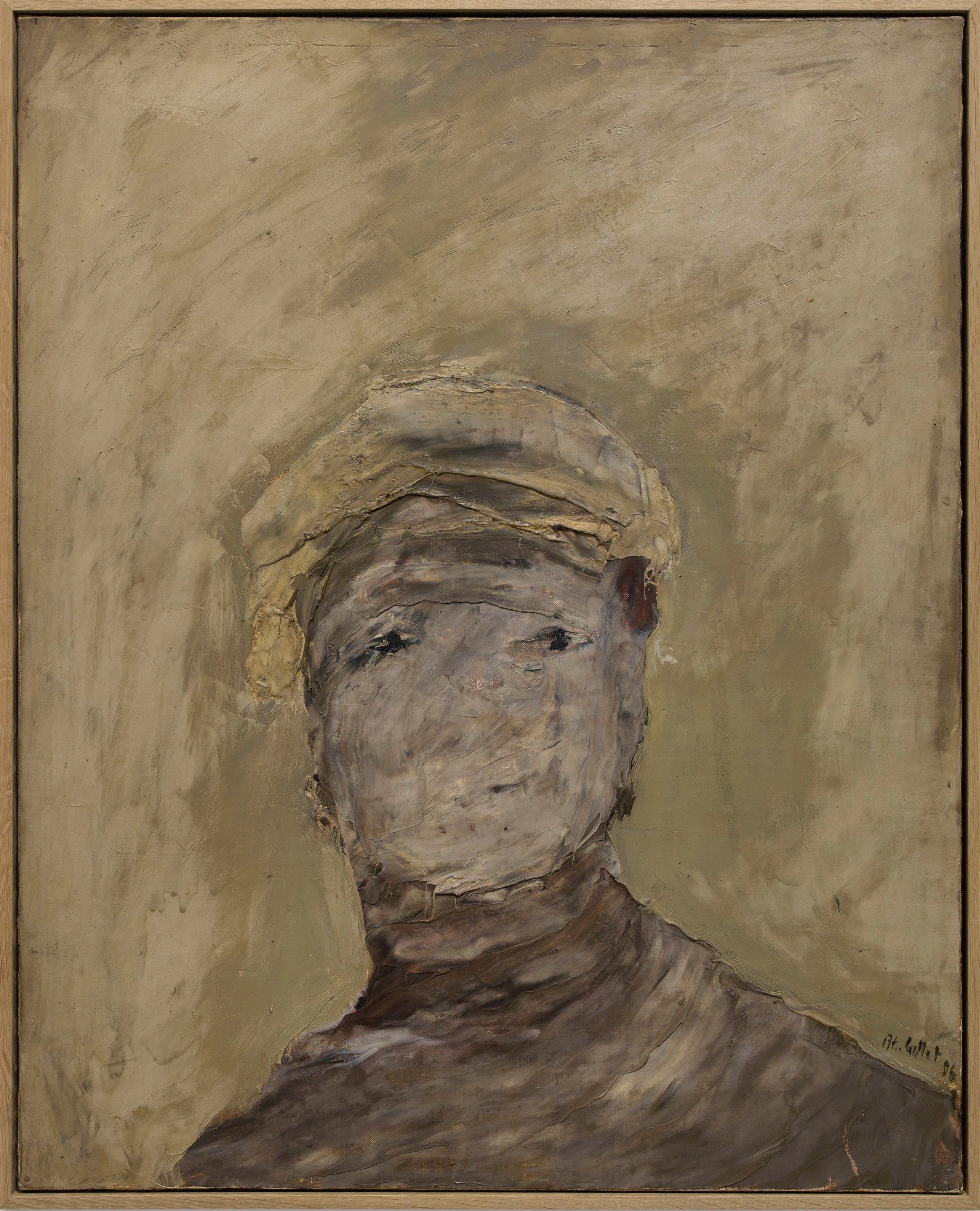
Nathalie ObadiaRonan Barrot, Valérie Belin, Nina Childress, Philippe Cognée, Roger-Edgar Gillet, Sophie Kuijken, Eugène Leroy, Caroline Mesquita, Roméo Mivekannin, Yan Pei-Ming, Sarkis, Andres Serrano, Claire Tabouret, Joris Van de Moortel, Wang Keping, Jérôme Zonder [Scroll down for French version / Veuillez trouver ci-dessous la version française] Galerie Nathalie Obadia is pleased to present Gillet et Compagnie, a group exhibition featuring the oeuvres of Roger-Edgar Gillet alongside those of other major artists of the contemporary scene. The works of Ronan Barrot, Valérie Belin, Nina Childress, Philippe Cognée, Sophie Kuijken, Eugène Leroy, Caroline Mesquita, Roméo Mivekannin, Yan Pei-Ming, Sarkis, Andres Serrano, Claire Tabouret, Joris Van de Moortel, Wang Keping, and Jérôme Zonder, are brought together in a series of dialogues around the subject of the portrait. Although portraiture has its early roots in Antiquity and has undergone numerous transformations in response to the prevalent artistic codes of various historical periods, it nevertheless remains a thriving genre and retains its position at the heart of artistic expression. The artists presented within this show are an integral part of this ongoing tradition, exploring their subjects from both artistic and philosophical points of view. In this way, Gillet et Compagnie puts forward a fresh reading of a timeless genre, seen through the prism of our own era. As an iconic figure of the Second School of Paris, Roger-Edgar Gillet (1924-2004) occupies a central position in the exhibition. Fourteen of his works are on show. They do not however appear as identifiable faces but rather as heads - or even bare bones - sometimes reduced to their most basic structural forms. These representations have been reshaped and even deformed by a vigorous technique and the use of dense material that the artist has worked to the limit of exhaustion. It is this matter, due to its texture, that transforms and distorts the works, blurring, erasing and reinventing their contours to the rhythm of the artist's brushstrokes. Following on from the works of Roger-Edgar Gillet, Homme Nu (1965-1982) by Eugène Leroy, as well as the works of Joris Van de Moortel, share the same intensity: their paintings could certainly be considered as the embodiment of raw flesh. The bodies appear to stretch and tear themselves apart, as if they might have been involved in some kind of accident. These transformations seem to be in keeping with the notion of "sensation" as defined by Gilles Deleuze, who declares that "What is painted on the canvas is the body, not insofar as it is represented as an object, but insofar as it is experienced as undergoing a given sensation."[1] The viewer might well experience a similar impression in the works of Jérôme Zonder and Sarkis, who, in their corporeal approach, involve their own bodies in their creative process. Their work with fingerprints, establishes a play on the interaction between human cells and the subjects depicted. Jérôme Zonder's Les Blessés series, created in the wake of the Nice terrorist truck attack, and Sarkis' watercolours, referring to the events of September 11, 2001, both transform acts of violence into physical artefacts. A new kind of perception emerges through these portraits: fragmented, odd and disturbing, the disfigured faces bring forth what was buried, thus jolting the eye's habitual gaze. Ronan Barrot and Philippe Cognée also belong to this line of artists, who explore the body as a raw material to be worked with. However, rather than removing its skin, they work on it with great delicacy, in order to reveal certain invisible aspects. In Philippe Cognée's Autoportrait (2021-2022), he employs a process that combines melted wax, dyes and resins, inherited from the techniques used in the creation of Egyptian funerary portraits. Applying heat to the materials with an iron, he distorts the image, producing visual "accidents" and material slippage. His smooth and refined work on the epidermis, transforms the initial photographs into enigmatic and disconcerting visions. As with Phillipe Cognée, a number of other artists have married ancient techniques with modern tools to reinvent the art of portraiture. Nina Childress, Sophie Kuijken, and Yan Pei-Ming, in contrast, draw inspiration from photographs of both celebrities or complete strangers, all sourced from the Internet. These images are then reimagined through processes such as cutting-out, re-composition or even complete transformation, in order to give birth to entirely fictitious characters. Sophie Kuijken's anonymous faces, entirely made-up from scratch, form a highly original counterpoint to traditional portraits that are, more often than not, associated with live models. In a distinct approach, Roméo Mivekannin, through his series Amazones, reinterprets the portraits of the female soldiers of the Kingdom of Dahomey (present-day Benin), imbuing them with new individuality while critically engaging with historical and colonial representations. By recontextualizing these figures in the present, he forges a connection between their heroic past and a broader reflection on memory and heritage. Based on historical archives or contemporary photographs, these artists transform each era into a visual bridge that redefines the genre of portraiture. Whether in close-ups or full-length portraits, utilizing a vibrant chromatic palette, shades of black and white, or nodding to the hues and tones preferred by the Flemish masters, these figures, through their misappropriation or reinvention of traditional conventions, are timeless. The subjects are at times bathed in dark, impenetrable monochromes, at others in iridescent hues, defying any attempt to fix them either spatially or temporally. With their origins lost in the digital flux, they have now been crystallised on canvas, lending them a semblance of eternal existence. In a similar manner, Claire Tabouret - recently chosen to create contemporary stained-glass windows for the chapels on the south side of Notre-Dame Cathedral - sets her figures in a neutral space, the children portrayed seem suspended in an ambiguous temporality. In a fusion of past and present codes, all these artists have transformed portraiture into a fresh visual experience. Photography, traditionally considered as a faithful mirror of reality, has become a realm of exploration of the boundaries that separate reality and fiction. Andres Serrano and Valérie Belin have hijacked this notion to take a critical look at the representation of identity. In his Nomads series, the American artist blurred these boundaries by setting up his studio directly in the New York subway, thereby merging social documentation with artistic mise-en-scene. In her portrait of a clown, who appears to be wearing a mask, Valérie Belin pushes this ambiguity even further. This depiction obscures the frontier between the animate and the inanimate, thus transforming photography into a space for questioning both identity and representation. The motif of the mask, whether from Andres Serrano's Torture series (2016), or from Caroline Mesquita's sculpture Roger (2021), embodies a dual dynamic at the heart of the exhibition: it conceals yet at the same time reveals, informed by the expression embedded in the work's material. Conversely, the sculpture Tête (2000) by Wang Keping, with its rounded, smooth form, erases any suggestion of facial features, suggesting a sensuality that seems to extend beyond the limits of its constituent material. Gillet et Compagnie thus showcases a wide range of works exploring the portraiture genre in the 21st century. Through the deconstruction of the traditional codes of representation, previously characterised by powerful symbolism, contemporary artists' research takes them way beyond simple appearances. They disfigure both faces and bodies to better delve into the human soul, revealing it in all its complexity. Gillet et Compagnie has been curated by Maimiti Cazalis, Managing Director, and Audrey Stefani, Associate Director at Galerie Nathalie Obadia. 1 - Gilles Deleuze, Francis Bacon, Logique de la sensation, Éditions du Seuil, 1981. Translated by Daniel W. Smith as Francis Bacon; The Logic of Sensation, Continuum, London, 2003. ***** La Galerie Nathalie Obadia est heureuse de présenter Gillet et Compagnie, une exposition collective qui met en lumière les œuvres de Roger-Edgar Gillet aux côtés de celles d'artistes majeurs de la scène contemporaine. Les créations de Ronan Barrot, Valérie Belin, Nina Childress, Philippe Cognée, Sophie Kuijken, Eugène Leroy, Caroline Mesquita, Roméo Mivekannin, Yan Pei-Ming, Sarkis, Andres Serrano, Claire Tabouret, Joris Van de Moortel, Wang Keping, et Jérôme Zonder dialoguent autour du portrait. Si celui-ci trouve ses racines dans l'Antiquité, en se soumettant à des transformations au gré des codes artistiques en vigueur, il demeure néanmoins un genre vivant, toujours au cœur de la création. Les artistes présentés ici s'inscrivent dans cette longue tradition, l'explorant sous des angles à la fois esthétiques et philosophiques. Ainsi, Gillet et Compagnie propose une relecture d'un genre intemporel, vu à travers le prisme de notre époque. Figure emblématique de la Seconde École de Paris, Roger-Edgar Gillet (1924-2004) occupe une place centrale dans cette exposition. Quatorze de ses œuvres y figurent, présentant non pas des portraits de visages identifiables mais des têtes - voire des ossatures - parfois réduites à leurs seules structures. Ces représentations ont été déformées par un geste vif et une matière dense, que l'artiste a travaillée jusqu'à l'épuisement. C'est cette matière qui, par sa texture, transforme et perturbe les formes, brouillant, effaçant et réinventant ses contours au rythme du pinceau. Dans la lignée de Roger-Edgar Gillet, Homme Nu (1965-1982) d'Eugène Leroy ou encore les œuvres de Joris Van de Moortel partagent une même intensité : leur peinture pourrait s'incarner comme de la chair. Les corps s'étirent et se déchirent, comme s'ils avaient subi un accident. Ces transformations de l'être semblent résonner avec la notion de « sensation » définie par Gilles Deleuze, qui déclare que celle-ci est "ce qui est peint. Ce qui est peint dans le tableau, ce n'est pas le corps en tant qu'il est représenté comme objet, mais en tant qu'il est vécu comme éprouvant telle sensation.»[1] Ces impressions se retrouvent dans les œuvres de Jérôme Zonder et de Sarkis, qui, dans une démarche charnelle, impliquent leur propre corps dans le processus de création. Leur travail à l'empreinte établit un jeu de circulation entre les cellules humaines et les sujets représentés. La série Les Blessés de Jérôme Zonder, née à la suite des attentats de Nice, et les aquarelles de Sarkis, en référence aux événements du 11 septembre 2001, transforment la violence en une empreinte physique. Une nouvelle forme de perception émerge à travers ces portraits : fragmentés, étranges et inquiétants, les visages défigurés font surgir l'enfoui, venant ébranler l'œil de ses turpitudes. Ronan Barrot et Philippe Cognée s'inscrivent également dans cette lignée d'artistes qui interrogent le corps comme matière à travailler. Cependant, au lieu d'ôter la peau, ils la manipulent avec subtilité, venant révéler certaines complexités invisibles. Dans Autoportrait (2021-2022) de Philippe Cognée, l'artiste utilise un procédé mêlant cire fondue, colorants et résines, hérité des portraits funéraires égyptiens. En chauffant la matière avec un fer à repasser, il déforme l'image, créant des accidents et des glissements de matière. Son travail sur l'épiderme, fluide et délicat, transforme les photographies initiales en visions à la fois troublantes et énigmatiques. À l'instar de Philippe Cognée, certains artistes mêlent techniques classiques et outils modernes pour réinventer l'art du portrait. Nina Childress, Sophie Kuijken et Yan Pei-Ming s'inspirent de photographies de célébrités ou d'inconnus collectées sur Internet. Ces images sont ensuite modifiées par des procédés tels que la découpe, la recomposition, ou parfois même la transformation totale, donnant naissance à des personnages fictifs. Dans l'œuvre de Sophie Kuijken, ces anonymes créés de toute pièce deviennent un contrepoint original au portrait traditionnel, souvent associé au modèle vivant. Dans une démarche différente, Roméo Mivekannin, à travers sa série Amazones, réinterprète les portraits des femmes- soldats du royaume du Dahomey (actuel Bénin), leur attribuant une nouvelle individualité tout en interrogeant les représentations historiques et coloniales. En réinscrivant ces figures dans le présent, il lie leur passé héroïque à une réflexion sur la mémoire et l'héritage. Que ce soit à partir d'archives historiques ou de photographies contemporaines, ces artistes métamorphosent chaque époque en une passerelle visuelle qui redéfinit le genre du portrait. En gros plan ou en pied, avec une palette chromatique vibrante, des nuances de noirs et de blancs ou en clins d'œil aux maîtres flamands, ces figures défient le temps. Les sujets flottent dans des monochromes sombres ou des teintes irisées, abolissant tout ancrage spatial. Dans cette continuité, Claire Tabouret - récemment choisie pour réaliser les vitraux contemporains des chapelles sud de Notre-Dame - plonge ses personnages dans un espace neutre, où des enfants semblent suspendus dans une ambiguïté temporelle. Ces artistes, en fusionnant passé et présent, transforment le portrait en une expérience visuelle réinventée. Du côté de la photographie, longtemps perçue comme un miroir fidèle de la réalité, celle-ci devient un terrain d'exploration des frontières entre le réel et la fiction. Andres Serrano et Valérie Belin détournent cette fonction pour poser un regard critique sur la représentation de l'identité. L'artiste américain, par exemple, brouille les frontières dans sa série Nomads, en installant son studio directement dans le métro new-yorkais, mêlant ainsi documentation sociale et mise en scène artistique. De son côté, Valérie Belin pousse encore plus loin cette ambiguïté avec le portrait d'un clown, qui semble porter un masque. La frontière devient alors trouble entre l'animé et l'inanimé, transformant la photographie en un espace de questionnement sur l'identité et la représentation. Le masque, qu'il soit issu de la série Torture (2016) d'Andres Serrano ou de la sculpture Roger (2021) de Caroline Mesquita, incarne une double tension au cœur de l'exposition : il dissimule, mais révèle à la fois, porté par l'expression inscrite dans la matière de l'œuvre. À l'inverse, la sculpture Tête (2000) de Wang Keping, qui efface tous les traits de visage avec sa forme ronde et lisse, suggère une sensualité qui semble aller au-delà des frontières de sa matière. Ainsi, Gillet et Compagnie présente un large éventail d'œuvres qui explorent le genre du portrait au XXIe siècle. En déconstruisant les codes traditionnels de la représentation, autrefois marquée par un symbolisme fort, les artistes contemporains vont au-delà des apparences. Ils déforment visages et corps pour mieux pénétrer l'âme humaine, révélant toutes ses complexités. Gillet et Compagnie a été conçu par Maimiti Cazalis, Managing Director, et Audrey Stefani, Associate Director à la Galerie Nathalie Obadia. 1 - Gilles Deleuze, Francis Bacon, Logique de la sensation, Éditions du Seuil, 1981