
Collateral, Venice
Chun Kwang Young
Times Reimagined
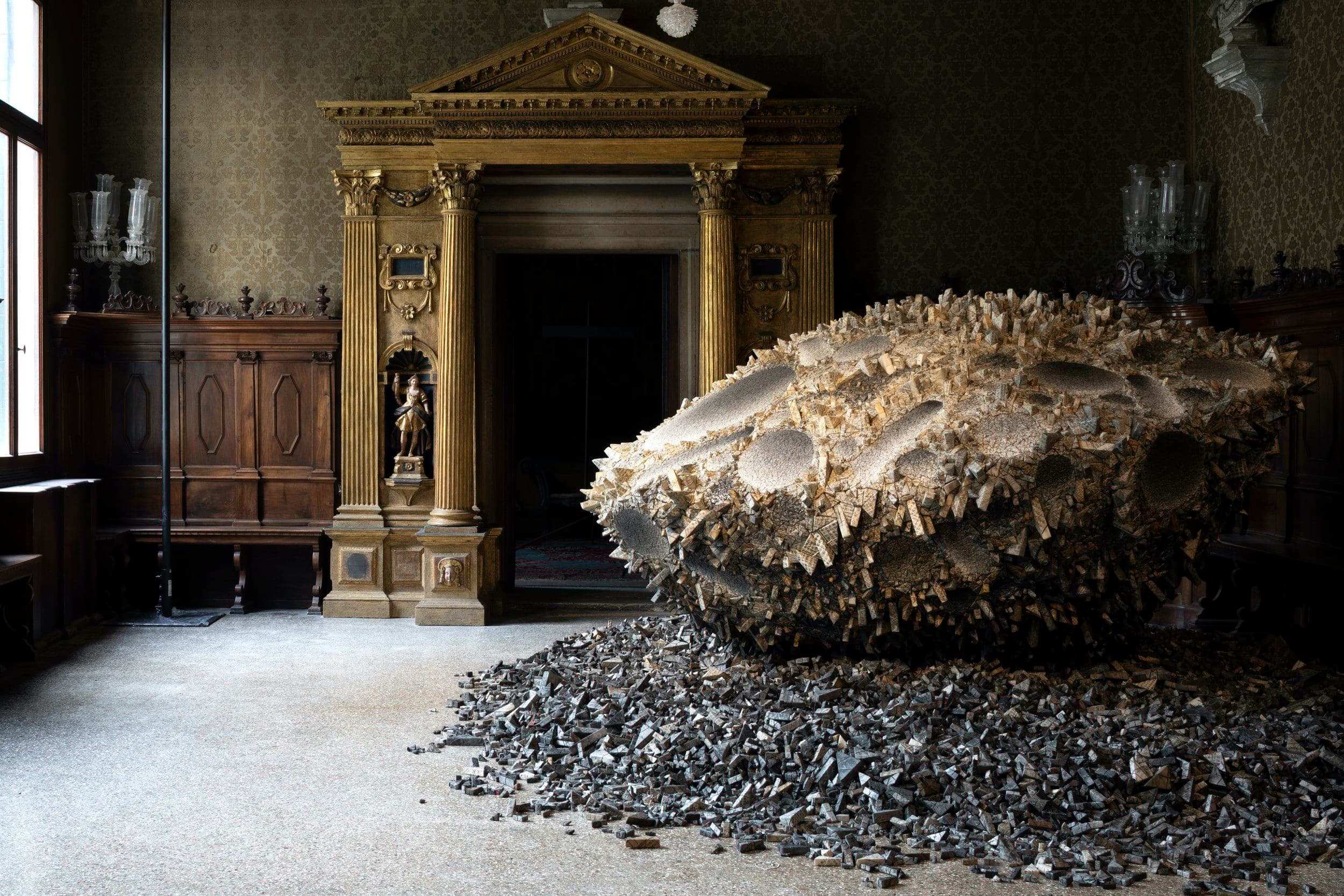
Palazzo Contarini PolignacArtist Chun Kwang Young's works reflect various socio-ecological subjects arising from environmental abnormalities. A sculpture in the shape of a virus, an enlarged heart suffering from polluted air with an irregular beating sound, a deformed mushroom overgrown to the size of four meters, a rough and wounded planet that seems tough for humans to inhabit appear in artistic forms based on stunning imagination. On the other hand, fragments of painful memories, such as the destruction of nature due to technology oriented or economic benefit driven development, are wrapped in beautifully dyed paper and delivered to the audience as an art of healing. For the past 30 years, Chun has researched and practiced under the theme of interconnectedness of living beings, developing a unique methodology of conveying his emotion and ambition. He finally settled in the medium of mulberry paper as his dominant aesthetic language. Thus, the nature of durability and permanence embodied in the mulberry paper adds contextual layers to his works. In ecology, interconnectedness is an absolute factor for the reproduction and survival of all living things, including humans, and it means an essential requirement for ensuring genetic diversity and enhancing sustainability under any adverse conditions such as climate change. Therefore, interconnectedness is the DNA of healing that overcomes the oppression and loss stemming from social disconnection. On the other hand, it is also a strong compelling force that makes art live up to its role, mediating among different discourses for human reflections. The paper he uses is not mass-produced, but handmade from mulberry trees according to the traditional paper-making techniques in East Asia. Its maximum durability can be witnessed over 1,300 years surprisingly. The artist used disassembled paper from discarded books that were about 100 years old to make reliefs, sculptures and installations. In this sense, the paper used in his works has a previous life that existed in the form of book as a storage of knowledge and information, and was resurrected this time as artwork through the hands of the artist Chun. Chun Kwang Young invited Italian architect Stefano Boeri as a collaborative partner for this project. In this cross-disciplinary dialogue, Boeri responded with his work of “Hanji House”, which conceptualized and reinterpreted Chun’s eco-friendly paper art into architecture. It is also a simple and poetic manifesto by Boeri that corresponds to the ecological organicity implied by Chun’s art formulated with ideas of time, space, humanism and ontology. Though installed in Palazzo Balbi Valier, Hanji House is actually foldable and reconstructable. Boeri is the one who coined the term “vertical forest” which has become a buzzword for today's sustainable architecture and urban reforestation. Hanji The paper used by artist Chun Kwang Young is hand-made hanji, not mass-produced paper. Hanji refers to the traditional Korean paper made of mulberry tree. It is an eco-friendly material that has been proven to have a maximum lifespan of over 1,300 years. Hanji is a biologically organic material that can be recycled and become a part of the nature at the fastest rate when it is discarded after being well consumed. After collecting and dismantling second-hand old books made of hanji that has been aged for nearly 100 years, Chun has produced his reliefs, sculptures, and installations by aggregating triangular-shaped paper packages. This form of package was inspired by medicine bags made of hanji that Chun saw as a teenager at the local clinic in the countryside. It was like a spiritual calling from his teenage memory. The texture and shape of the little medicine bag engraved in the memory hit the artist one day. This idea was gradually developed into substantial concept through insightful contemplation and relentless practice, which eventually made him an international paper artist today. Chun Kwang Young's paper art is deeply rooted, emotional, and aesthetically relational. Hanji House In dialogue with Chun Kwang Young’s works, the Italian architect Stefano Boeri has designed the Hanji House as a site-specific commissioned architecture of this project. This foldable architectural structure was built with timber and textile membrane on soil as a practical model of ‘paper-tree architecture’, which can be viewed as a ‘light box’ from a distance. The outdoor self-standing object’s design is inspired by playful and yet meditative practice of folding the paper - in an infinite number of ways. The shape recalls ancient East Asian practices of paper-folding and tangram, besides the traditional Korean and Japanese houses, based on simple geometric modularity. It is made by a simple combination of volumes: four pyramids on the top of a parallelepiped leave a planar surface shaped as a regular rhombus in the middle. Inside the Hanji House, an interactive animation developed by multi-media artist Calvin Lee transformed triangular hanji packages created by artist Chun Kwang Young into virtual form. The tranquil environment inside Hanji House offers a space for visitors to unwind and explore their inner selves as if walking through the interior of Chun’s works. Art and Ecology Chun Kwang Young’s works have only one title, 'Aggregation', but in fact, several sub-themes can be generated. Among them, human-caused decline of biodiversity, disruption of ecosystems and increase in diseases are manifested. His message in this project is very clear and decisive. He suggests that now is the time for all of us to act, whether in arts or architecture, urban planning, environmental activism or academia. His works are not just socio-ecological and metaphorical, but also humorous and healing. Relief works in various colors are pleasing to eyes and have strong emotional appeal. These bright colors also remind us of his career as an abstract painter until the 1980s, before he went all-in on paper. The folding and assembling of those tiny hanji packages that compose the basic unit of his work requires harsh time and enormous labor engagement. However, the energy emitted by the repetitive work of installing tens of thousands of small gadgets radiates a message of participation that captivates audiences. Born in South Korea, Chun Kwang Young (b.1944) is an artist who has been working for over 40 years under the theme of the interconnectedness between living beings and the socio-ecological values of their relationships. He studied at Hong-Ik University in Korea and received his MFA from the Philadelphia College of Art. Chun was named Artist of the Year by the National Museum of Modern and Contemporary Art in Seoul and awarded Presidential Prize in the 41st Korean Culture and Art Prize by the Ministry of Culture. Chun has held about 40 solo exhibitions, including the ones in Brooklyn Museum, New York (2018), Museum De Reede, Antwerp (2017), Villa Empain - Boghossian Foundation, Brussels (2017), Knoxville Museum of Art, Tennessee (2011), Mori Art Museum, Tokyo (2009), Aldrich Contemporary Museum, Connecticut (2008), The National Museum of Contemporary Art, Korea (2001), etc. His works are in the collections of the British Museum, Victoria & Albert Museum in London, KUNST Museum Bonn, Yale University Art Gallery, M+ Museum, Hong Kong, National Gallery of Australia, The Leeum Samsung Museum, Seoul, Rockefeller Foundation, New York, among others. Stefano Boeri is an architect, urban planner, and a professor of Urban Planning at Milan Politecnico. He was a member of the Architecture Council for Expo 2015, councillor for Culture, Fashion and Design of the Municipality of Milan (2011-2013), and a member of the scientific committee of the Uffizi Galleries in Florence (2015-2018). Since February 2018 he has been President of the La Triennale di Milano Foundation. His work the Vertical Forest received the Inter- national Highrise Award (2014) and the Best Tall Building Worldwide (2015). The work of the Stefano Boeri Architetti studio ranges from the production of urban visions and architecture to interior and product design, with constant focus on the geopolitical and environmental implications of urban phenomena. Yongwoo Lee is an art historian and curator. He was the executive director of Shanghai Himalayas Museum and the artistic director of Shanghai Project. Lee was the founding artistic director of Gwangju Biennale initiated in 1995, and the president of Gwangju Biennale Foundation. He was the president of International Biannual Association (IBA). Lee curated numerous exhibitions, including Dansaekhwa (Palazzo Contarini Polignac, Venice), Nam June Paik Retrospective (National Museum of Modern and Contemporary Art, Seoul), Film and Video since 1980s (Shanghai Himalayas Museum), The Flower of May (Gwangju Museum of Art), among others. He was a professor of Shanghai Academy of Fine Arts at Shanghai University, and of Korea University. He authored books such as Information and Reality, Nam June Paik, On Video Art, among others. Manuela Lucà-Dazio holds a degree in Architecture and a PHD in History of Architecture. She is the Executive Director of the Pritzker Architecture Foundation, and Advisor to the LUMA Foundation in Arles, France. From 2009 until 2019 she has been the Managing Director of the Visual Arts and Architecture Department of La Biennale di Venezia, where she was also formerly responsible of the technical organization and production of the International Exhibitions. Earlier than that, she was in charge of the restoration project and permanent exhibition design of the Jewish Museum of Rome, Italy from 2000 until 2009. From 1996 until 1999 she was part of the architectural firm in charge of the restoration and permanent exhibition design of the National Museum of San Martino in Naples, Italy. Created in 1992 by Robert Boghossian and his two sons, Jean and Albert, jewelers of Armenian origin, the Boghossian Foundation’s primary objective was to contribute to development and education. Throughout its first fifteen years of existence, the Boghossian Foundation mainly focused on the task of helping to improve the living conditions of young people in Armenia and Lebanon in order to cultivate their potential to give them a better future. Convinced that their Foundation’s work needed to extend beyond the humanitarian approach and dedicate itself to humanist values through outreach, reconciliation and a better mutual understanding of Eastern and Western cultures, Jean and Albert Boghossian launched the project of the Villa Empain. After four years of restoration, the Villa Empain, a masterpiece of the Brussel’s Art Deco architecture, the Boghossian Foundation opened its doors in 2010 and has since welcomed close to one million visitors. Led by Louma Salamé since 2016, the Villa Empain is now a key venue on the international cultural scene. As a Centre for art and dialogue between Eastern and Western cultures, the Foundation offers a rich program of exhibitions, concerts, lectures, performances, as well as a artists residency.