
Hollywood, Los Angeles
Raymond Saunders
Notes from LA
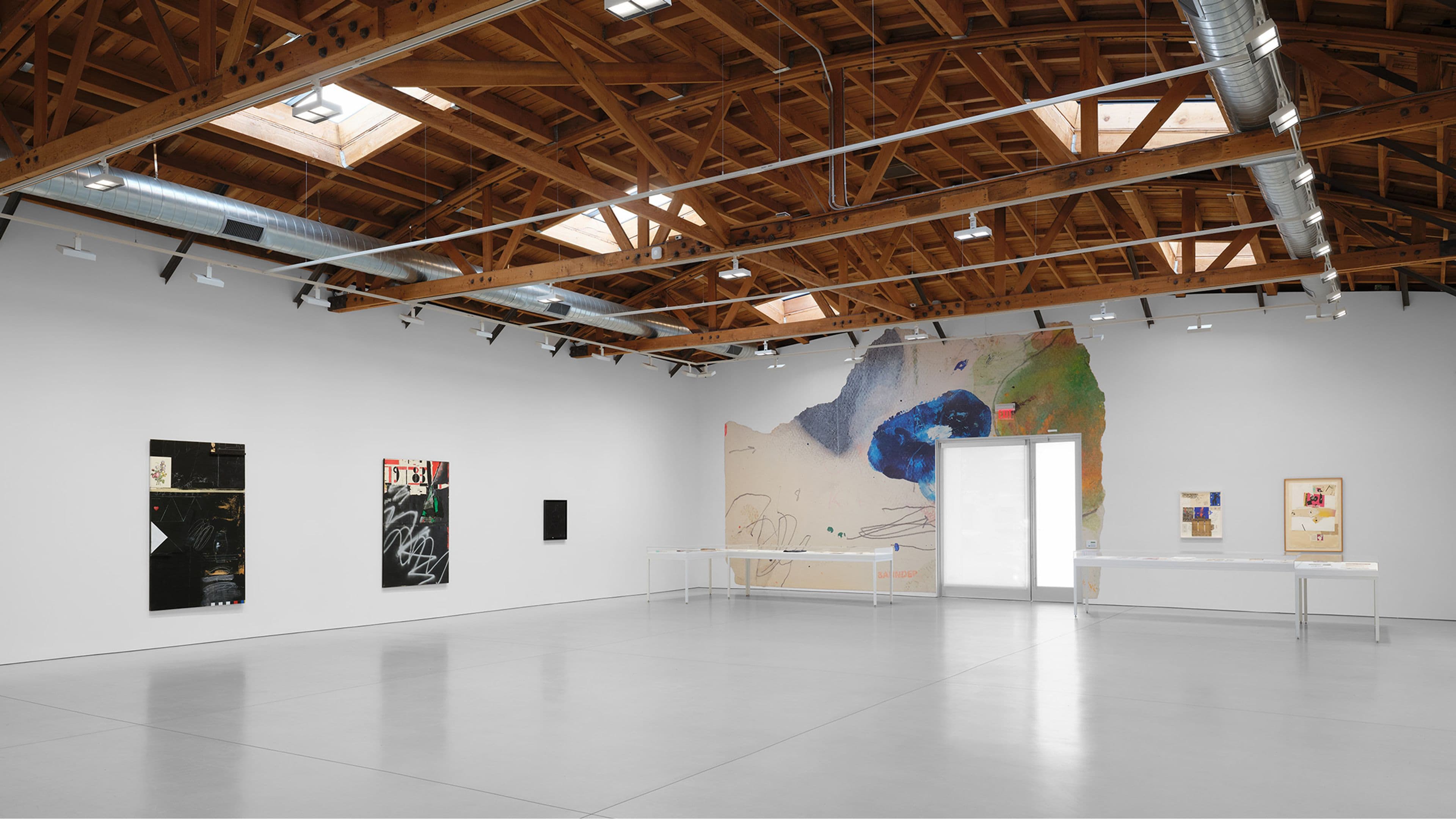
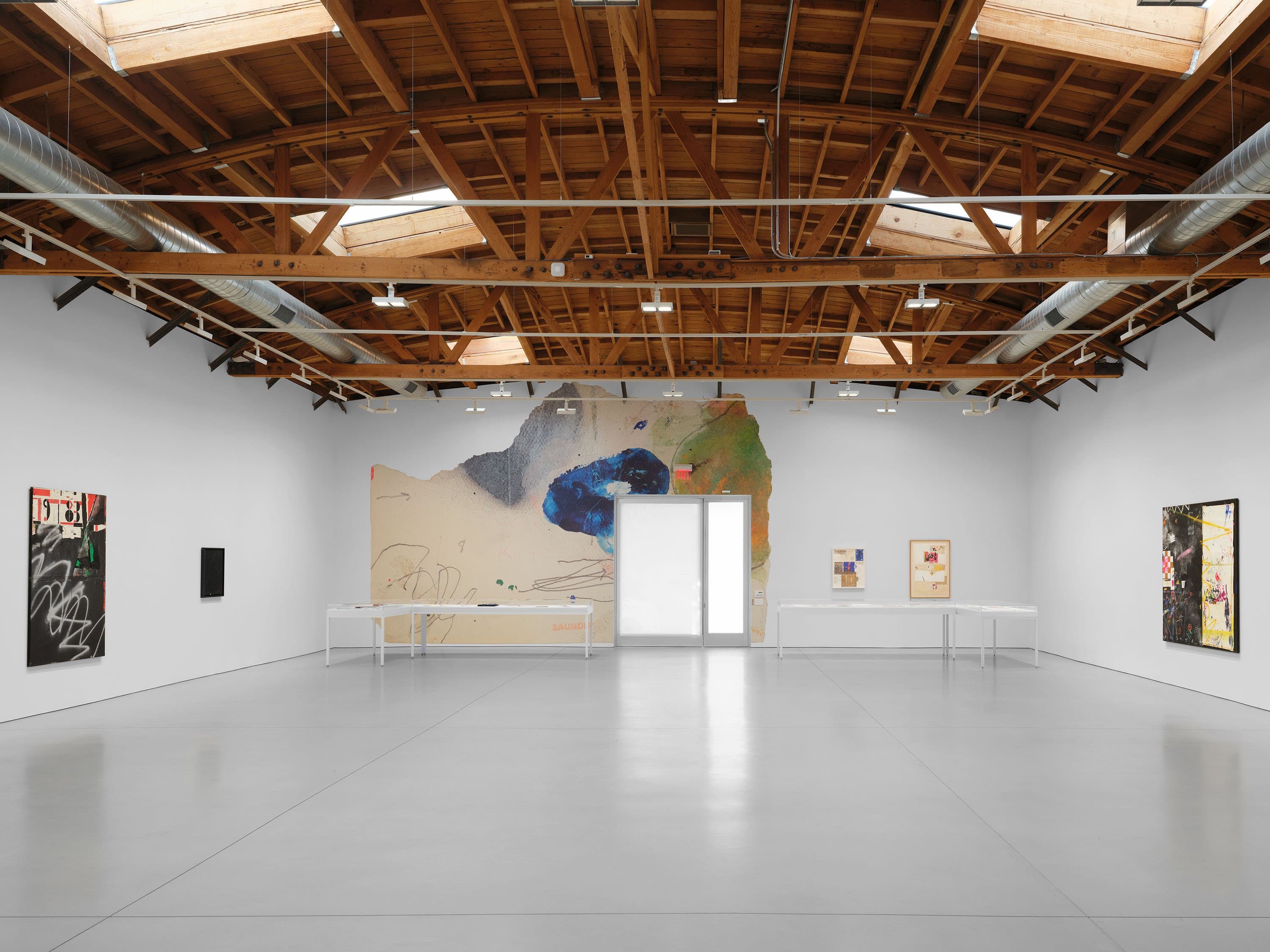
David ZwirnerDavid Zwirner is pleased to present an exhibition of works by Raymond Saunders (1934–2025). Curated by Ebony L. Haynes, this is Saunders’s third solo exhibition with David Zwirner and marks the first exhibition in Los Angeles devoted to the artist’s work in more than a decade. Celebrating Saunders’s time in California—the artist lived and worked in Oakland for most of his adult life—Notes from LA features a selection of paintings and works on paper that embody many of the distinct material and conceptual concerns of the artist’s decades-long practice. Saunders had close ties to the West Coast, where most of his studio years were spent. He also became well-known as an arts educator there: having earned his MFA from the California College of Arts and Crafts, Oakland, in 1961, he began teaching at California State University, Hayward, in 1968 and went on to join the faculty of his alma mater (later known as California College of the Arts), where he was given the distinction of professor emeritus. For Saunders, teaching and artmaking were equal pursuits, and each in turn informed the other, resulting in the frequently didactic, shorthand mode of expression that is a hallmark of his works. Beginning with his early art training in Pittsburgh’s public schools, Saunders developed a nonhierarchical relationship to pedagogy that came to echo the expansive nature of his artmaking. Select paintings on view in the exhibition speak to Saunders’s decades as a student and as an arts educator, in particular black-ground compositions like We Try (1985) and Untitled (1995–2000), which are worked over with white chalk—both a pointed reversal of the traditional figure-ground relationship and a nod to the artist’s profession. In It Wasn’t Easy Being a First Grader—first executed in 1979 and reworked by Saunders in 1984 in keeping with the loose, ever-evolving, and improvisatory nature of his painting style—crayons and fragments of children’s drawings and book illustrations are among the elements affixed to the striking royal blue canvas, a rare use of colored ground for the artist. The work’s title overtly references grade school and the growing pains of youth, with color swatches, a number table, and “Raymond” written in neat cursive appearing as nostalgic emblems of early education. Saunders understood teaching to be, like making art, an ongoing process of learning, and embraced the classroom as a vital site for exchange—of knowledge, of experiences, of ways of seeing the world. He embodied a creative and holistic approach to education that was in part a response to his skepticism around traditional, didactic systems of training. As the artist stated, “I’ve had too much schooling to think of myself as either naive or childish.… I mean, children paint beautifully, but as long as the designation ‘children’s art’ exists, there will be an undermining of their content. In some instances I seek the content of children’s brilliance, which is no more or no less than the brilliance of any other time in life.”[1] Enhanced with a typical range of other markings, materials, and talismans, other works on view incorporate motifs that recur throughout Saunders’s mature oeuvre, such as scrawling text, urnlike vases, and flowers. Two paintings from the 1980s stand out for their graphic quality and political import. M al col m (1983)—originally in the collection of writer Toni Morrison, a friend of Saunders’s—features energized loops and jags of white spray paint on a large black ground, with the year “1983” printed boldly on a torn Bloomingdale’s shopping bag that fills the upper register of the canvas. In the towering Untitled (Apartheid) (1989), Saunders utilizes the heft of acrylic paint, layering a large, vigorous swath of bright red over bands of teal and orange; characteristic motifs of a cross and handprint emerge in black against a lower band of white. Invoking a teacherly mode of communication, he uses language directly here: black spray paint spells the French word for “freedom, ” and “No Apartheid. ” In 1993, Morrison wrote of Saunders’s work, “In painting after painting emotion fused by a rapier intelligence forces us to see clearly what we only guess at: the shape of language, the speed of color, the massy weight of space. We look at his pictures and (suddenly or slowly) begin to imagine our own humanity—a kind of trembling tenderness touched with menace, exhilaration, relief, and the outrageous bounty at our disposal. ”[2] As well as an artist and teacher, Saunders was a committed correspondent. Along with his large-scale, assemblage-style paintings, Saunders also made works on paper and intimate collages whose mixed materials point to the artist’s practices of note-taking—an extension of his mark-making that encompassed scribbling notes to himself, giving notes to his students, receiving notes from colleagues and friends—and the related routine of collecting. Saunders was an archivist who gathered and kept objects and mementos both personal and cultural, precious and abandoned, and these materials appear throughout his work. This throughline is underscored by an illustrative selection of archival materials from his Oakland studio, which are displayed in vitrines installed in the gallery space and further demonstrate the artist’s lifelong impulse to annotate, keep in touch, and accumulate. These materials include selections from Saunders’s extensive collection of postcards, photographs, and stamps, as well as ephemera from exhibitions, conferences, and classes, among other documents from the artist’s life, one that produced a rich archive both professional and personal. On the occasion of the exhibition, the gallery has published a book of postcards printed with statements by a wide range of contemporary artists, its design informed by Saunders’s personal archive of postcards. Proceeds from the sales of the publication will benefit Inner-City Arts, Los Angeles, which was founded in 1989 to provide quality arts instruction for students from underserved communities, integrated arts workshops for educators, and programming designed for the community. In his assemblage-style paintings, American artist Raymond Saunders (1934–2025) brought together his extensive formal training with his own observations and lived experience. Expressionistic swaths of paint, minimalist motifs, line drawings, and passages of vibrant color tangle with found objects, signs, and doors collected from his urban environment, creating unexpected visual rhymes and resonances that reward careful and sustained looking and allow for a vast and nuanced multiplicity of meanings. Born in Pittsburgh, Saunders first studied art in the city’s public schools, participating in a program for artistically gifted students. His mentor, Joseph C. Fitzpatrick, the director of art for Pittsburgh’s public schools, taught other artists including Andy Warhol, Philip Pearlstein, and Mel Bochner. Through Fitzpatrick’s support and encouragement, Saunders earned a scholarship to the Pennsylvania Academy of the Fine Arts in Philadelphia; once there, he also took courses at the Barnes Foundation organized through the University of Pennsylvania, before returning to Pittsburgh and earning his BFA from the Carnegie Institute of Technology in 1960. He subsequently earned an MFA from the California College of Arts and Crafts in Oakland in 1961. In 1968, he accepted a teaching position at California State University, Hayward, eventually joining the faculty of his alma mater (later known as California College of the Arts), where he was given the distinction of professor emeritus. In 1967, Saunders achieved wide recognition when he published the pamphlet Black Is a Color as a rebuttal to an article by the writer Ishmael Reed about the Black Arts Movement. In this text, Saunders argues powerfully that Reed fails to capture the vastness of Black expression and in doing so siloes Black artists and their work as delimited by the category of race alone. He concludes with the imperative that we separate identity from artistic output, that “we get clear of these degrading limitations, and recognize the wider reality of art, where color is the means, not the end. ”[3] The first solo exhibitions of Saunders’s works were held at the Terry Dintenfass Gallery in New York (1966, 1969, 1970, 1972). In 1971, the artist was the subject of his first West Coast exhibition and first major museum presentation, at the San Francisco Museum of Modern Art, which was also shown at Terry Dintenfass Gallery, New York. Saunders exhibited widely across the United States and in Europe, with solo exhibitions at the Providence Museum of Art, Rhode Island (1972); Pennsylvania Academy of Fine Arts, Philadelphia (1974, 1990); University Art Museum, University of California, Berkeley (1976); Stephen Wirtz Gallery, San Francisco (1979; traveled to Baum/Silverman Gallery, Los Angeles), Terry Dintenfass Gallery, New York (1980, 1982, 1985, 1987, 1989, 1991, 1993, 1996, 1999); Seattle Art Museum (1981); Los Angeles Municipal Art Gallery (1984); Addison Gallery of American Art, Andover, Massachusetts (1987; 1989); Galerie Resche, Paris (1990; 1993); Tampa Museum of Art, Florida (1992); Oakland Museum (1994); Phoenix Art Museum (1994); Giorgio de Chirico Art Centre, Volos, Greece (1995); M. H. de Young Memorial Museum, San Francisco (1995); American Embassy, Ouagadougou, Burkina Faso (1996); Carnegie Museum of Art, Pittsburgh (1996); Miami University Art Museum, Oxford, Ohio (1996); and Hunter College Gallery / Times Square, City University of New York (1998). The artist also participated in the 1972 Whitney Biennial. Over the last two decades, Saunders has continued to be the subject of solo exhibitions globally, in addition to appearing in several notable group exhibitions. In 2011, Saunders was included in Now Dig This! Art and Black Los Angeles 1960–1980 , curated by Kellie Jones at the Hammer Museum, Los Angeles, which traveled to MoMA PS1, New York, and Williams College Museum of Art, Williamstown, Massachusetts. In 2017, the artist was included in Soul of a Nation: Art in the Age of Black Power at Tate Modern, London, which traveled to Crystal Bridges Museum of American Art, Bentonville, Arkansas; the Brooklyn Museum, New York; and The Broad, Los Angeles. In 2022, his work appeared in the exhibition Just Above Midtown: Changing Spaces at The Museum of Modern Art, New York. Saunders’s work was on view at the Centre Pompidou, Paris, in the group exhibition Paris noir: Circulations artistiques , luttes anticoloniales 1950–2000, and at Whitney Museum of American Art, New York, in the exhibition Sixties Surreal, in 2025. In 2021, Andrew Kreps Gallery and Casemore Gallery organized the two-part solo exhibition 40 Years: Paris/Oakland in San Francisco, which spanned four decades of the artist’s career. The following year, Andrew Kreps Gallery presented the first exhibition of Saunders’s work in New York since 1998. In 2025, Raymond Saunders: Flowers From a Black Garden was on view at the Carnegie Museum of Art in Pittsburgh. This presentation marked the artist’s first solo museum exhibition since 1996 and was the most comprehensive consideration of his practice to date. Saunders was the recipient of the National Institute of Arts and Letters Award (1963), Ford Foundation Award (1964), Rome Prize Fellowship (1964), Guggenheim Fellowship (1976), and two National Endowment for the Arts Awards (1977, 1984). In 2024, David Zwirner announced the co-representation of Saunders with Andrew Kreps Gallery. The announcement was accompanied by a two-part solo exhibition of the artist’s work, P ost No Bills, curated by Ebony L. Haynes, held concurrently at David Zwirner’s 519 and 525 West 19th Street galleries in Chelsea and Andrew Kreps’s gallery at 22 Cortlandt Alley in Tribeca. Raymond Saunders: Déménagement , a solo presentation curated by Ebony L. Haynes, was on view at David Zwirner Paris in 2025, marking the artist’s first exhibition there in twenty years. Work by the artist is held in numerous public collections, including the Addison Gallery of American Art, Andover, Massachusetts; Berkeley Art Museum and Pacific Film Archive, University of California, Berkeley; Carnegie Museum of Art, Pittsburgh; Chrysler Museum of Art, Norfolk, Virginia; Corcoran Gallery of Art, Washington, DC; Crocker Art Museum, Sacramento, California; The Metropolitan Museum of Art, New York; M. H. de Young and Legion of Honor, Fine Arts Museums of San Francisco; Museum Brandhorst, Munich; Museum of Contemporary Art, Los Angeles; The Museum of Modern Art, New York; National Gallery of Art, Washington, DC; Philadelphia Museum of Art; Phoenix Art Museum; Portland Art Museum, Oregon; Saint Louis Art Museum; San Francisco Museum of Modern Art; Seattle Art Museum; Walker Art Center, Minneapolis; and Whitney Museum of American Art, New York, among others. 1 - Raymond Saunders in Harvey Stein, Cornell Capa, and Elaine A. King, Artists Observed (New York: Abrams, 1986), p. 86. 2 - Toni Morrison, “Introduction, ” in R a ymond S aund ers. Exh. cat. (San Francisco: Stephen Wirtz Gallery, 1993), p. 5. 3 - Raymond Saunders, Black Is a Color (self-published pamphlet, 1967), n.p.