
Marais, Paris
Mel O'Callaghan
My Heart Beneath the Earth
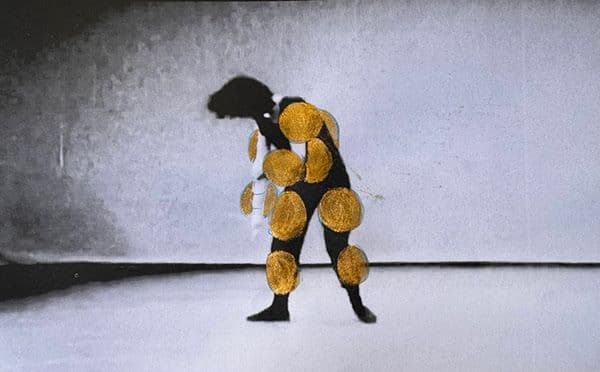
Galerie Allen[Scroll down for French version / Veuillez trouver ci-dessous la version française] Mel O’Callaghan’s practice is concerned with the wonder of the universe as it manifests in the materials and phenomena found here on our planet. She is interested in how this relates to our bodies, whether it is through performance, sound or the gaze. This often results in objects and experiences in which O’Callaghan invites audiences to touch the sublime through the immediacy of art. Her practice in some ways inherits 19th Century Western Romanticism’s interest in the sublime as it manifests in nature. Romantics often depicted the subject of their paintings as dwarfed by the enormity of nature which gave a sense of overwhelm or alienation. Instead, O’Callaghan creates intimacy with the viewer by drawing attention to the profound manifestations of the universe, deep time, and ubiquitous realities which unites humanity and living entities. The artist often channels these realities which side-steps esoteric cultural references to instead focus on the interrelationships between life and matter, and to conjurea sense of connection between humanity and all living beings. One of the key strategies the artist employs is focusing on human experiences of natural materials, such as the metals and minerals O’Callaghan works with in her 2025 Mineral Paintings series. Working with mineral pigment infused acrylic paint, O’Callaghan experiments with mixing, scraping and scratching to create layers of pigment. This process gives a skin-like appearance and the artist delights in experimenting with how the different minerals and metals create different colours and textures as they interact with each other such as how crushed cinnabar becomes red vermillion and oxidised copper transforms to green. O’Callaghan will often crush the minerals herself, adding these and powdered metals in the final stages. For instance, in her large-scale 2024 painting, My Heart Beneath the Earth, O’Callaghan uses rare minerals which are both ancient and healing. The white-green Zeolite is administered to balance pH and remove heavy metals from the body and the grey-black hematite is used to restore, strengthen and regulate the blood supply, which is beneficial for blood conditions such as anemia. The epic painting connects the eye, body, and earth through its abstract composition. It simultaneously evokes different temporal registers between the deep time evoked through the minerals, the lifetime of the body, and the contemporary moment in which these connections are made. These connections across time, materials and bodies continue in O’Callaghan’s 2025 performance video installation, Inside My Hands the World Trembles. A stack of three video monitors placed on top of each other displays a performer with large cymbals attached to different parts of their body as both musical instruments and costume. As they move, the performer sounds the cymbals to the rhythm of both the earth’s and their heartbeat. The artist is intrigued with the inconsistencies of the heart’s rhythm which is only consistent before death, therefore inconsistency is a sign of health and the vibrancy of life. It also evokes the two heartbeats of mother and child, both beating to their own rhythms yet at different speeds and all contained within one body. The earth’s heartbeat is the frequency which comes from the vibrations beneath the earth’s crust. It consistently yielded a 7.83 frequency but has sped up to 8 recently - still too low for the human ear to hear and signifies the complexity of our home planet. O’Callaghan explains ‘I think of the performer as a symbiocenic body, where humans and nature coexist. The body becomes an instrument, the cymbals an outward manifestation of the life force pulsing within.’ —Tamsin Hong Mel O’Callaghan (b. 1975, Sydney, Australia, lives and works in Paris, France and Sydney, Australia) Communion and resonance with nature, and with each other, is at the heart of Mel O’Callaghan’s practice. The body – in its broadest sense – permeates O’Callaghan’s video, installation, glass, sound, painting and performance work. Drawing on notions of resistance and endurance, alongside other disciplinary experts, essential to O’Callaghan’s practice, is to ask questions anew, highlighting the natural synergies between highly curious disciplines, and how they reciprocally approach complex questions about our existence. Recent institutional solo exhibitions have been held at Esker Foundation, Calgary, Canada; Museum of Contemporary Art and Design (MCAD), Manila, Philippes; Samstag Museum, Adelaide, Australia; Carriageworks, Sydney, Australia; Le Confort Moderne, Poitiers, France; UQ Art Museum, Brisbane, Australia; Artspace, Sydney; National Gallery of Victoria (NGV), Melbourne, Australia and Palais de Tokyo, Paris, France. Group exhibitions include, Govett-Brewster, New Plymouth, New Zealand; Bally Foundation, Lugano, Swizterland; Seoul Museum of Art, Korea; Centre Pompidou, Paris, France and Centre Pompidou Malaga, Spain; IAC Villeurbanne/Rhône-Alpes, France; National Gallery of Victoria (NGA), Canberra, Australia; MOCA, Toronto, Canada; Serralves Museum, Porto, Portugal; ACCA, Melbourne, Australia; 19th Biennale of Sydney, Australia; National Taiwan Museum of Fine Arts, Taipei, Taiwan; AGNSW, Sydney, Australia; CASM, Barcelona, Spain; Gillman Barracks, Singapore; Witte de With Center for Contemporary Art, Rotterdam, Holland; Les Abattoirs, Museum – Frac Occitanie Toulouse, France; Videobrasil 05 15°, Festival de Arte Contemporânea Sesc Videobrasil, São Paulo, Brazil. O’Callaghan is a 2024 laureate of the Prix Carta Bianca, France and in 2015 was the recipient of the prestigious SAM Prize for Contemporary Art resulting in her solo exhibition at Palais de Tokyo, France. Palais de Tokyo, Artspace, UQ Art Museum and Confort Moderne have published catalogues and monographs of her work. Her artworks are included in many public and private collections including FRAC Bretagne, Rennes, France; UQ Art Museum, Brisbane, Australia; NGV, Victoria, Australia; MUMA, Melbourne, Australia; Art Gallery of South Australia; Artbank, Australian Government Art Collection, Australia; Woods Hole Oceanographic Institution, USA and the Attorney Generals Department, Australian Government, Australia. ***** C’est vers l’univers dans ce qu’il a de plus merveilleux que se tourne la démarche artistique de Mel O’Callaghan. Elle cherche sa présence à travers des matériaux et des phénomènes bien terrestres, en explorant la relation qu’ils entretiennent avec notre propre corps, que ce soit par le son, le regard ou la performance. Les objets et les expériences qui résultent de cette démarche invitent le public à effleurer quelque chose du sublime grâce à l’immédiateté de l’art. L’approche de Mel O’Callaghan hérite à sa manière de l’attrait que les Romantiques de l’Europe du XIXe portaient au sublime qui émane de la nature. Cependant, là où ces derniers figuraient souvent l’individu comme écrasé par des immensités naturelles, submergé par une sensation vertigineuse proche de l’aliénation, O’Callaghan explore une voie différente. Elle tisse avec le spectateur une forme d’intimité en attirant son attention sur les rouages de l’univers, le « temps profond » et sur les liens intrinsèques qui unissent les êtres humains à l’ensemble du vivant. Afin d’introduire ces phénomènes, l’artiste évite les références trop ésotériques et s’attache plutôt à souligner l’interdépendance entre vie et matière. Elle vise ainsi à faire ressentir la connexion profonde entre l’humanité et toutes les formes de vie. L’une des voies d’exploration principale d’O’Callaghan se fonde sur notre expérience sensorielle des matériaux naturels, comme les métaux et les minéraux qu’elle utilise dans sa récente série Mineral Paintings (2025). Travaillant avec une peinture acrylique infusée de pigments minéraux, O’Callaghan joue des mélanges, de l’éraflure et du grattage pour révéler différentes couches de pigments. Le résultat final évoque un épiderme, sur lequel l’artiste explorerait avec joie des combinaisons variées de minéraux et de métaux. Ces derniers réagissent entre eux pour créer des couleurs et textures diverses : le cinabre broyé devient ainsi rouge vermillon, tandis que le cuivre oxydé prend une teinte verte. O’Callaghan se charge fréquemment de broyer elle-même les minéraux, qu’elle incorpore ensuite avec des poudres métalliques lors des étapes finales de son travail. Dans son tableau grand format de 2024, My Heart Beneath the Earth, O’Callaghan a par exemple choisi des minéraux rares aux antiques vertus curatives. D’un blanc tirant au vert, la zéolite est encore utilisée pour réguler le pH corporel et favoriser l’élimination des métaux lourds. Fortifiant la circulation sanguine, l’hématite à la robe gris-foncé était, quant à elle, traditionnellement employée contre l’anémie. À travers sa composition abstraite, cette peinture aux dimensions épiques connecte l’œil, le corps et la terre. Elle évoque simultanément divers registres temporels : le temps géologique inscrit dans les minéraux, la durée de vie du corps humain et le moment présent où ces connexions s’établissent. Cet entrecroisement de temporalités, de matériaux et de corps se prolonge dans l’installation vidéo performative de 2025 intitulée Inside My Hands the World Trembles. Une pile de trois écrans vidéo superposés révèle un performeur dont le corps est orné de grandes cymbales, utilisées à la fois comme instruments de musique et comme costume. Au fil de ses mouvements, le performeur frappe les cymbales au rythme des battements de son cœur et de celui de la planète. L’artiste ne cache pas sa fascination pour la nature irrégulière de notre rythme cardiaque, qui ne se stabilise qu’avant la mort ; cette inconstance serait-elle donc un signe manifeste de santé et de vitalité ? Il s’agit aussi d’évoquer les battements de cœur distincts d’une mère et de l’enfant qu’elle porte, chacun vibrant à son propre rythme, à des vitesses différentes, mais tous deux unis au sein d’un seul corps. Ce qu’on appelle ici le battement de cœur de la Terre correspond à la fréquence de certaines vibrations de la croûte terrestre. Ordinairement mesurée à 7,83 Hz, cette pulsation aurait récemment accéléré pour atteindre les 8 Hz, c’est toujours trop bas pour être perçu par l’oreille humaine, mais cela demeure un puissant rappel de la complexité de notre planète. Ce à quoi O’Callaghan ajoute : « Je considère le performeur comme un corps du Symbiocène, ère où les humains et la nature coexistent. Le corps y devient instrument et les cymbales une manifestation perceptible de la force vitale qui pulse à l’intérieur. » —Tamsin Hong, traduit par Noam Assayag