Tiergarten, Berlin
Ugo Rondinone
Two Men Contemplating The Moon 1830
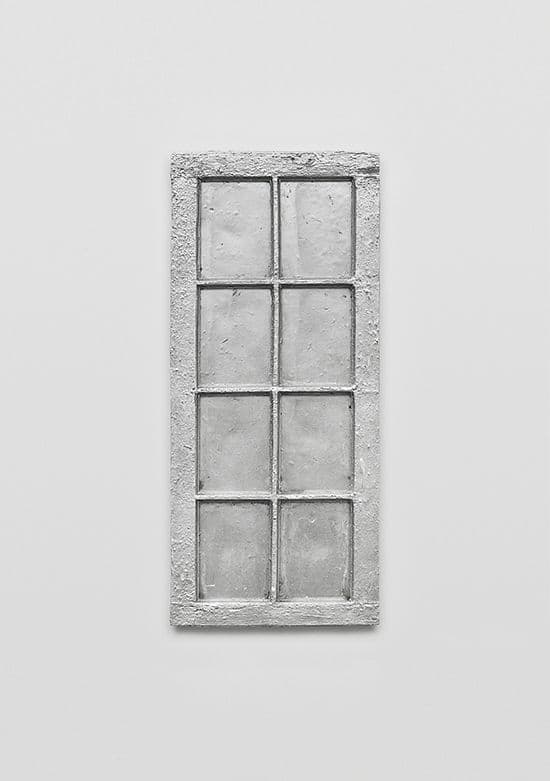
Esther SchipperEsther Schipper is pleased to present Two Men Contemplating The Moon 1830, Ugo Rondinone’s fth solo exhibition with the gallery. Taken from a painting by Caspar David Friedrich, the exhibition’s title makes manifest Rondinone’s long-standing indebtedness both to the iconography and philosophy of German Romanticism. “The German Romantic movement was the rst to blur the line between reality and illusion. In this sense I’m very attached to the idea of art and art making as an environment that is itself outside of time and inaccessible to a linear logic.“ (The Brooklyn Rail, 2013) Rondinone has modi ed the exhibition space to create a self-contained environment: new walls cover the existing windows. The works themselves index architectural barriers between outside and inside – a monumental new series of aluminum-cast windows, a large-scale brick-wall painting and a new series of concrete sculptures cast from the corners of urban buildings – collectively comprising the space of an inner world. Rondinone’s windows–a recurring motif in his work since the 1990s–play on the combination of the familiar and the strange. Rather than framing a view to the outside, they themselves become objects to be looked at. In the current exhibition, these new aluminum-cast windows are each titled after a speci c Friedrich painting, and when the series is completed, will stand in for Friedrich’s complete oeuvre, 160 windows in total. Cast from weathered window frames in raw aluminum - chosen for its distant, ghost-like re ective e ect - the windows range in style, size and patina. Bringing the structures of the urban street into a gallery setting, Rondinone’s latest series of sculptures, Street Corners, investigates the idea of place. The rst two sculptures of the series, on view in Berlin, are freestanding concrete casts of the exterior corners of buildings from two street intersections in the artist’s current neighborhood in Harlem, New York. Thick uneven stonework of East 126 Street + Madison Avenue (2016) evokes urban ecclesiastical structures, while the intricate carved stone of the nearby corner at East 127 Street + Madison Avenue (2016) suggests the ornate detailing of the iconic Harlem brownstone. Conjuring a fantastical sense of being in two di erent places simultaneously, Street Corners is a continuation of Rondinone’s ongoing explorations of the frontiers between illusion and reality. A large-scale oil painting with a brightly colored yellow brick pattern creates the impression a new wall has been installed in the exhibition space. Creamy brushstrokes and heavy impasto form bricks; the brown color of the raw burlap doubles as ground and grout. Installed at one end of the room on a wooden frame about one meter from the existing wall, the painting’s exposed back shows the seams of roughly stitched-together patches of the raw material. The artist has noted several autobiographical references to his studios—his rst studio had only one window that looked out onto a brick wall – while also remarking the occupations of his parents: his father was a bricklayer, his mother a seamstress. Employing a vocabulary of iconic and/or everyday objects, Rondinone’s works exact a level of contemplation and introspection that sometimes, as with the motif of the window, appears in apparent contrast to its manifest function: “Windows, doors, brick walls, light bulbs, trees, and masks are reoccurring symbols in my work. They are static metaphors in transition, which undermines the nature of time in terms of linear progression. They elaborate an idea not as progress through time but in terms of circularity, entropy, passivity, and dreaminess. A present tense, where time has stopped and opened out to reveal suggestiveness or changelessness or hollowness.” (The Brooklyn Rail, 2013) Ugo Rondinone was born in 1964 in Brunnen, Switzerland. He studied at the Hochschule für Angewandte Kunst, Vienna. The artist lives and works in New York. In 1991, 1994, and 1995 Rondinone received the Swiss Eidgenössischer Preis für freie Kunst. Selected solo exhibitions include: giorni d’oro + notti d’argento, MACRO Testaccio and the Mercati di Traiano, Rome (2016); Seven Magic Mountains, Art Production Fund and Nevada Museum of Art/Desert of Nevada, (2016–2018); Becoming Soil, Carré d’Art, Nimes (2016); Ugo Rondinone: Breathe Walk Die, Rockbund Art Museum, Shanghai (2014); Ugo Rondinone: we run through a desert on burning feet, all of us are glowing our faces look twisted, Art Institute of Chicago, Chicago (2013); Ugo Rondinone: Human Nature, Public Art Fund, Rockefeller Plaza, New York (2013); thank you silence, M Museum, Leuven (2013); Wisdom? Peace? Blank? All of this?, Kunsthistorisches Museum, Vienna (2012); Nude, Cycladic Art Museum, Athens (2012); The Night of Lead, Aargauer Kunsthaus, Aarau (2010) and MUSAC, Léon (2009); zero built a nest in my navel, Whitechapel Gallery, London (2006); roundelay, Musée National d’Art Moderne, Centre Pompidou, Paris (2003); no how on, Kunsthalle Wien, Vienna (2002); and So much Water so close to home, MoMA PS1, New York (2000). Rondinone has curated three exhibitions on the relationship between art and poetry, artists and poets (Secession, Vienna, 2015), the spirit level (Gladstone Gallery, New York, 2011), the third mind (Palais de Tokyo, Paris, 2007), and in 2016 a one-person exhibition of John Giorno’s work, entitled I love John Giorno, at the Palais de Tokyo, Paris (2016). In 2007 Rondinone represented Switzerland at the 52nd Venice Biennale.