
Chinatown, New York
Myles Bennett
Waves
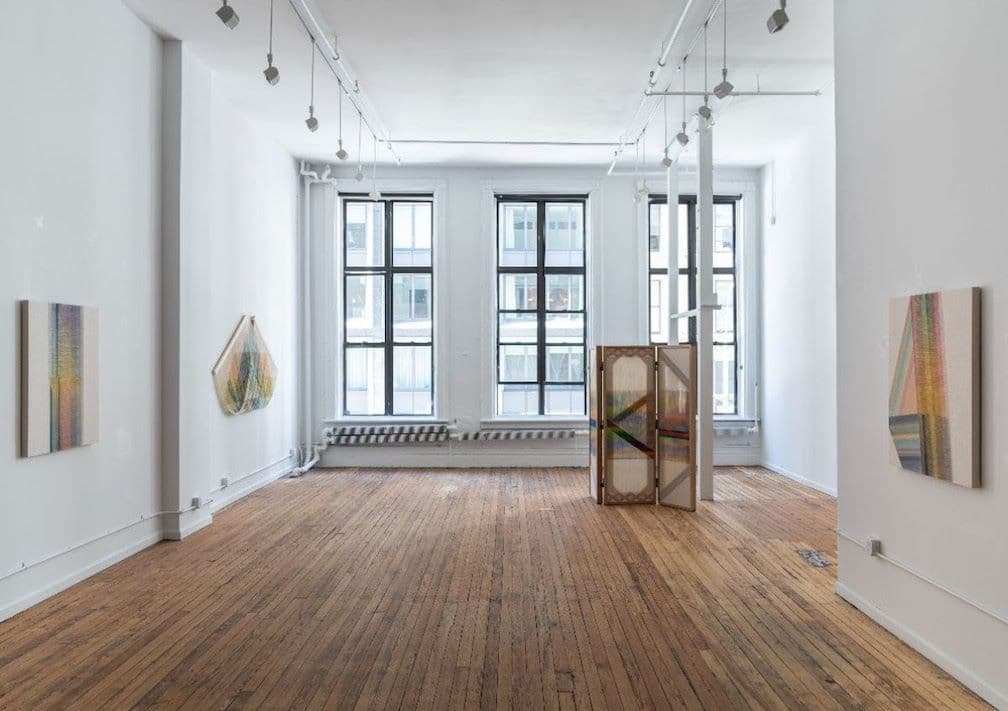
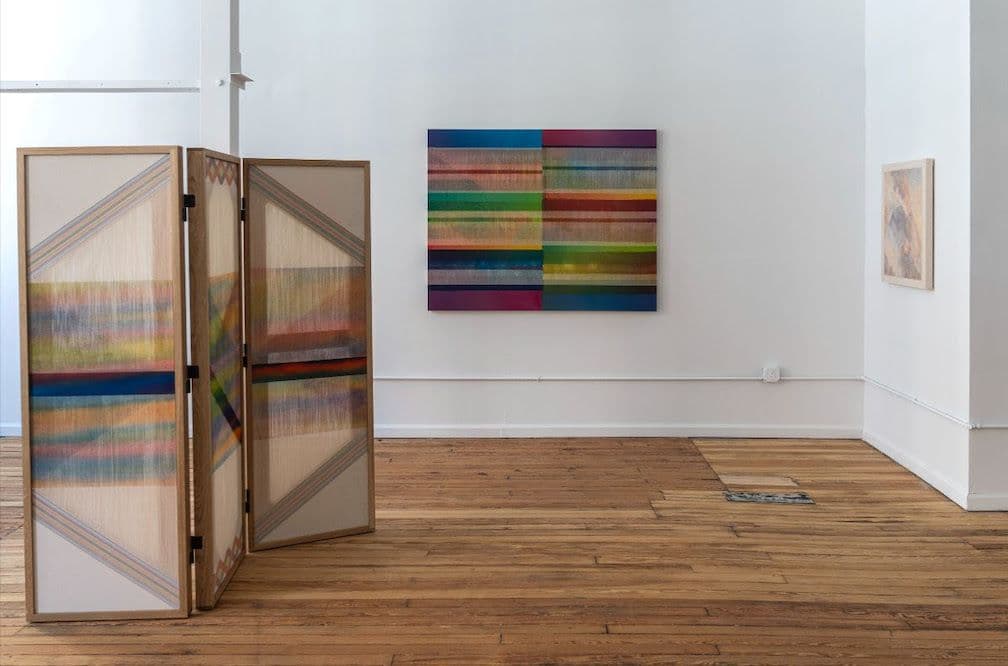
JDJJDJ is thrilled to present Waves, the gallery’s debut solo exhibition with Myles Bennett. Using the grain of the canvas as his guide, Bennett explores its material capabilities in unique and innovative ways. The resulting works, which incorporate ink, acrylic, graphite and colored pencil, blur the divisions between painting, drawing, textile, and sculpture, and incorporate a sense of space both within and beyond the two dimensional plane. In several of the works on view, Bennett applies ink to both sides of the raw canvas to achieve colorful gradients—some subtle, others quite bold, depending on whether he has inked it on the recto or verso. He then uses a small blade to remove the warp—the vertical threads of the canvas—with exacting precision, leaving only the finest threads intact. The cut sections of the paintings bring the space behind the painting toward the foreground, and in so doing, Bennett allows the space behind its surface to play an important role. In some of the paintings in the eponymous Waves series, he inserts a colorful panel behind the cut portion of the surface, so we can see a subtle reflection of color glow from the slits he made into the surface of the canvas. In the painting/folding screen hybrid, The Attendant (Light, Union, Separation), 2023, Bennett plays up the relationships between support, surface, transparency and opacity, as bands of color mimic the wood construction of the screen’s panels, and the taut strings of canvas overlap with solid pieces in varying combinations. Dying Light #14 and Matter of Hanon #10, both executed in 2024, bring the threads even more front and center. Bennett’s interventions to the structure of the canvas create a unique optical and perceptual experience, and call to mind a number of artistic movements—from the Spatialism of Lucio Fontana, to the Supports/Surfaces artists working in France in the 1960s, to the Light and Space movement in California, who were interested in how geometry and light can affect the perception of the viewer. Another surprising art historical reference found in Bennett’s work is to the 18th century French landscape painter Claude-Joseph Vernet. In Eruption (Vernet Volcano), 2024, Bennett transposes a composition to canvas using gossamer-thin intersecting lines of colored pencil that trace along the grain of the canvas. Bennett uses a similar technique of intersecting straight lines to create Penumbra, 2024. The composition is bifurcated horizontally by a subtle but slightly disorienting shift in color, reminiscent of what happens in the afterimage one experiences when staring at the sun. Myles Bennett (b. 1983, Nashville, TN, lives and works in Brooklyn, NY) received his BFA and BArch from the Rhode Island School of Design. His work has recently been exhibited at JDJ, New York in the gallery’s inaugural exhibition of its newest location in New York City. Bennett’s work has also recently been exhibited at Rutger Brandt Gallery, Rotterdam, NL, Pamela Walsh Gallery, Palo Alto, CA, and The Wassaic Project, Wassaic, NY among others.