
Hollywood, Los Angeles
Dorothy Hood
Transportation of the Spheres
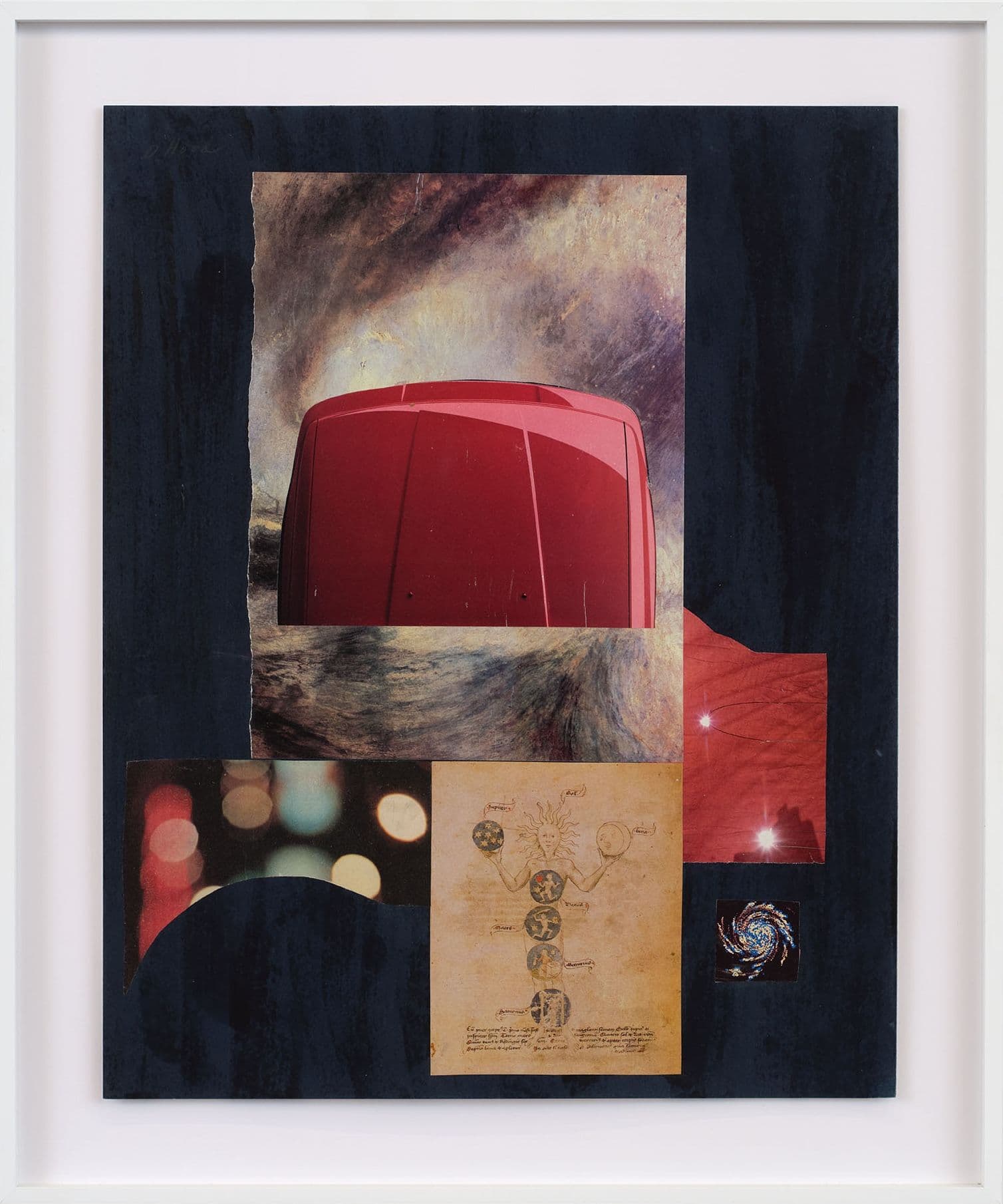
FernbergerThroughout the 1980s and 1990s, Dorothy Hood created a series of collages on mat board that engaged her lifelong interests in metaphysics and the cosmos. Unlike her abstract paintings, the figurative and referential qualities of her collages offer more concrete jumping off points into the complex ideas that captivated Hood intellectually. Drawing from the modernist collage tradition inaugurated by Georges Braque and Pablo Picasso at the turn of the 20th century, and influenced by her own mastery of tone, contrast, and the tension between bound areas of color as a painter, Hood’s collages are at once autobiographical and universal. The suite of collages featured in this exhibition were unearthed posthumously, accounting for their broad date range, and they reveal the cultural imagination of an artist whose life was shaped by unceasing exploration, both geographic and metaphysical. Planetary bodies commingle with animals, skulls, and celestial and religious imagery from various cultures around the world. Like solar systems themselves, her compositions often have a central or grounding element from which the rest of the collage radiates outward, though potential meanings are multivalent, and often unresolved. Rather, each collage offers up multiple possibilities. One work, Transportation of the Spheres, slyly incorporates the hood of an automobile (a humorous autobiographical play on her surname), but also highlights the concept of the passage of time—quite literally represented in a 15th century German diagram of an anthropomorphic sun transporting the moon and planets from one hand to another. For all their existential inquiry, the collages often strike a playful note, animated by a quality that Hood called “tonality,” or harmony through juxtaposition, seen here in her distinctive color sensibility and extraordinary compositional refinement. Through collage, Hood found an ideal medium to explore harmony’s inverse—rupture—embodied through the physical textures of cut and torn edges, and the weight and sheen of various papers laid against each other. She explained: “Texture is like a kind of psyche—the sum total of it all. Juxtaposed in a startling way, the eyes are opened to a key to be explored.” Texture thus unlocks the discursive possibilities of the philosophical and artistic concepts that captivated Hood throughout her career, and enables the multiple interpretations of each collaged work. The tension between harmony and rupture in her collages recalls the compositions of Hood’s paintings, where the borders between disparate areas of color and texture feel loaded with possibility. Pedernal (1975), included in this exhibition, is a painting in which Hood’s characteristic staining technique and fragmented compositional structure are particularly evident. Visually evocative of torn papers layered atop one another, the work illuminates an important connection between the collage and painting dimensions of Hood’s practice. Looking at Pedernal, it is easy to imagine a reciprocal relationship between the two bodies of work, each informing and enriching the other. During her lifetime, Hood’s work garnered an impressive exhibition history and support from influential critics, curators, and collectors, including Philippe de Montebello, Dorothy Miller, Clement Greenberg, and Barbara Rose. In the years since her death in 2000, scholarly and institutional attention has increasingly returned to Hood’s contributions to art history. While Hood enjoyed significant recognition during her career, recent reassessments have further secured her place within the canon of postwar modernism, affirming the importance of an artistic legacy that has long deserved broader acknowledgment. Dorothy Hood (b. 1918, Bryan, Texas, US; d. 2000, Houston, Texas, US) established herself as a pioneer of modernism from 1937, first as a scholarship student at the Rhode Island School of Design and briefly at the Art Students League in New York City, before settling in Mexico City in the 1940s. There, she would spend two decades embedded in the rich cultural fabric of a city in the midst of post-war and post-revolutionary bohemia. She befriended leading artists and intellectuals including Pablo Neruda, José Clemente Orozco, Leonora Carrington, Remedios Varo, Mathias Goeritz, Diego Rivera, and Rufino Tamayo. In 1962 Hood returned to Houston and had solo exhibitions at the Contemporary Arts Museum, Houston; Witte Museum, San Antonio; Rice University, Houston; Museum of Fine Arts, Houston; Everson Museum of Art, Syracuse, New York; and her work is in the permanent collections of numerous American museums, including the Museum of Modern Art, New York; Whitney Museum of American Art, New York; Everson Museum, Syracuse, New York; Philadelphia Museum of Art, Pennsylvania; among many others. During her lifetime, Hood’s work, from her formally rigorous yet metaphysical and intimate abstract paintings, to ink drawings on paper and collages, garnered an impressive exhibition history and support from influential critics, curators, and collectors including Philippe de Montebello, Dorothy Miller, Clement Greenberg, Jim Harithas, and Barbara Rose, among others. In 2016, the Art Museum of South Texas (AMST), Corpus Christi, organized a major retrospective of Dorothy Hood’s works and published a monograph about her life and career which culminated in the exhibition and book entitled The Color of Being/El Color del Ser: Dorothy Hood (1918-2000). In the fall of 2018, the Museum of Fine Arts, Houston presented an exhibition entitled Kindred Spirits: Louise Nevelson & Dorothy Hood, mounting an unprecedented visual dialogue between the works of both artists.