
Upper East Side, New York
Wyatt Kahn
New Work
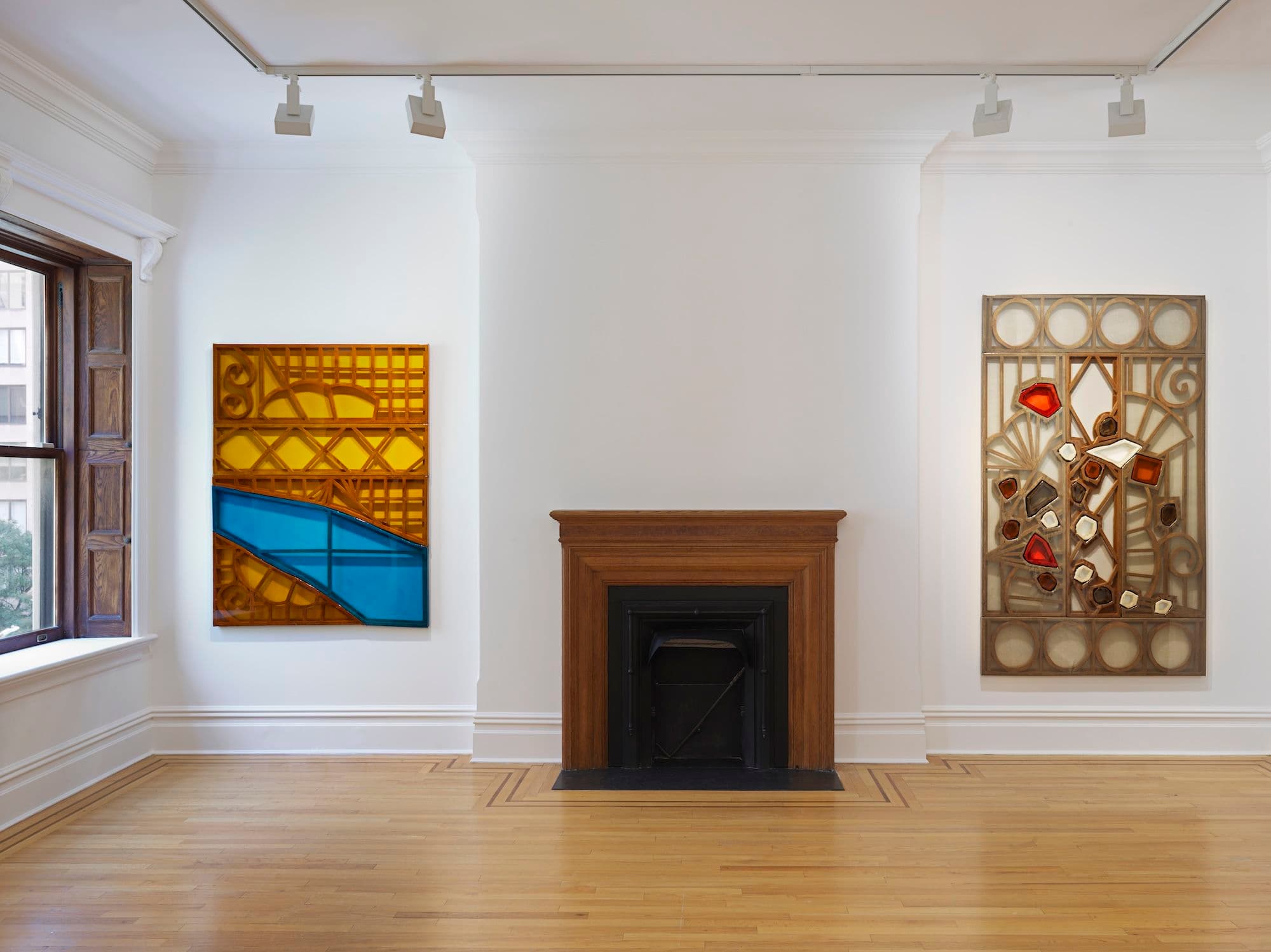
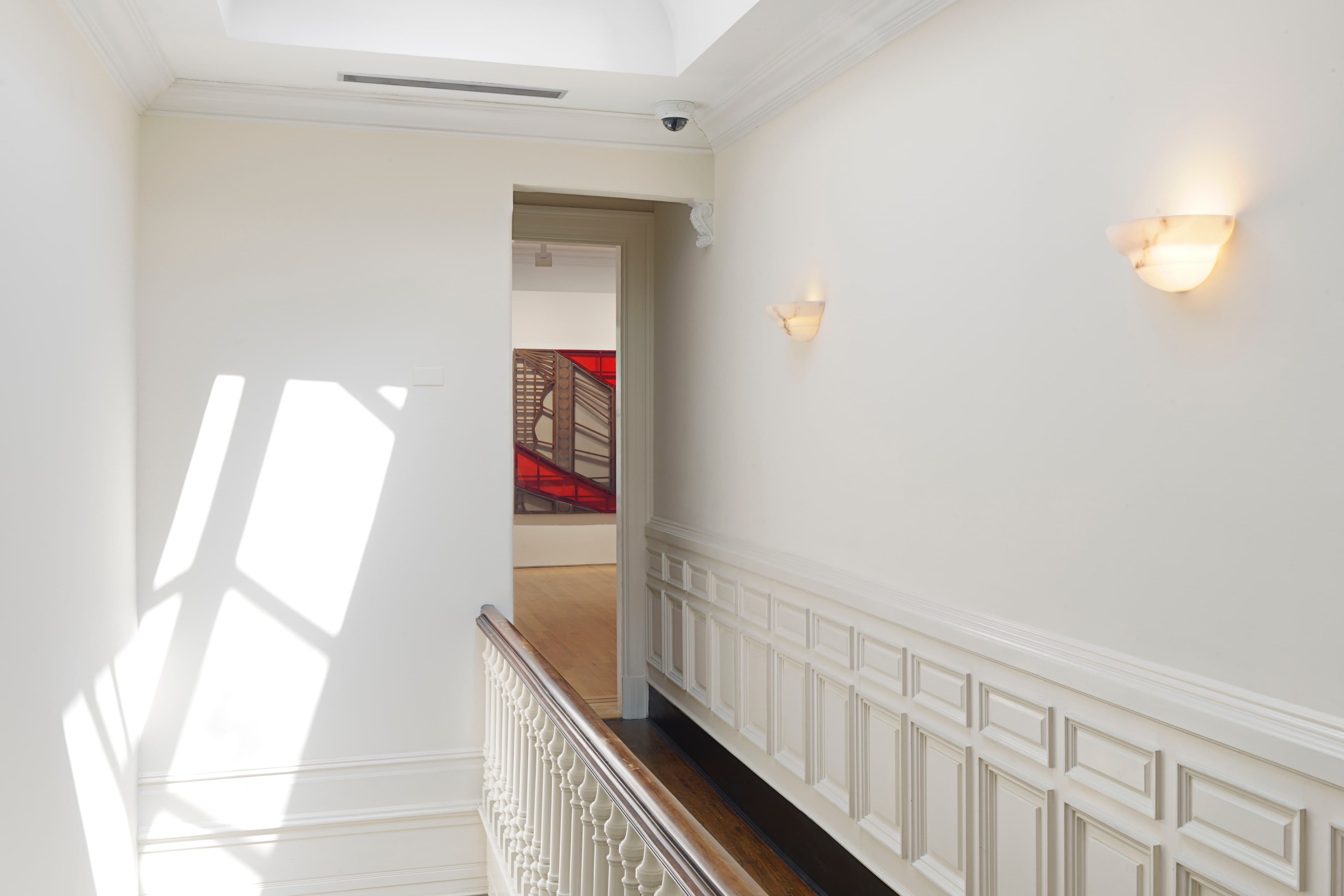
RodderRodder is pleased to present the gallery’s inaugural exhibition Wyatt Kahn New Work, the artist’s debut exhibition with the gallery. This latest body of work by Wyatt Kahn (b. 1983) marks a new direction for the New York-based artist. Known for challenging traditional notions about painting and sculpture, Kahn returns to the flat surface for the first time since 2017—this time exposing the interior of the colorful works to reveal their construction. In doing so, the artist highlights their objecthood. In more recent bodies of work, Kahn’s practice has focused on layering panels and building out the artwork over a flat surface with additional elements, such as in the Pile Up Paintings from 2020-2023 or the Sign paintings from 2023-2024. These new works turn inward, creating an added composition by exposing the interior of the work. Drawing inspiration from stained-glass windows, Kahn stretches transparent high-grade marine vinyl rolls over handmade wooden bars. On the backside of the vinyl, Kahn uses a solvent-based paint—originally intended to create stained glass—to manipulate the material, achieving a smooth surface on the front and a specific graininess on the reverse that subtly shows through. Kahn then goes further to create dynamic depth on the flat surfaces. He achieves this by shaping the wooden stretcher bars—typically hidden beneath the canvas and outside of a painting, but here exposed underneath the transparent vinyl—into patterns and shapes that extend far beyond their mere utilitarian function, elevating them as decisive compositional elements. This includes fin de siècle inspired swirls and rays, four-leaf clovers as well as gem- like panels, that are either underneath or set into the flat surface. At times, they function as nods to religious ornaments or, in the case of Construction (After Moholy-Nagy) (2025) a nod to László Moholy-Nagy painting Konstruktion AL6 (1933-34); or, in New Jersey (2025), a reference to the Ellsworth Kelly painting Jersey (1958). The resulting painting is reminiscent of a centuries old object with the illusion of stained-glass windows, placing Kahn in dialogue with a small collection of contemporary artists that have drawn inspiration from stained glass. In a 2008 New Yorker article titled “Many-Colored Glass,” which discusses stained-glass window commissions by Sigmar Polke and Gerhard Richter, Peter Schjeldahl wrote: "Stained-glass art, including that of Gothic masterworks, is hard to contemplate. It is hard even to see. Our eyesight is wired to make sense of light falling on objects, not shining through them. When presented with variably bright sources, we automatically select the brightest, consigning the rest to shadow." Kahn employs these powers of light and transparency by revealing how the works are made on the inside, which also allows him to accentuate the handmade quality of these works, a key theme in his oeuvre. Made entirely by his hand—in contrast to the stained-glass commiss- ions one typically sees in places of worship—Kahn does not force the exactness of individual stretcher bars and panels, but rather allows them to gently embrace each other imperfectly. The stretched vinyl itself is at times colorful—bold or subdued—and sometimes fully translucent or gleaming with grainy, stained glass paint. After many years of working with a limited, monochromatic palette, this body of work highlights Kahn’s brilliance as a colorist, opening up his works to subtle shifts in perception and inviting intense examination. Wyatt Kahn (b. 1983) lives and works in New York. Kahn is primarily known for his investigations into the visual and spatial relationship between painting and sculpture. Kahn assembles complex wall-mounted works in which the gaps between the individual canvases give rise to abstract or pictorial compositions. Rather than tracing the lines and shapes directly onto the canvas itself, he turns them into physical components of the artwork. Referencing the tradition of minimalist abstraction, Wyatt Kahn’s monochrome multi-panel ‘paintings’ are informed by a desire to explore non-illusory forms of representation. In essence, their subject becomes the interplay between two and three dimensions, as experienced via shifts in surface, structure and depth. In Kahn’s work, the wall upon which the work is hung becomes an integral part of the composition. Interested in a painting’s potential to function as the very embodiment of the object it depicts, Kahn has also developed works in which the shaped stretchers combine to create the form of an actual object, while a synthesis of hand-drawn motifs and words epitomize its essential qualities. His work is included in the collections of the Whitney Museum of American Art, NY; The Metropolitan Museum of Art, New York; Museum of Modern Art, New York, NY; Centre Georges Pompidou, Paris; Dallas Museum of Art; and Albright-Knox Art Gallery, Buffalo, among others.