
Marais, Paris
Ishita Chakraborty
East Is Everywhere
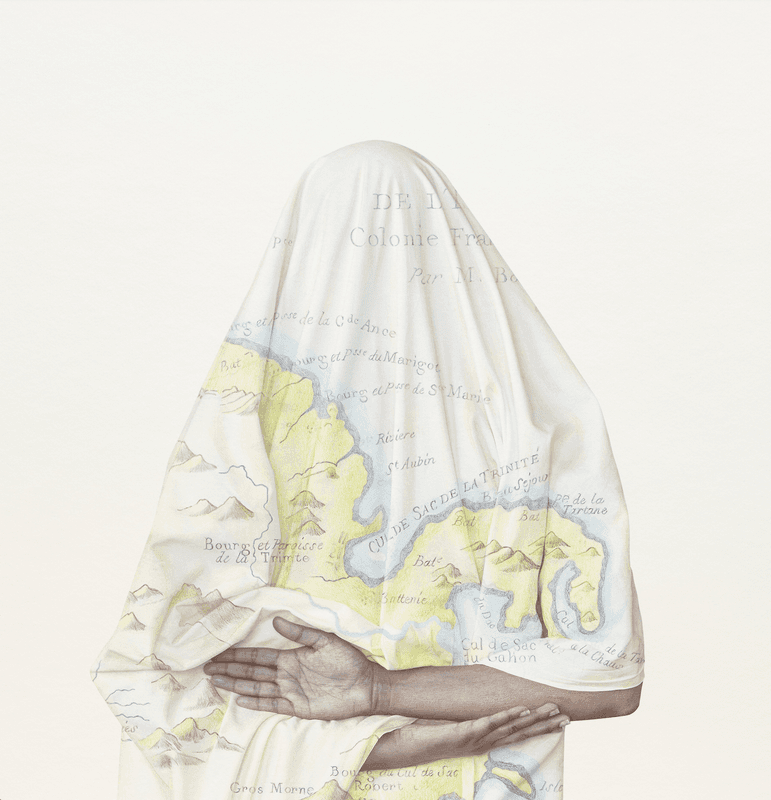
Peter KilchmannGalerie Peter Kilchmann Paris is pleased to present East Is Everywhere, the first solo exhibition in France and the second with the gallery by Ishita Chakraborty (b. 1989, West Bengal, India; lives and works near Zürich, Switzerland). On this occasion, the artist continues to develop her ongoing body of work, moving between archival colonial maps sourced from historical documents and reworked through self-portrait photographs taken beneath a white cloth, then hand-painted, and her botanical drawings, realised as canvas cut-outs mounted on Indian cotton sari fabric, a traditional floral textile worn by Indian women, presented either as works on paper or as suspended textile elements within the exhibition space. Extending these interrelated series, a monumental charcoal drawing on uncoated cotton, conceived as an immersive botanical fresco, spans an entire wall of one of the exhibition rooms, alongside new porcelain sculptures, some left unglazed and others hand-painted, developed from her experience in the Brazilian rainforest. In recent years, Chakraborty’s inquiry has expanded toward the entanglement of existential and ecological questions. Her projects increasingly address climate migration, ecofeminism, and the shifting relations between the Global South and North in post-migrant societies. The concept that "East is everywhere" in the context of colonialism and extraction refers to the proliferation of colonial power structures, resource exploitation, and the imposition of capitalist, "modern" ideologies across the globe, transcending traditional geographical boundaries. This viewpoint suggests that the dynamics of extraction—the exploitation of land, labour, and knowledge—operate universally, turning marginalized communities worldwide into modern-day "colonies". —Ishita Chakraborty Ishita Chakraborty places the landscape, understood as territory, memory, and political space, at the center of the exhibition. Drawing on colonial maps produced by European cartographers, herbarium collections, and photographic archives, she examines how botanical circulation, land exploitation, and systems of labour have been deeply intertwined within colonial economies. From slavery and indentured labour to forced agricultural production, these strategies contributed to the enrichment of Western powers while restructuring and dispossessing local territories, ecosystems, and communities. Her work reveals these entangled histories of capital, extraction, and control embedded within both landscapes and bodies. Ishita Chakraborty studied at the Faculty of Visual Arts, Rabindra Bharati University in Kolkata, and later at Zurich University of the Arts (ZHdK), where she completed her MFA. Her works grapple with socio-political and geopolitical realities, probing themes of displacement, colonial traumas, identity, and language. At the core of her practice lies an engagement with subaltern narratives—stories of resistance, survival, and belonging that often remain unheard. She has been featured in solo exhibitions at Aargauer Kunsthaus (Switzerland, 2025 and 2023), Museo Vincenzo Vela (Mendrisio, Switzerland, 2025), Whispering Benches, PH Public Project (2022), Prameya Art Foundation (New Delhi, India, 2020), as well as Art Container Zurich and Kunstraum ZHdK (Switzerland, 2019). In September 2026, she is participating in a group exhibition at Kunstmuseum Wolfsburg, Germany and she is currently nominated for the Sovereign Asia Art Prize 2026. She has participated in numerous group exhibitions, including at Kunsthaus Zürich, Zentrum für Kunst und Medien (ZKM) Karlsruhe, Museo Villa dei Cedri Bellinzona, and RIZQ Art, Abu Dhabi (all 2024); Aargauer Kunsthaus (2024, 2023, 2021); Kunsthalle Charlottenborg, Copenhagen (2023–2024); We Are AIA, Löwenbräu Kunst, and Helmhaus Zürich (both 2022); Löwenbräu Kunst, Zurich (2021); and Kunsthaus Zofingen (2017). Her works are included in significant projects and collections, and she has been the recipient of multiple grants and awards, including the Pro Helvetia Brazil Amazon Residency, Manor Art Prize Aarau, and the Aargauer Kuratorium Art Grant (all 2024); the Hyundai Art Grant, India (2022); and the Credit Suisse Art Grant (2021). In 2024, she was nominated for the Prix Mobilière, Art Genève.