
Mitte, Berlin
Toshihiko Mitsuya
Where Shadow Fails
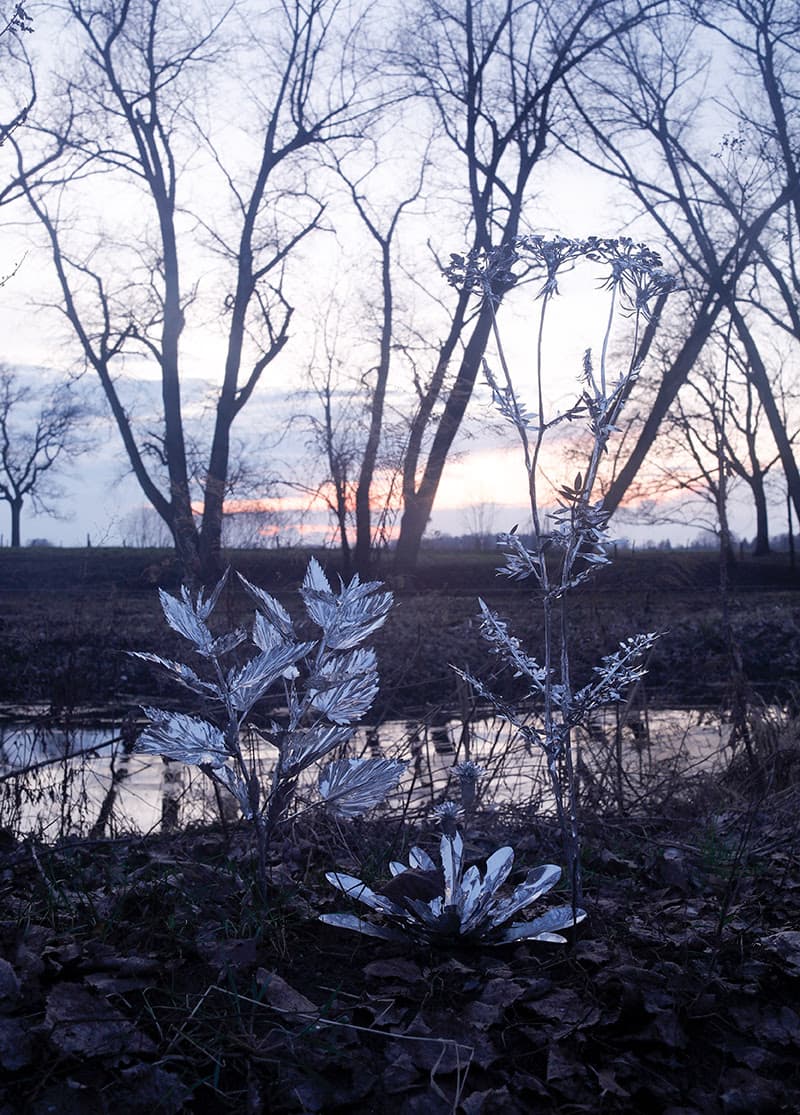
Nagel Draxler"A shadow confirms presence. It binds a body to the ground, stabilizing its place in the world. Where shadow fails, this certainty begins to loosen. The installation unfolds as a garden that cannot be fixed in time. Plant-like forms made of aluminium reflect light and their surroundings, their outlines shifting with movement and changing conditions. Metallic yet fragile, they resist clear states of growth or decay, remaining suspended between the living and the non-living. In this space, the loss of shadow is not merely visual. It marks a moment in which life and death are no longer opposed. Death does not appear as an ending, but as something already folded into the continuity of life. What emerges is not a defined boundary, but a threshold where distinctions loosen and remain unresolved. Here, form does not insist on stability, and presence persists without the need for clear contours." —Toshihiko Mitsuya With the grace of a gardener, Toshihiko Mitsuya’s touch transforms the natural diversity of plants and flowers into a new species of botanic realism. He responds to nature’s fleeting mortality with poetic installations ingeniously crafted from aluminium sheeting. Derived from silvery-white ore, aluminium is the third most abundant element in the Earth’s crust and occurs as an oxide in soil, water, and air. Mitsuya was five years old when he started making objects from the kitchen foil that his mother gave him to play with. Even then, his dexterity was not mechanical alone. He taught himself how to reverse engineer a physical form into a flat outline from which he could create something new and three-dimensional. His ability to transfigure a flower, a tree, or even a knight on horseback, relies on the conceptual deconstruction of matter without recourse to software. Mitsuya perceives the flower’s structure in his mind, and with virtuoso silhouetting and skillful pattern-cutting, translocates the stem and petals onto a drawing of several meters in length, which he then cuts out of a single sheet of aluminium. With the hands of a florist, he twists and turns the sculpture until it acquires soul. The artwork’s morphology literally grows out of the flower’s unfolding. —Dr. Clémentine Deliss