
NoHo, New York
Group Exhibition
In Conversation
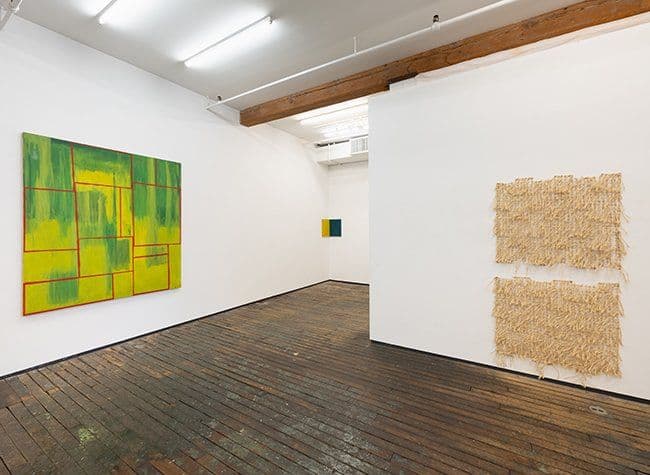
Zürcher GalleryRegina Bogat, Ed Clark, Tom Doyle, Douglas R. Ewart, Stewart Hitch, Alix Le Méléder, Brenda Miller, Kazuko Miyamoto, Rakuko Naito, Leela Ramotar, Lynn Umlauf, Stephen Westfall Zürcher Gallery is pleased to bring together 12 artists, some represented by Zürcher and some not, in conversation with various approaches to the grid or structure in their works. Regina Bogat (b. 1928, Brooklyn, NY). A part of the 10th Street art scene, Regina Bogat was the only woman artist working in the Bowery Studio building with Mark Rothko, James Brooks, Ray Parker and other Abstract Expressionists. A friend of Ad Reinhardt and Eva Hesse, Regina subsequently married the painter Alfred Jensen and has continuously painted throughout her life. Bogat has exhibited across the United States and in Europe and her work is in prominent collections including The Metropolitan Museum of Art (New York), Musee National d’ Art Moderne/Centre Pompidou (Paris), and The Blanton Museum of Art (Austin, TX). She was included in the 1973 exhibition, Women choose Women curated by Lucy Lippard at the New York Cultural Center. In 2015, Regina Bogat was shown by Zürcher Gallery in a solo show at Frieze, New York (Spotlight Section curated by Adriano Pedrosa). Zürcher Gallery was one of the 5 shortlisted galleries for the Pommery Stand Prize at Frieze NY, highly commended for its presentation of Regina’s works from 1967-77. In 2015, Regina Bogat was invited by Sarah Cain to be part of her exhibition, Sarah Cain Blue in your Body, Red when it hits the Air, at the Museum of Contemporary Art, San Diego, CA. In 2017, Karen Wright invited Regina Bogat to participate in Entangled: Threads & Making at the Turner Contemporary (Margate, UK). In 2017, Kelly Baum included Regina in the major exhibition, Delirious: Art at the Limits of Reason, 1950 – 1980 at the Met Breuer. Her work was recently included in the exhibition, Meeting Points at the Centre Pompidou in Paris and the historical exhibition, Postwar Women, curated by William Corwin at the Art Students League of NY. In 2019, Bogat was elected as a member of The National Academy of Design. Ed Clark (1926-2019) was born in New Orleans and moved to Chicago at the age of 7. In 1944, at the age of 17, Clark served with an all-black unit for the U.S. Air Force. Upon return from the military, he pursued an art education, taking classes at the School of the Art Institute of Chicago and later the Académie de la Grande Chaumière in Paris. While in France, Clark mingled with various creative circles, until his return to the US in 1956. Ed Clark was largely undersung throughout his career due to the attention devoted to white artists over black ones. However, later in his 70-year journey as a painter, Clark became recognized for his contribution to abstract expressionism through his signature “sweeping” brushstrokes which he produced with brooms and rags, his color gradients, and large canvases. He also pioneered the use of shaped canvases in the breadth of his work, utilizing ovals rather than conventional rectangles. Clark won multiple awards including the Art Institute of Chicago’s Legends and Legacy Award (2013), the Joan Mitchell Foundation’s Painters and Sculptors Grant (1998), and the United States Congressional Achievement Award (1994) to name a few. Ed Clark passed away in October of 2019 at the age of 93 in Detroit, Michigan. Ed Clark is currently represented by Hauser & Wirth. His work is included in Paris Noir 1959 - 2000 at the Centre Pompidou in Paris (March 19 - June 30, 2025). Tom Doyle (1928-2016) earned his BFA in 1952 and MFA in 1953 from Ohio State University, Columbus. He is a member of the American Academy of Arts and Letters and the National Academy of Design. In 1982, he was awarded the John Simon Guggenheim Fellowship in Sculpture and the National Endowment for the Arts Fellowship in Sculpture in 1991. Doyle has had multiple solo exhibitions in New York since his debut at Allen Stone Gallery in 1961/62 and Dwan Gallery in 1966/67. His work has also been exhibited at The Brooklyn Museum, The Bronx Museum, SculptureCenter (NY), The Cooper-Hewitt Museum (NY), The Smithsonian Institute (Washington, D.C), The Parrish Art Museum (NY), The Neuberger Museum of Art (NY), The Walker Art Museum (Minneapolis), The New Britain Museum of American Art (CT), Miami Art Museum (FL), Moderna Museet (Stockholm, Sweden), Kunsthalle Berlin, Stadtlische Kunsthalle Dusseldorf, and Kunsthalle Essen, Baden-Baden Germany Kunstverein, The Israel Museum (Jerusalem, Israel). Doyle was a tenured professor at Queens College and taught at the School of Visual Arts, The New School for Social Research and the Brooklyn Museum Art School. Douglas R. Ewart (b. 1946, Kingston, Jamaica) has been honored for his work as a composer, improvising multi-instrumentalist, conceptual artist, philosopher, writer, sculptor, mask and instrument designer, visual artist, tailor, cultural community builder and more. As an educator, Ewart bridges his kaleidoscopic activities with a vision that opposes today’s divided world by culture-fusing works that aim to restore the wholeness of communities and their members and to emphasize the reality of the world’s interdependence. Ewart immigrated to Chicago From Kingston, Jamaica, in 1963. There he studied with the master musicians of the Association for the Advancement of Creative Musicians—an organization at which he later served as chairman at different times throughout 1979-1987 and into the millennium. Ewart is the founder of Arawak Records, is the leader of ensembles such as the Nyahbingi Drum Choir, Quasar, the Clarinet Choir, and Douglas R. Ewart & Inventions. He is a designer and creator of instruments and kinetic sonic sculptures that have been exhibited in venues such as Houston’s Contemporary Arts Museum and the Museum of Science and Industry Chicago. “Crepuscule,” his vast conceptual work is collectively actualized by scores of musicians, dancers, visual artists, poets, capoeirista, puppeteers, martial artists, activists and the honoring of elders and more. In 2024, Douglas R. Ewart participated in the Busan Biennial in Busan, South Korea (August 17 - October 20, 2024). “Douglas R. Ewart’s interdisciplinary work encompasses music compositions (including graphic and conceptual scores as well as conventionally notated works), painting and kinetic sound sculpture, and multi-instrumental performance on virtually the full range of saxophones, flutes, and woodwinds, including, panpipes, rainsticks and percussion instruments of his own design and construction for which he is known worldwide. Ewart’s work as composer, instrument maker and visual artist has long reflected his understanding of the importance of sustainable and natural materials, particularly bamboo, which serves not only as primary physical materials for many of his sculptures and instruments, but also crucial conceptual elements of some of his most important recordings.” - Statement from 2024 Busan Biennial Catalogue. Stewart Hitch (1940-2002) was an artist who left the world with a complex and mysterious legacy. Hitch was born in Lincoln, Nebraska in 1940 and moved to New York City in 1968 after obtaining an MFA from the University of Nebraska. His dynamic character, as was reflected in his paintings, gained him a reputation in the NYC art and social scene. He was a heavy drinker and a notorious figure at Fanelli’s Cafe on Prince Street in Manhattan, acquiring the title of “The Lord of Fanelli’s.” Throughout his painting career, Stewart Hitch played with a Color Field application of hue and a modernist sense of geometric abstraction, in conjuction with variety of other distinct movements of his time. While some of his works are preserved within notable institutions and collections including the National Gallery of Art, the Brooklyn Museum, and the Broad Museum, the majority of his estate collection consisting of about 100 paintings remains lost and uncovered. Alix Le Méléder (b. 1955, Boulogne sur Seine, France) lives and works in Burgundy and Brittany, France. Alix graduated from the Ecole des Beaux-Arts of Paris (from the Sculpture department where she studied with the sculptor Cesar Baldaccini). After graduating, she resumed painting in 1985 and moved to La Villette into a warehouse which burnt down in 1990. She lost all her work in the incident. When she emerged from this big trauma, her work developed in an impressive way. The City of Paris then gave her a large studio which she occupied until she stopped painting in 2011. Alix Le Méléder has never claimed to belong to any abstraction movement or to descend from one group, she’s always been fiercely independent and extremely singular in her thinking and practice. “I looked to free myself from any forms of expression and wanted painting to start again from color, to reveal things,” she says. In 1994 Alix decided to work exclusively on square formats. In the early 90’s she met Shirley Jaffe who introduced her to Jean Fournier gallery in Paris. Alix showed there until 2004 before joining Zürcher Gallery, New York/Paris who now represents her work. She has had numerous solo exhibitions in France at Galerie Jean Fournier (Paris), Maison d’art contemporain (Chaillioux), Centre d’art de Montbéliard, La Maison des Zervos (Vézelay), Galerie Pixi (Paris), Chateau de Tours, and Galerie Zürcher (Paris), and in New York at Zürcher Gallery and the French Institute Alliance Française (FIAF). Her work is included in prominent collections such as the TiA Collection (USA), Deji Art Museum (Nanjing, China), Musée des Beaux-Arts (Nantes, France), Musée des Beaux-Arts (Tours, France), Ministère des Affaires étrangères, Bureau du Patrimoine (Paris), and Le Bon Marché (Paris). Brenda Miller (b. 1941, The Bronx, NY) is best-known for her sisal wall sculptures, her typewriting, and her Alphabet rubber-stamped ink and pencil on wall or pape, which she has made since 1969-70 and exhibited at the Whitney Museum of American Art (1975), Museum of Modern Art (1973) and later at P.S.1. As a feminist and active participant in the 1970s women’s movement, Miller co-founded the Ad-Hoc Women Artists Committee with notable figures like Faith Ringgold and Lucy Lippard. Her early work merges gender politics with post-minimalism, using repurposed materials like sisal and rubber stamps to imbue abstraction with meaning. Brenda Miller explores the relationship between process, repetition, and time, emphasizing impermanence. Her Alphabet series, based on a specific grid structure and incorporating a distinctive use of rubber stamps and blue pencil, reflects her focus on obsessive repetition and the physicality of language. With her sisal sculptures, Brenda Miller also engages with the idea of permanence through transient materials, making work that exists in multiple stages: diagrammed, potential, and actualized. Her art’s intellectual rigor and materiality speak to the complexity of change, time, and memory. “Ideas imposed by language, and the disproportion between language, which is finite, and speech, which is nearly unlimited in its variety, are used as equivalent elements in the underlying structures of my work. Perceptually assimilated measurements, for example, the alphabet and its physical structure or the height of a standard door: 80 inches, as well as, the number of characters, and the numerical sequence of the characters, are used to determine the system by which each piece is constructed... The material, Sisal, of different thicknesses, is essentially another variant; it is neutral, colorless, shapeless, available anywhere in the world, and its linearity is subject to gravity.” Kazuko Miyamoto (b. 1942, Tokyo, Japan) studied art at the Gendai Bijutsu Kenkyujo (Contemporary Art Research Studio). She moved to New York in 1964 and attended The Arts Student League of New York (1964–1968). Early in her career, Miyamoto worked as Sol Lewitt’s assistant and became interested in minimalist and post minimalist attitudes. She adopted from Lewitt a serious investigation of modular forms, repetition, and geometry. In her work, she explores geometry, female forms of craft, body relationships, and quotidian materials. In 1971, she began making her String Constructions from industrial cotton strings systematically hand-stretched between a constellation of nails hammered into the floor and the wall. From the early 70’s, Kazuko Miyamoto responded to Minimalism by emphasizing process, material and performance. She is the recipient of Federico II: Premio Internazionale di Pittura; Italy, 2003, the Francis J. Greenburger Foundation Award in 2003, and the National Endowment for the Arts in 1979 & 1980. Public Collections include The Metropolitan Museum of Art (NY), Museum of Modern Art (NY), Wadsworth Antheneum (CT), Princeton University Art Museum (NJ), National Museum of Modern Art (Tokyo), National Museum of Modern Art (Kyoto, Japan), Neue Gallerie der Stadt (Linz, Austria), Lentos Art Museum (Linz, Austria), Art Gallery of New South Wales (Sydney), Smithsonian American Art Museum (Washington DC), Yale University Art Gallery (New Haven, CT), Daimler Art Collection (Berlin), SFMoMA (San Francisco), and the Guggenheim (NY). Miyamoto had solo exhibitions at the museo Madre, Napoli, Italy (July 6 - November 6, 2023) and at Belvedere 21 (September 12, 2024 - March 2, 2025), and was included in the exhibition A League of Nations (October 26 - November 30, 2023) at the Art Students League of New York. She has an upcoming solo exhibition at the KW, Berlin: String Constructions (October 18, 2025 - January 11, 2026). Rakuko Naito (b. 1937, Tokyo, Japan) received her B.F.A. from Tokyo National University of Art in Japan 1958. Shortly after, Rakuko Naito moved to New York City. In the 1960s, Naito participated in techniques of the Optical Art movement. In the 1970s, Naito transitioned from abstraction towards representation, with a focus on nature and flowers. Simple forms, monochromatic colors and clean lines have consistently been major components of her work. She had her first solo exhibition at the World House Gallery in New York in 1965. Her works are included in various collections internationally including the San Francisco Museum of Modern Art, The Voorlinden Museum, Wassenaar, the Netherlands, and the Kemper Art Collection, Chicago. “My interest has been always shape and texture, shape of geometry and shape of nature. Materials I choose are mostly organic natural materials. Paper, metal or sometimes pieces of wood. I feel natural forms and textures have a reality that can not be competed by trying to paint or draw, a line formed naturally is not a same line drawn by hand. I try to experiment and manipulate materials to create my own world. I don’t try to tell stories of politics or social problems, my concern is purely art and visual stimulation.” Leela Ramotar (b. 1952, Guyana) is a painter, printmaker, and educator. She studied art at North East London Polytechnic and St. Mary’s College in London before moving to New York in 1979 to attend the Brooklyn Museum Art School as a Max Beckmann Scholar, where Nina Yankovitz was the group facilitator. From 1981 to 1983, she studied print-making at the Pratt Graphics Center in Manhattan. In 1985, Ramotar participated in the exhibition Rape, dedicated to the memory of Ana Mendieta and juried by Susan Brownmiller, Barbara Kruger, and Jenny Holzer, at the Ohio State University Art Gallery. She was a member of Repohistory (1989-2000), a New York City-based collective of artists and educators who developed public art interventions reckoning with the construction and display of history. Ramotar was an educator in the New York City public school system for over two decades. Lynn Umlauf (1942-2022) was born in Austin, Texas, into a family of artists. Lynn graduated in Austin with a Bachelor’s degree in 1965 and MFA in 1969. She moved to New York in 1966-67. She took classes at the Academia di Belli Arti in Florence, Italy and the Art Students League in New York. Lynn first started showing in Italy. Her first solo-show in New York was with the Hal Bromm Gallery in 1980. She was included in the Whitney Biennial in 1975. She has shown extensively in Italy, France and the United States. Her work is in the collections of MOMA PS 1, Long Island City, NY and Reading Public Museum, Reading, PA. What makes Lynn Umlauf’s work quite unique is her relationship to the moment. There are moments of the real world in these works. They are not abstracted from nature but abstracted from experiences of nature. Zürcher Gallery represents the Estate of Lynn Umlauf. Stephen Westfall (b. 1953, Schenectady, NY) received his MFA from the University of California, Santa Barbara in 1978. He had his first solo exhibition in 1984 at Tracey Garet in New York City. His work became distinguished for combining bold and contemporary colors within post-minimalist geometric compositions. Westfall’s paintings are included in several collections including the Whitney Museum of American Art, New York, the Kemper Museum, Kansas City, and the Museum of Fine Arts, Boston among others. “I make paintings with planes of color that lie next to each, border to border, like bodies pressing up against each other. There’s no tape, everything is done with a flat sable brush. I let the painting go when I decide the surface is rich enough and the colors are deep enough without crossing over into an overt, performative expressionism. ‘Navigator’ is from a series of paintings I made that give the illusion of overlapping grids, but there’s no overlap. Every area of color is on the same level. The grids aren’t lines, but bands that have shape-value as narrow and extending areas of color on their own. All the spatial depth that is created is optical. The areas of color in the painting are as ‘solid’ as the areas of color in icon paintings. The grids dance a bit because their intercities are twisted, thus torquing their spread into a kind of rhythmic shimmy. So there’s motion and depth while everything is still and flat. I love the conceptual whammy of holding those contradictions together. Polysemy is held to exist in language and images with stories. This is one way it can exist in an image that is abstract.”