

Lower East Side, New York
Analivia Cordeiro
Freedom
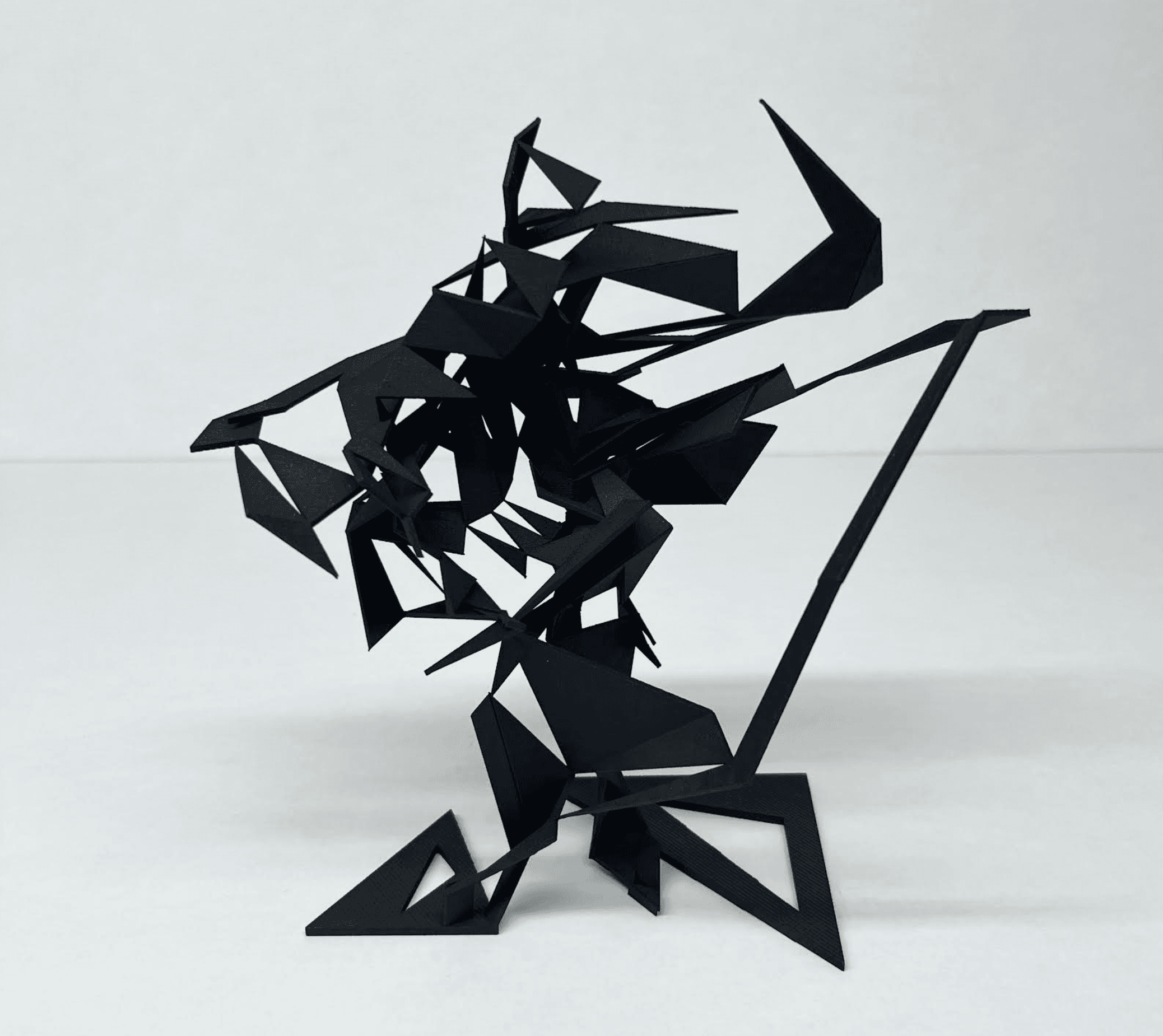
BitformsBitforms Gallery is pleased to present Freedom, a solo exhibition by pioneering artist Analivia Cordeiro, whose groundbreaking practice has shaped the dialogue between movement and computation for over five decades. As one of the earliest artists to integrate the language of dance with the logic of software, A. Cordeiro investigates how the body functions simultaneously as subject and interface within systems of digital mediation. From the outset of her career, A. Cordeiro has centered a sense of freedom in her work—initially offering dancers in the 1970s and 80s the ability to interpret choreography individually, and later extending that agency to audiences through interactive formats from the 2000s onward. This ongoing pursuit of freedom challenges the structured logic of computational systems. Her early experiments with plotters and computers anticipated the development of motion capture and generative technologies that now define much of contemporary media art. Freedom brings together both historical and recent works that trace this trajectory from analog systems to today's artificial intelligence. The 0=45 series (versions I–VIII) presents a chronological arc of the artist's computer-based choreography from 1974 to 2024. These works demonstrate an early and sustained engagement with the relationship between body, code, and form.The artist developed 0=45 I (1974) using algorithms written in Fortran to define the spatial coordinates of a dancer's body. She then translated this data into movement using illustrated notation. This method served as a precursor to motion capture: her algorithm assigned fixed positions to body parts, enabling the computer to dictate the dancer's movement. Elemental forms, binary color palettes, and spatial precision positioned the body within an abstracted environment. The resulting works, presented as both video and printed tableaus, collapse distinctions between performer and program. Nota-Anna is a custom software that acts as the foundation of the artist's generative works. In the early 1980s A. Cordeiro began researching ways to digitize the body's three-dimensional movement for a computer. Her early Movement Notations MC 1 and MC 2 demonstrate how sketched pictograms that translate movement into notation. The artist later used the recording of a folk dance, titled The Yemenite Steps, to study and capture movement through individual positions. This process entirely predated motion capture, webcams, and contemporary motion-tracking technologies.To translate human movement into digital form—before the advent of motion capture or computer vision—dance sequences were filmed on Super 8. The footage was then broken down into individual frames, each one hand-drawn onto paper to map 24 points on the body from which x and y coordinates were extracted. In 1983, the computer was added to this process. Programmer Nilton Lobo and A. Cordeiro translated the drawings onto an InterAct graphic workstation at Integraph São Paulo. Together they would work at the lab from 9 PM to 2 AM, the only hours they were allowed access to the computers. At the time, this hardware was rare and tightly controlled, virtually inaccessible to artists, making these late-night sessions the sole opportunity for them to experiment and realize their digital projects. The resulting images of the Yemenite Dance Jump and Step demonstrate the outcome of the great attention to detail involved when digitizing motion. The Architecture of Movement presents video documentation of how Nota-Anna traces human motion, using archival footage of Pelé performing his iconic bicycle kick and volley in 1968. Frame by frame, the software translates Pelé's movement into graphic trajectories that can be viewed from multiple angles within the program, revealing the abstract geometry of motion itself. Between 2015 and 2018, a series of sculptures was produced from this Nota-Anna analysis, materializing the captured motion into three-dimensional form. Each sculpture, offered both as a physical object and as a digital . GLB file, eternalizes not the image or identity of the athlete, but the trajectory of his action—the pure movement itself. Comparable to musical notation, Nota-Anna records motion as an expressive and rhythmic composition, making visible the beauty and precision of a gesture that transcends the body that performed it.