
Marais, Paris
Tim Wilson
Drift Halation
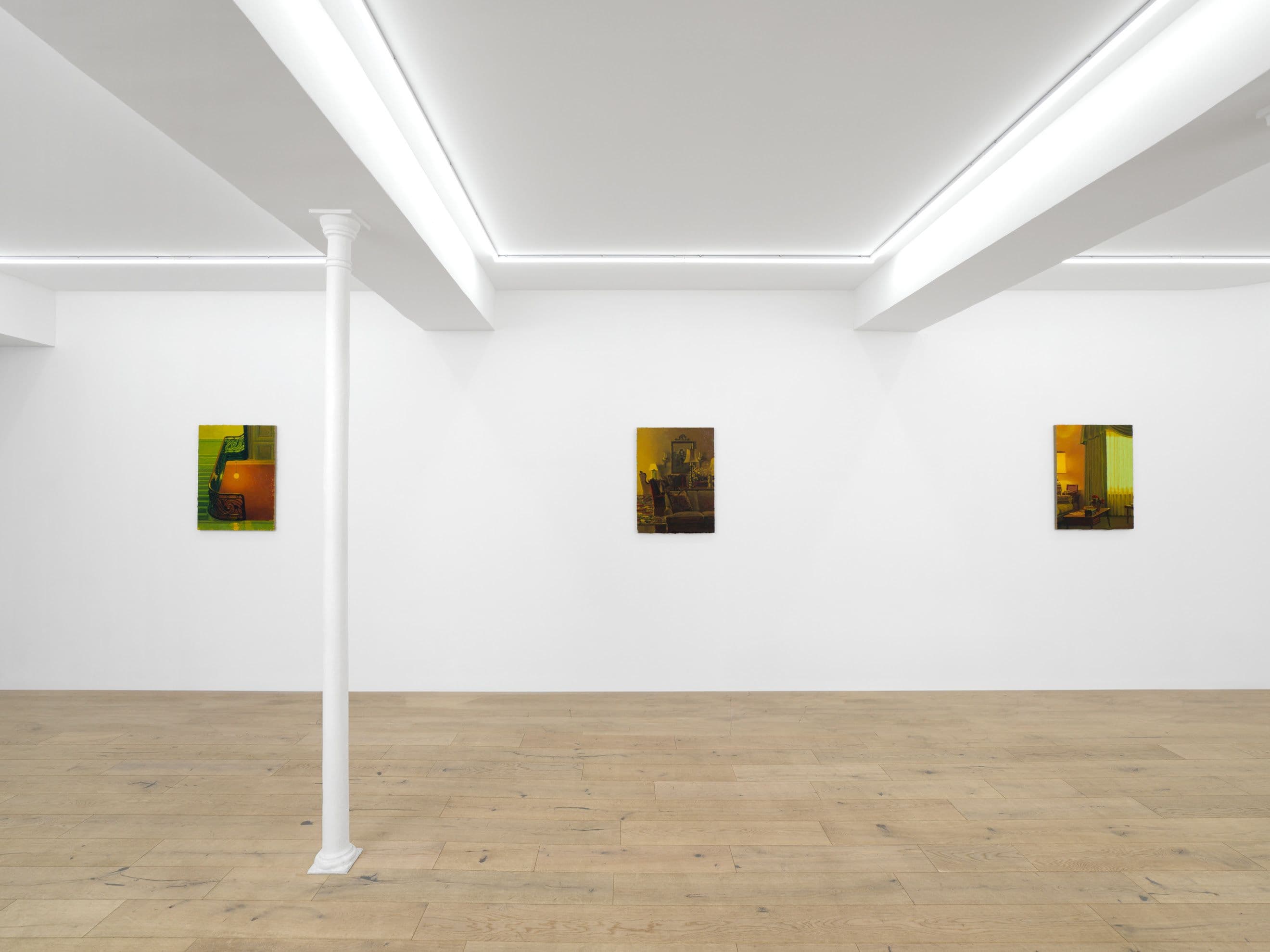
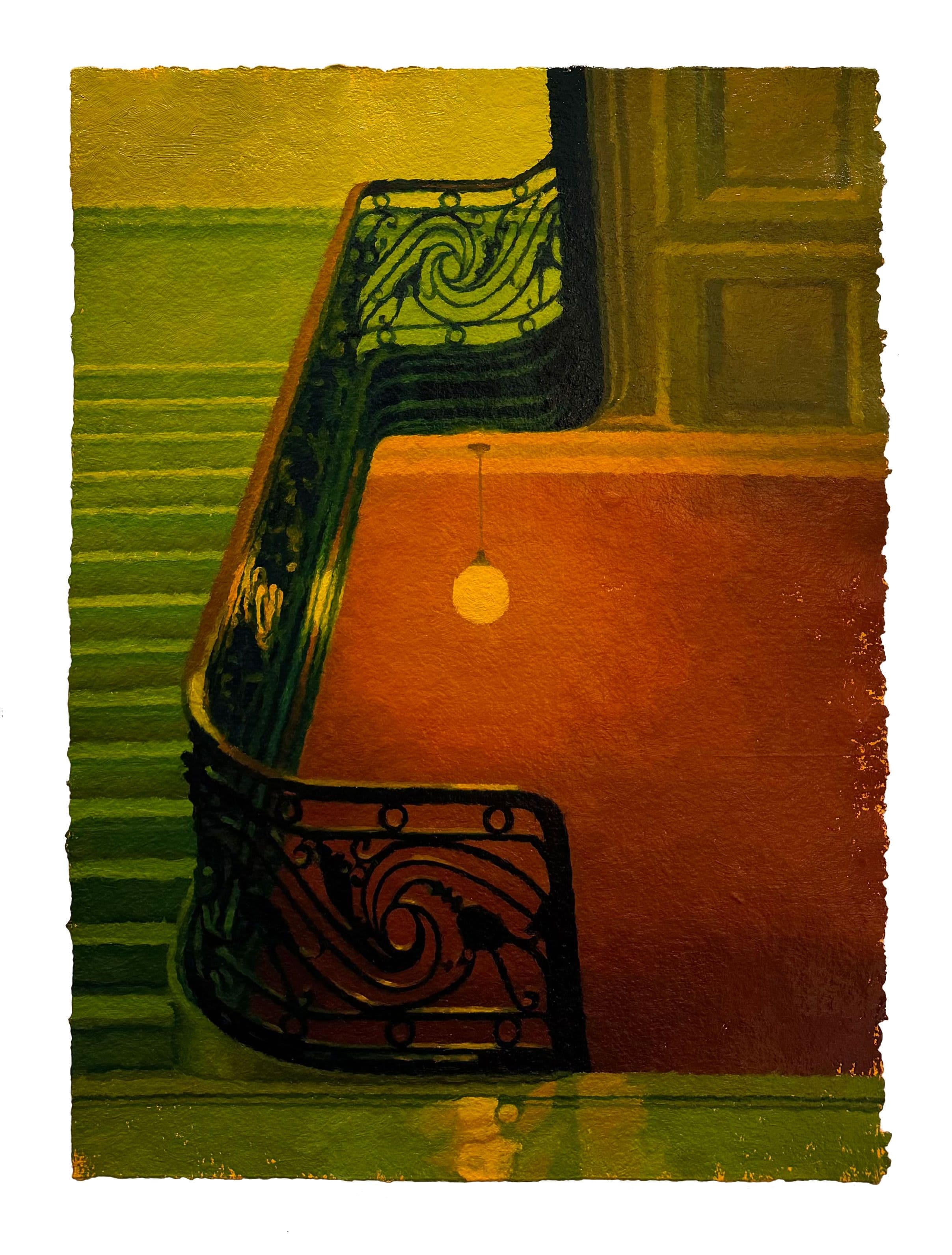
Long Story ShortLong Story Short is delighted to present Drift Halation, the Paris debut of New York artist Tim Wilson. “What has been, has been” —Gustave Courbet “Tim Wilson’s paintings of lamps, mirrors, lonely stairwells, and unoccupied rooms recall the romantic anonymity of staying in an expensive hotel; in front of them I feel an illicit thrill, as if I’d given a fake name to the concierge. Lying suits them—in the tradition of reflexivity they come out of, their true subject is less the centered objects and quiet spaces they depict than it is artifice, glimpsed in the bright underpainting bleeding through the image, the materiality of the canvases’ deckled edges and rough, cold-press surfaces. The painter’s ruthless attunement to compositional order prioritizes a syntax of form and color that is more abstract than representational, disinterested in depth of space, disinterested in the asymmetrical messiness of real life. These are not malicious lies. They are lies told by a friend, possessed with a melancholic knowledge, and I look at them — I listen to their quietness — hoping to glean what they are trying to impart. I’ve been in the presence of Wilson’s paintings many times, starting in a studio on Grand Street in Brooklyn a handful of years ago. He was experimenting with painting on burlap then, letting the coarsely woven material subvert the delicate exactness of his paintings, a related but more exaggerated effect than what the paper and linen grain gives his present work. I’ve seen his canvases perched in a line on the edge of his couch and flat on the work table he set up in his living room. I’ve seen them exhibited, and marveled at their relation to each other. Wilson’s control of sequence and spacing is as deliberate outside the canvas as within. In all of these contexts, I’ve felt their insistence on fact—the fact of material, the fact of painting. They don’t need me to believe their lies; in them, artifice is simply another fact. As diminutive in size and straightforward in subject as they are, I see in them a philosophical stance. They revel in beauty and mystery but do not imbue the unknown with any higher meaning. Mystery, the past, desire, death––these too are just facts. Wilson, who survived an accident that has partly impaired his hearing, stands to the right of me when we walk together, and it’s familiar to see him cup his hand at his ear in order to hear me—my bad habit of mumbling doesn’t help. I think of that gesture sometimes when I feel that I must stand very close and very still and tilt my ear to his canvases in order to hear them. They are not entirely silent. I can make out the padding of feet on a carpet, the clinking of glasses in the hotel restaurant, the faint buzzing of the stairwell light. Because his accident involved a flight of stairs, and because I’ve heard him tell a story about a dramatic incident having to do with his grandmother’s lamp, it is tempting to read into his choice of subject matter a hidden narrative. I think that is an over-interpretive impulse, a desire for story and meaning. Instead, his work erases narrative altogether. Life exists before or after an event, simply a kind of waiting—to be seated, for the arrival of a friend or partner, for the light to change. Maybe because his source images are taken sometimes from films, I have often thought of Godard’s Contempt when looking at Wilson’s paintings, in particular the prologue scene in which Brigitte Bardot lies in bed, light filters abruptly changing the mood in which she appears. That color and thus feeling can change so suddenly and — from a certain view — arbitrarily, resonates with the concept of contempt, that invisible crossing between two people. In Wilson’s paintings, color is often invented but always forcefully, irrevocably real. ‘Arbitrary,’ artificial, and yet no less a fact. Color is infinite, which is to say unmasterable, but of our living painters, Wilson makes a strong argument for being one of its most masterful practitioners. It is color most of all, to my eye, that his paintings wait for—that sudden changing color from which there is no going back.” —Henry Chapman