
Hollywood, Los Angeles
Charles Mayton
Song Of The Shrimp
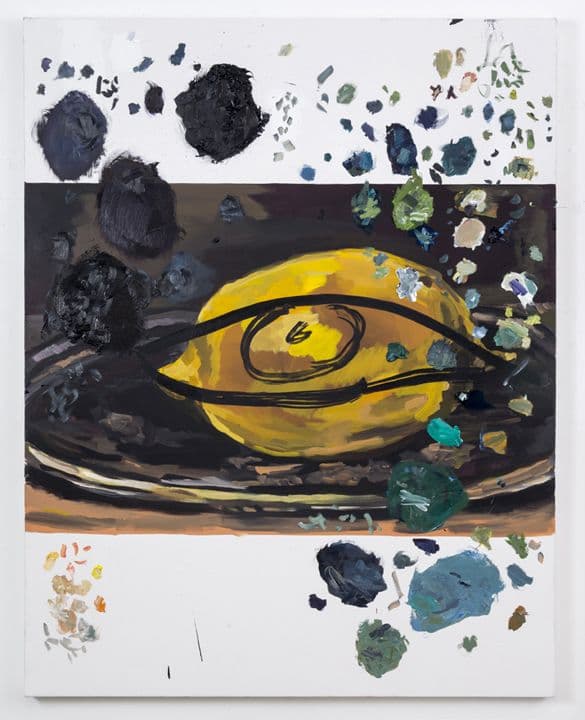
Thomas Duncan Gallery“Song of the Shrimp”, Charles Mayton’s exhibition of new paintings at Thomas Duncan Gallery, Los Angeles, expands his formal reservoir of references beyond the modernist art historical canon, producing and exploring sedimented layers of imagery drawn from art of the ancient world, archaeological excavation, natural history and marine biology. In these large format paintings, fish appear and disappear along with eyes and other orifices, Medusa heads and human hands merge, and surrealist tropes take their place alongside fragments of classical mosaic. The themes of taste and consumption that have preoccupied Mayton’s work for some time are developed here through puns on the painters’ palette and the gastronomic palate. Continuing this line of metaphorical reasoning, questions of authorship and influence that appeared in his earlier work, like the formal quoting of Magritte’s script for example, have now been digested, and these new paintings plummet and rise, replacing the presentation of an array of motifs on flat tablecloths with a sense of incorporation and depth. The references to surrealism in these works show the process of their emerging and reemerging as motifs: moving between palimpsest and tableau, some are still indigestible and determined to return. These paintings insist on surrealism as a type of logic rather than a style: with the conviction of a dream, its signifiers are less important. To this end, the organizing consciousness of the exhibition is a giant painting of a black shrimp, a motif found on a specialist shrimp-breeding website. Like shrimp bred for display in aquaria, this work depicts a motif bred solely for the purposes of appearing in a painting, a farmed image, referring only to things that populate imagery, as distinct from things that populate the world. The hobbyist shrimp exists only within the boundaries of its own discourse and fails to find a home or thrive outside its carefully manufactured environment. In this sense, it provokes an unexpected question about the generative properties of painting that is neither fully figurative nor abstract: for example, does painting perform a critique of anything outside its own proper field? If not, does it generate a strong enough alternative logic of its own? The sediment of ideas that the shrimp as bottom feeder consumes makes it wonder how we came by these notions in the first place. How long did it take for them to settle into these layers of accepted, self-evident historical narrative? At what point, it asks, did we receive surreal as shorthand for weird? The shrimp with its complex digestive system asks how we have come to accept a certain transparency or direct relationship between intake and output, when there are so many seas of experience to traverse? – Eva Kenny Charles Mayton (b. 1974) lives and works in New York. Recent solo exhibitions: American Academy in Rome, Rome; David Lewis Gallery, New York; Campoli Presti, London; Campoli Presti, Paris; The Power Station, Dallas; Balice Hertling, Paris. Recent group exhibitions: Tanya Leighton, Berlin; Thomas Duncan Gallery, Los Angeles, Human Resources, Los Angeles; Federico Vavassori, Milan; Dominique Lévy, New York; The Walker Art Center, Minneapolis.