
Upper East Side, New York
Mark Bradford
Thievery by Servants
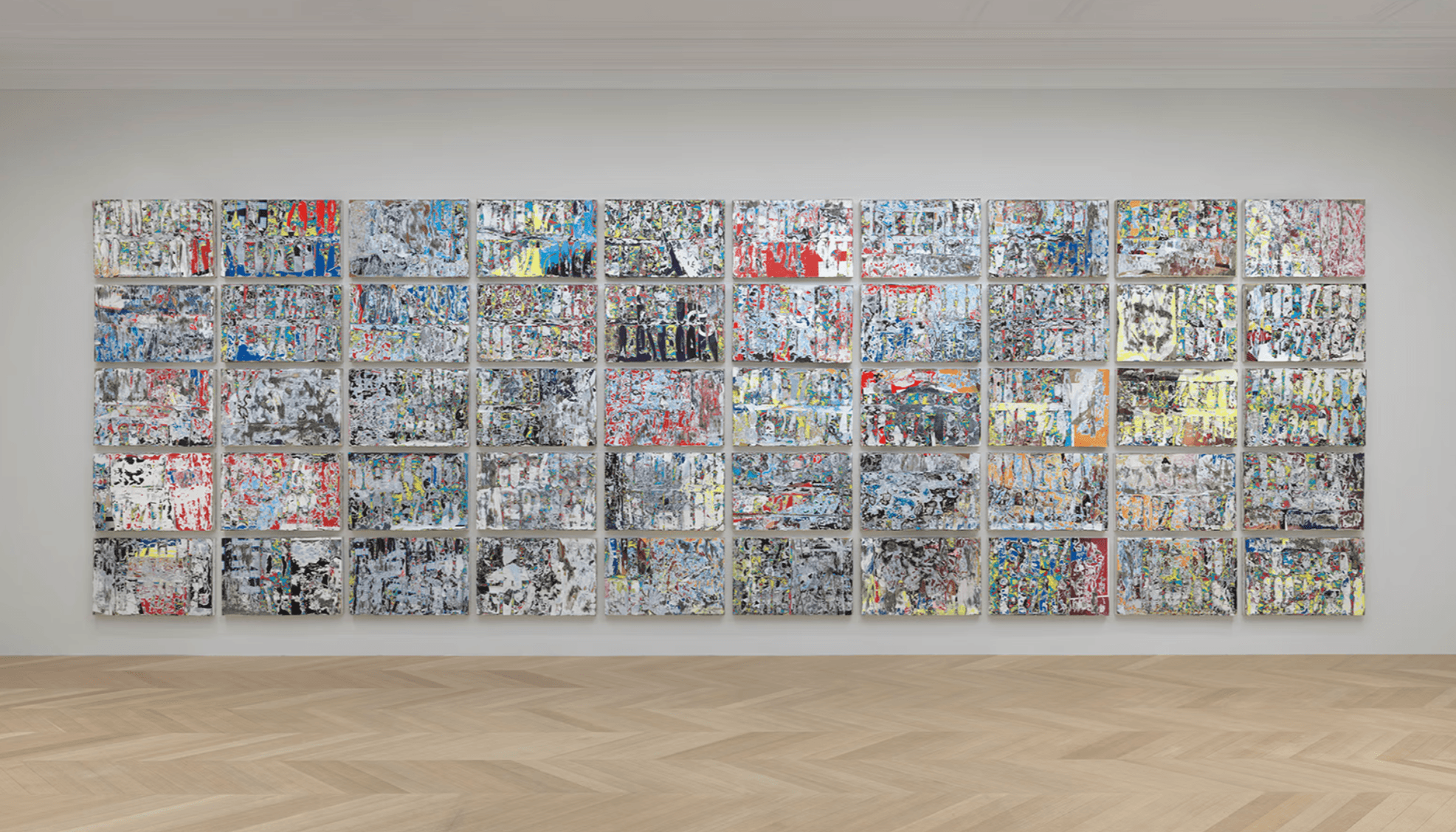
Lévy Gorvy Dayan"I want my materials to actually have the memories—the cultural, personal memories that are lodged in the object. You can’t erase history, no matter what you do. It bleeds through." —Mark Bradford Monumental in scale, Mark Bradford’s Thievery by Servants (2013) comprises 50 panels across nearly 30 feet—in a bold interplay of paper, text, and color that demonstrates the artist’s provocative repositioning of abstraction in the twenty-first century. The work is a crucial example of Bradford’s Merchant Poster series, initiated circa 2005. In this body of work, Bradford repurposes a particular form of local advertisement— collected from the streets of his neighborhood in South Los Angeles—that promotes among other things, small business offerings, quick cash, legal services, and housing. He sources these materials—which take the forms of billboards, flyers, newsprint, posters, and handmade signs, and reflect the specific needs of local communities—from the windows of small shops, fences, telephone poles, and wood scaffolding. Layering such posters and other found papers in his studio, Bradford creates dense surfaces that are carved into and sanded down, exposing underlying strata and textural relationships. In the resulting works, the surface text often becomes intentionally obfuscated, allowing other material traces to come to the foreground— echoing the artist’s personal movements through city streets, as well as the ephemeral nature of shifting social currents. “What fascinates me about surface is the way in which paper creates depth, but at the same time it still has its singular form,” Bradford has said. “It’s one complete thing on top of another… They’re singular yet in tandem with each other.” In Thievery by Servants, Bradford made extensive use of merchant posters advertising a “Slip and Fall” lawyer. He notes, “These signs are very clearly speaking to the needs of the people in the community who are passing them by every day. It’s not like popular culture, where it’s all globalized. This is very localized. And what’s fascinating about it is that it changes so rapidly…” In the present work, words from the posters are rendered illegible, giving way to unique patterns, line work, and veins of color that emerge from Bradford’s techniques of accumulation and excavation. While mirroring the fragmentary yet distinctly urban impressions sought by midcentury European affichiste artists such as Mimmo Rotella, Raymond Hains, and Jacques Villeglé, Bradford’s work goes further in its articulation of a decisive gesture which is, at once, abstract and political. “The sheer density of advertising creates a psychic mass, an overlay that can sometimes be very tense or aggressive,” Bradford has said. “As a citizen, you have to participate in that every day. You have to walk by until it’s changed.” Working with urban detritus and the throw-away yet potent impressions of advertisements and billboards, Bradford reveals the near-unconscious socio-political aspects of inhabiting contained community spaces. His commitment to exploring social class and power relations is further emphasized by the work’s title, Thievery by Servants—an old-fashioned phrase that carries significant, and troubling, ideological undertones, voicing concerns by a privileged strata about the morals and actions of lower-class or enslaved people; the charge had severe repercussions and could lead to execution. Born in 1961, Bradford grew up in Los Angeles’s Leimert Park neighborhood at a time when its largely Black community was impacted by repressive measures following the Civil Rights era. He worked in his mother’s beauty salon—a formative period for the artist, feeding into, among other things, his body of work using hairdressing end papers—before studying at the California Institute of the Arts in Valencia. Developing his art in what he called a “bubble” based on intuition and experience, Bradford later connected his aesthetic philosophy with “the 1950s… It’s Abstract Expressionism in a way.” The artist has noted parallels between his own accumulations of found materials and Robert Rauschenberg’s Combines (1954–64), noting the latter’s “genius of material.” Furthermore, the heroic scale, all-over composition, and emotive force of Bradford’s works share likeness with Jackson Pollock’s drip paintings —while the material inscription of history invokes Cy Twombly’s graffito surfaces. In 2009, Bradford said, “I just love Twombly… My work is moving towards Twombly.” Bradford has further discussed how “As a twenty-first-century African-American artist, when I look back at Abstract Expressionism, I get the politics, I get the problems, I get the theories.” He continues, “but I think there are other ways of looking through abstraction. To use the whole social fabric of our society as a point of departure for abstraction reanimates it, dusts it off. It becomes really interesting to me, and supercharged. I just find that chilling and amazing.” Departing from his forebears by adopting a radical and outspoken perspective, Bradford reinterprets and revitalizes the history of abstraction. An epic painting in his oeuvre, Thievery by Servants was prominently on view in 2016 at the San Francisco Museum of Modern Art, at the entrance of the Walter and Elise Haas Galleries. In size and scope, it rivals some of Bradford’s grandest works in museum and institutional collections, including Corner of Desire and Piety (2008; The Broad, Los Angeles); Sexy Cash Wall (2015; Daros Collection, Hurden, Switzerland); and We The People (2017; US Embassy, London).