
Hollywood, Los Angeles
Josef Albers
Duets
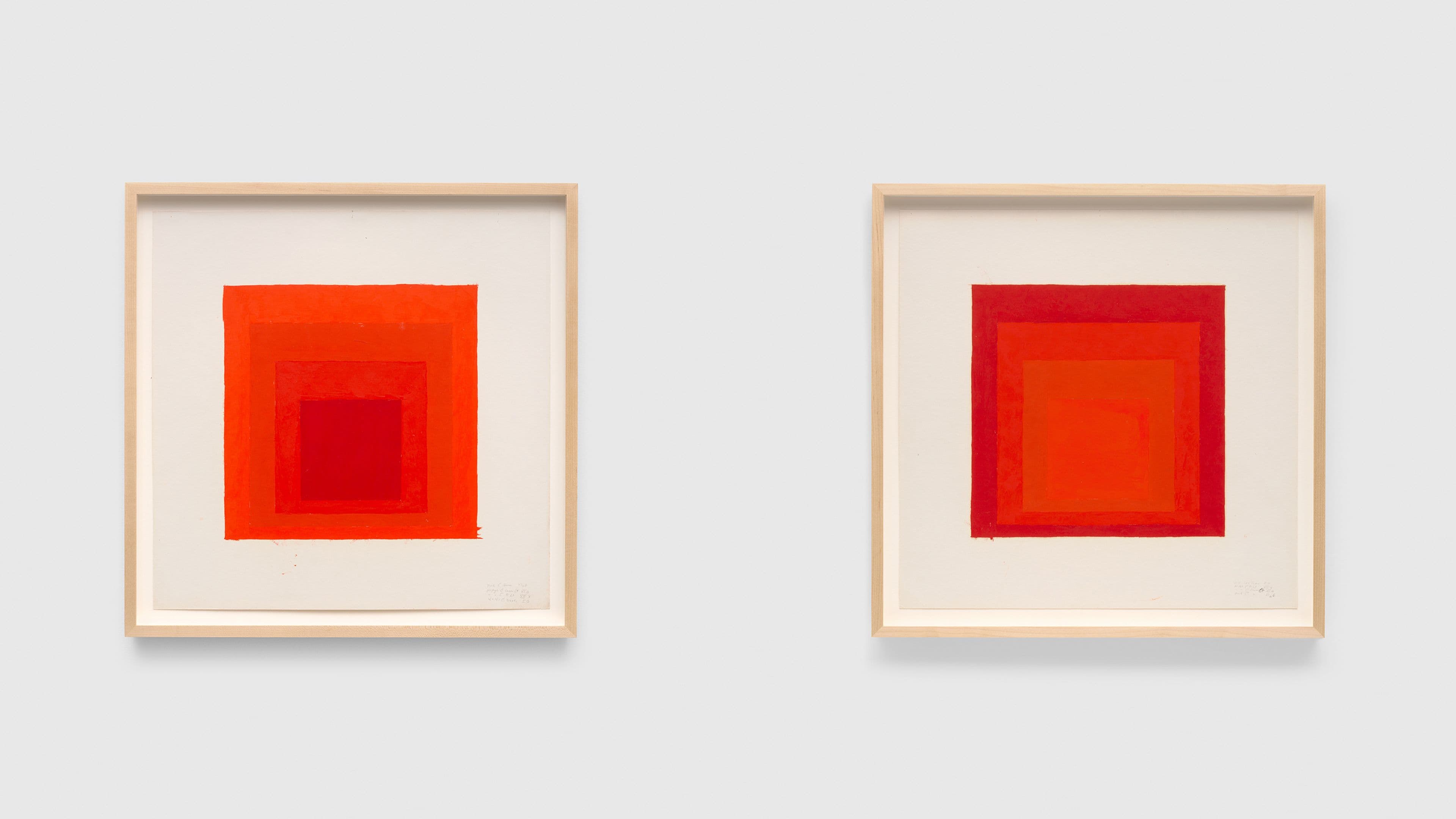
David ZwirnerDavid Zwirner is pleased to present an exhibition of paintings and works on paper by Josef Albers (1888–1976). Organized in collaboration with the Josef and Anni Albers Foundation, this exhibition is an iteration of Josef Albers: Duets, recently on view at David Zwirner Paris. Centered on a selection of paired compositions wherein two related forms are played against one another, this presentation features significant paintings and works on paper from the 1930s through the 1970s that further explore the concept of dualities, a prevailing fascination for Albers. This is the first significant show in Los Angeles devoted to the artist’s work in several decades and opens simultaneously with the solo exhibition Josef Albers: Meditations at Villa Panza, Varese, Italy (April 9, 2026–January 10, 2027). As Nicholas Fox Weber, executive director of the Josef and Anni Albers Foundation, notes: Albers delighted in pointing out that “in math and science, one plus one is two; in art, one plus one is two and also many more. ” Lifelong, he would periodically play two related forms against one another to demonstrate the multiple events, exciting and mysterious, that occur as a result of dualities. To juxtapose closely related forms enabled Albers to give you, the audience whom he cherished, a visual feast. Albers was, at heart, a magician. Pairing resemblant forms created a surcharge of visual activity. As a teacher, starting from his early days when as a young man he taught classes in a one-room school in an agricultural region of his native Westphalia, through his time as the first student to be appointed a “master” at the Bauhaus, then during his years inspiring renegades at the experimental Black Mountain College and on into his teaching at Yale University and lecturing all over North and South America and Germany, he inspired people to recognize the infinite possibilities of parallel shapes. Eventually, as an octogenarian, he loved nothing more than to guide open-eyed children to see the wonderful visual events that can occur when two disparate elements are placed side by side. Sometimes Albers would have one element be simply a reversal of the other, but usually the pairings are more complex. In all instances, the viewer becomes engaged with the wonderful experience of two (and sometimes more) variations on a single theme. It is the sort of rich diversion provided by the music of J. S. Bach, whose work was one of Albers’s lifelong passions. Duets is the first exhibition ever to focus on the powerful ways that one plus one is more than two. On view are paintings and works on paper from Albers’s groundbreaking series Homage to the Square (1950–1976), in which he experimented with endless chromatic combinations and perceptual effects set in precise formats. In the main gallery, the color yellow and its various permutations appear throughout works from this series, including in two seemingly identical paintings from 1962, both titled Study for Homage to the Square: Rare Echo and dominated by shades of golden ochre; nearby, a sunnier tint contrasts with pale gray in a larger 1961 painting and a complementary work on paper. In two medium-scale studies from c. 1970–1973, both executed on blotting paper—Albers’s preferred support for such works due to how quickly it absorbed oil paint—hues of vermillion, red, and fiery orange become especially vibrant when viewed side by side. Also exhibited are two studies for the poster Albers designed for the 1972 Olympic Games in Munich, one of twenty-eight posters by various artists published for the occasion. With a central field of blue framed by two concentric rectangular forms, the works resemble elongated versions of Albers’s Homage to the Square compositions. The alternating tones of the exterior forms further recall the artist’s mitered square compositions, a variation on his signature nested squares that adds an even greater illusion of depth through its optical play of light and dark. The exhibition additionally highlights Albers’s work in black, white, and gray. Early series by the artist are represented in part by two gouaches from the series Treble Clefs (1932–1935), which each depict the musical notation in grayscale tones. These significant works bridge the period from Albers’s departure from the Bauhaus to his arrival in the United States, and are complemented here by important black-and-white woodcuts from the same early period as well as a complete portfolio of Gray Instrumentation I (1974), comprising a suite of Homage to the Square screenprints published by Tyler Graphics in Bedford Village, New York. Additionally featured are selections from Albers’s series of Vari ant s (begun in 1947); these works are also called Adobes because of their relationship to the architecture that riveted the artist in Mexico and the American Southwest, with one of the hallmarks being the presence of two entrances, inviting the viewer to experience the same structure following two different but related routes. Albers was very aware that these alternate visual experiences were analogous to what happens in life itself when one considers or takes different paths, emotionally or physically, rather than adhering to the idea that there is only a single way to do something. Josef Albers (1888–1976) was one of the most influential abstract painters and art teachers of the twentieth century. Albers’s artistic career, which bridged European and American modernism, consisted mainly of a tightly focused investigation into the perceptual properties of color and spatial relationships. Working with simple geometric forms, Albers sought to produce the effects of chromatic interaction, in which the visual perception of a color is affected by the hues adjacent to it. Albers’s precise application of color also created plays of space and depth, as the planar colored shapes that make up most of his works appear to either recede into or protrude out of the picture plane. Albers was born in Bottrop, Germany, and studied briefly at the Königliche Bayerische Akademie der Bildenden Kunst, Munich, in 1919, before becoming a student at the Weimar Bauhaus in 1920. In 1922, Albers joined the school’s faculty, first working in stained glass and, starting in 1923, teaching design. In 1933, he and Anni Albers emigrated to North Carolina, where they founded the art department at Black Mountain College. During their time at Black Mountain, Albers began to show his work extensively within the United States, including solo exhibitions at the Addison Gallery of American Art, Andover, Massachusetts (1935); J.B. Neumann’s New Art Circle, New York (1936, 1938); The Germanic Museum at Harvard University, Cambridge, Massachusetts (1936); Katharine Kuh Gallery, Chicago (1937); San Francisco Museum of Art (1940); and the Nierendorf Gallery, New York (1941). The Alberses remained at Black Mountain until 1949 and, in 1950, moved to New Haven, Connecticut, where Josef Albers was invited to direct a newly formed department of design at the Yale University School of Art. In 1950, too, he developed what would become his seminal Homage to the Square series, which he continued to elaborate until his death in 1976. This body of work was featured in a major exhibition organized by The Museum of Modern Art, New York, in 1964 that traveled to twenty-two venues in the United States and Latin America. Albers retired from teaching in 1958, a few years prior to the publication of his important text Interaction of Color (1963), which was reissued in two volumes in 2013. Following numerous gallery and museum exhibitions, as well as his participation in Documenta I (1955) and Documenta 4 (1968), Albers became the first living artist to be the subject of a solo exhibition at The Metropolitan Museum of Art, New York, with his career-spanning retrospective there in 1971. More recent exhibitions include Painting on Paper: Josef Albers in America, which originated at the Pinakothek der Moderne, Munich (2010; traveled to Josef Albers Museum, Quadrat, Bottrop, Germany; Louisiana Museum of Modern Art, Humlebæk, Denmark; Kunstmuseum Basel; Centre Georges Pompidou, Paris; Centro de Arte Moderna, Gulbenkian Museum, Lisbon; and the Morgan Library and Museum, New York); Josef Albers: Minimal Means, Maximum Effect at the Fundación Juan March, Madrid (2014; traveled to Henie Onstad Art Centre, Høvikodden, Norway); and A Beautiful Confluence: Anni and Josef Albers and the Latin American World at Mudec, Museo delle Culture, Milan (2015–2016). From 2016 to 2017, The Museum of Modern Art, New York, presented One and One Is Four: The Bauhaus Photocollages of Josef Albers. In 2017, Josef Albers in Mexico was presented at the Solomon R. Guggenheim Museum, New York, and traveled to the Peggy Guggenheim Collection, Venice, in 2018. Anni and Josef Albers: Art and Life was on view at the Musée d'Art Moderne de Paris in 2021 and subsequently traveled to IVAM (Instituto Valenciano de Arte Moderno), Valencia, Spain, in 2022. At the Josef Albers Museum in Bottrop, Germany, Josef Albers: Homage to the Square was on view from 2022 to 2023. The artist’s first retrospective exhibition in Japan, Josef Albers: Pedagogical Experiments, was on view at the Kawamura Memorial DIC Museum of Art, Sakura, Japan, in 2023. In 2016, David Zwirner announced the exclusive representation of The Josef and Anni Albers Foundation. The same year, Josef Albers: Grey Steps, Grey Scales , Grey Ladders was presented at the gallery’s New York location. The artist has since been the subject of numerous solo exhibitions at David Zwirner, including Josef Albers: Sunny Side Up (London, 2017); Josef Albers: Sonic Albers (New York, 2019); Josef Albers: Primary Colors (Hong Kong, 2022); and Josef Albers: Paintings Titled Variants (London, 2023). Work by the artist has also been featured in several group and two-person exhibitions presented by the gallery, including Albers and Morandi : Never Finished (New York, 2021); Black Mountain College: The Experimenters (London, 2023); and Affinities: Anni Albers, Josef Albers, Paul Klee (New York, 2025).