
West, London
Su Yu-Xin
Precious
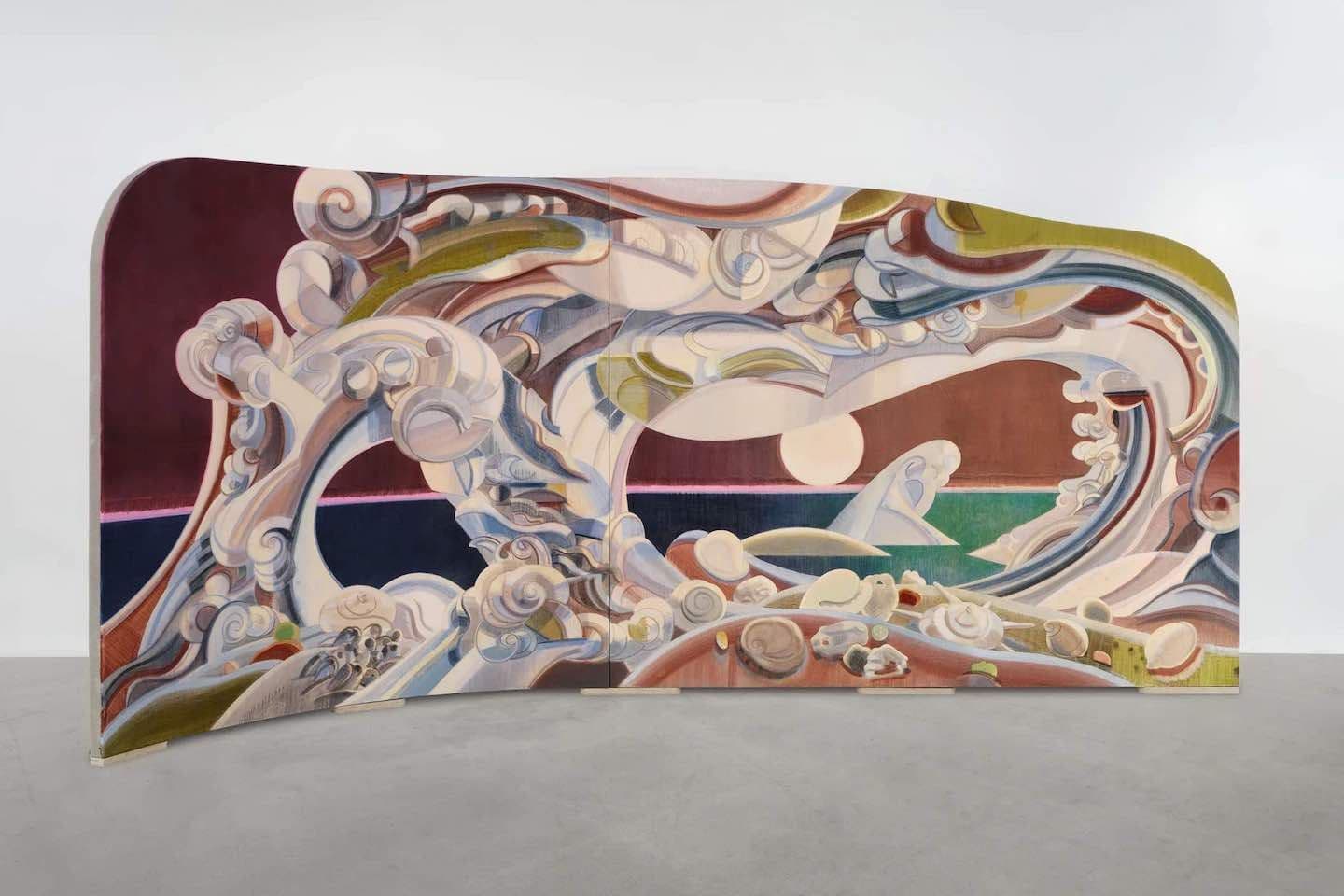
Albion JeuneAlbion Jeune is pleased to present Precious, Los Angeles-based artist Su Yu-Xin’s first solo exhibition in the U.K. The exhibition consists of a series of dynamic paintings that examine the history of migration and the vicissitude of pigments through a geological perspective. Portraying sea caves, shells, and natural objects found along the California coastline, this new body of work invites us to consider the value attribution of material objects. Employing a unique material language, in which she collects, extracts, and transforms organic and man-made colour substances into paint, the artist interrogates the politics of pigment: the pulverization of exploitative ecological and imperial histories into colour. Through materiality and subject matter, the works seen in Precious act as portals between Los Angeles and Taiwan, levying the artist’s personal journey and the cross-cultural dialogue of her own diasporic identity and experience. Born in Hualien, Taiwan, the artist has an academic background in the traditional techniques such as the ‘boneless’ method of Chinese painting and nihonga, or “Japanese-style painting” that binds pigments derived from natural ingredients such as minerals, shells, or semi-precious stones with glue made from animal hide. The artist processes these pigments from collected natural materials, which she applies to the surface in layered washes to construct nebulous, multi-perspective horizons. For the artist, colours are no longer mere visual signifiers but embodiments of their complex identities and origins. Su sources materials from various locales, deepening the relationships between subjects by often depicting the California coastline with materials sourced in the land itself. Throughout Precious, the artist uses ground cowrie shells to create a spectrum of white hues across her paintings, while also evoking the forgotten history of trade and the invisible workforce. Originating in the oceans surrounding the Maldives islands, cowrie shells or Cypraea moneta, were transported to various parts of Asia as precious goods in the prehistoric era. Later, this small marine product was used as a currency in the slave trade from the sixteenth century onward and eventually became a form of currency in several ancient Chinese provinces[1]. Su is interested in the prevalence of these natural objects and how humans ascribe value to items based on their geographic location and scarcity, underpinning notions of invisible infrastructure through commodity trade. Along with shells, sea caves are the central subject of this exhibition. Commonly found along the northern Los Angeles coastline, these architectural wonders are subjects of immense fascination for the artist for their geological formation from wind and sea erosion into cavernous grottos. In Bone Caves, Su presents a panoramic view of a double sea cave, immersing us within the tunnel, as though the painting is transforming into the subject itself. The canvas is physically curved and monumentally proportioned, echoing the organic forms of sea cave walls, while also paying reference to the traditional horizontal perspective of Chinese scroll paintings. On the right, the setting sun commands our attention, while the violet night sky unfolds simultaneously, evoking a sense of ancientness and capturing the ephemeral transition to dusk. The pigments bring their physical presence into the painting, becoming as much a protagonist as the landscape. For instance, the green sea is comprised of oxidised copper, pointing to California’s mining history, while the white pigment found in the moon and the sea cave is obtained from bleached coral, evoking our environmental loss and the circularity of materials. The paintings in Precious are rhizomatic, with each painting leading to the next in a continuous process of experimentation. Monumental works allow an immersive perspective, while more intimate paintings, or ‘colour swatches’ serve as sites of experimentation, enabling the artist to test new colour combinations, motifs, or ways of layering paint. In A Chase for Treasure, a concave map of the Pacific Ocean along the Equator, the artist applies swatches of whites, using materials such as diamond dust and silver alongside colours derived from shells and minerals. As in her inclusion of the cowrie shells and copper pigments, the use of diamonds links the paintings back to Su’s study of commodities and value in the capitalist system, reminding us that the value of these gemstones will change with the ebb and flow of the forming of both anthropic and planetary history. The recurrence of these small, organic objects has a heartfelt quality. The title of the exhibition, Precious, evokes all of the associations seen within the paintings: hunting for treasure, memories of childhood, and beachcombing. By repeating the motif, Su asks us where we find meaning and why. Her dreamlike paintings present a natural world which acknowledges the harshness of economic and political realities. Yet, the most precious things in her works are free. Su Yu-Xin (b. 1991, Hualien) considers painting as a place where multiple disciplines and various perceptual capacities intersect. Painters have always played a vital role in the visual art industry, and the medium of painting reflects the discovery and re-invention of the material world. Hence, paintings bear witness to the history of the exchange between cultures and nature and project the painter’s role through wars and migrations; they manifest territorial invasions and restitutions, and the exploitation of pigments and their trades. Su collects, studies, and processes these colour substances scattered on the earth’s crust and invents a new order on the painting surface through drawing, compression, and accumulation. For her, such landscape painting is a geological practice of rearranging plants, minerals, organic and synthetic matters. As a result of these pigments, her landscapes achieve a connection to the land that extends beyond the visual into material. 1 - Bin Yang, "Cowrie Shells and Cowrie Money: A Global History" (New York: Routledge, 2018), 9.