
Belleville, Paris
Pauline Bastard
Bonne Journée
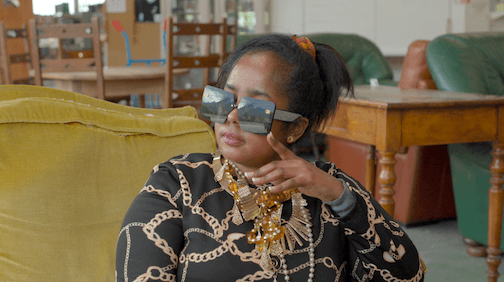
,48 m²[Scroll down for French version / Veuillez trouver ci-dessous la version française] The exhibition is based on a workshop held over 4 years in a work integration centre. There are objects and a film entitled Bonne Journée : In a warehouse, people sort and repair donated objects in order to resell them. Little by little, they collect video material and begin to stage the objects for advertising, producing still and moving images. They become models for clothing and furniture pictures. The film was shot in the shop and warehouse of the Emmaus community in Grenoble. It tells the story of a photographic and filmic practice that developed alongside the activity of repairing objects. In this economy where everything counts, film has been incorporated into the revaluation system and, in its own way, is re-enacting the re-marketing of objects. In the midst of the flow of things and continuous work, the film also represents a pause, extracting objects from the mass, recording them, watching them for what they are, what they contain. People who are also passing through the store pose, becoming the photographers and actors in a series of portraits. It's a moment away from the action, from which we observe the shop, a parenthesis, where the characters rest, observe and replay the work, certain objects catch their attention, and we linger to contemplate them. The workshop constituted a separate moment in the place and time of the usual work. The film is a parallel space where we interpreted this crucial work of sorting and managing the overflow of things, using the objects that passed by as a narrative framework, such as uniforms, a camera, illuminated frames or oversized garments... The photographic and filmic techniques of object marketing are reproduced here with the means at hand. What we're seeing is a replay of second-hand merchandising, in which these objects are presented in an attempt to give them a new life, but we can tell that they have a different status because of the way they've lived and the way they've been around for so long. An extra soul that is not the added value. We look at commerce, its systems and the end of its course, along with something new. Marketing, applied to what consumer society has left behind, is freed from the real issues of commerce, and reveals a gentleness, a meticulous care given to these objects, a concentration, a creativity, an invention to manage this titanic flow and the people who carry out this endless work with extreme patience. The film is accompanied by posters and a catalogue produced during the workshops. Other pieces produced over the years using materials salvaged during filming are also on display. Born in 1982, Pauline Bastard studied at the Beaux-Arts de Paris, Sorbonne and New York Universities. Her practice is built around various social structures, which she questions by reproducing them in collective experiences. Being a person, being part of a family, working together, gathering around grand narratives: these re-enacted situations produce images, films and objects. Her work can be found in several public collections. She has been teaching since 2007 (Sorbonne, ESAAA, ENSBA). ***** L’exposition se déploie autour d’un atelier mené pendant 4 ans dans une structure d’insertion par l’emploi. Il y a des objets et un film Bonne Journée : Dans un entrepôt, des personnes trient et remettent en état des objets issus de dons pour les revendre. Petit à petit, ils et elles récupèrent du matériel vidéo et commencent à mettre en scène les objets pour faire des publicités, ils produisent des images fixes et animées. Ils et elles deviennent les modèles pour les photographies des vêtements et des meubles. Le film s’est tourné dans le magasin et l’entrepôt de la communauté Emmaüs de Grenoble. Il raconte et met en scène une pratique photographique et filmique qui s’est développée en parallèle de l’activité de remise en état des objets. Dans cette économie où tout compte, le film s’est greffé au système de revalorisation et il rejoue, à sa façon, la remarchandisation des objets. Au milieu du flux des choses et du travail continuel, le film représente aussi une pause, il extrait les objets de la masse, les enregistre, on les regarde pour ce qu’ils sont, ce qu’ils contiennent. Les personnes, de passage également dans cette structure, y prennent la pose, ils deviennent les photographes et les acteurs d’une série de portraits. C’est un temps en retrait de l’action, d’où l’on observe le magasin, une parenthèse, les personnages s’y reposent, observent et rejouent le travail, certains objets retiennent leur attention, on s’attarde à les contempler. L’atelier a constitué un moment à part sur le lieu et dans le temps du travail habituel. Le film est un espace parallèle où nous avons interprété ce travail crucial de tri et de gestion du trop-plein des choses en utilisant les objets qui passaient comme une trame narrative : des uniformes, un appareil photo, des cadres lumineux, des vêtements géants... Les techniques photographiques et filmiques du marketing d’objet sont ici reproduites avec les moyens du bord. Il se rejoue un merchandising de seconde main qui présente ces objets pour tenter de leur donner une nouvelle chance, mais dont on voit qu’ils ont un statut différent de par leur vécu et leur ancienne. Un supplément d’âme qui n’est pas la valeur ajoutée. On observe le commerce, ses systèmes et la fin de sa course et une nouvelle chose apparaît. Le marketing, appliqué à ce que la société de consommation a laissé, est libéré des enjeux réels du commerce, il laisse voir une douceur, un soin méticuleux porté à ces objets, une concentration, une créativité, une invention pour gérer ce flux titanesque et les personnes qui effectuent dans une patience extrême ce travail sans fin. Le film est accompagné des enseignes et du catalogue produit pendant les ateliers. D’autres pièces produites au cours de ces années avec des matériaux récupérés en marge des tournages sont aussi présentées. Née en 1982, Pauline Bastard a étudié aux Beaux-Arts de Paris, à la Sorbonne et à New York University. Sa pratique se construit autour de différentes structurations sociales qu’elle interroge en les reproduisant dans des expériences collectives. Être une personne, faire partie d’une famille, travailler ensemble, se rassembler autour de grands récits : ces situations rejouées produisent des images, des films et des objets. L’artiste crée ainsi des univers où la fiction et la réalité sont étroitement mêlées. Son travail fait partie de plusieurs collections publiques. Elle poursuit une activité d’enseignement depuis 2007 (Sorbonne, ESAAA, ENSBA).