
Kreuzberg, Berlin
Anna Bella Geiger
Typus Terra Incognita
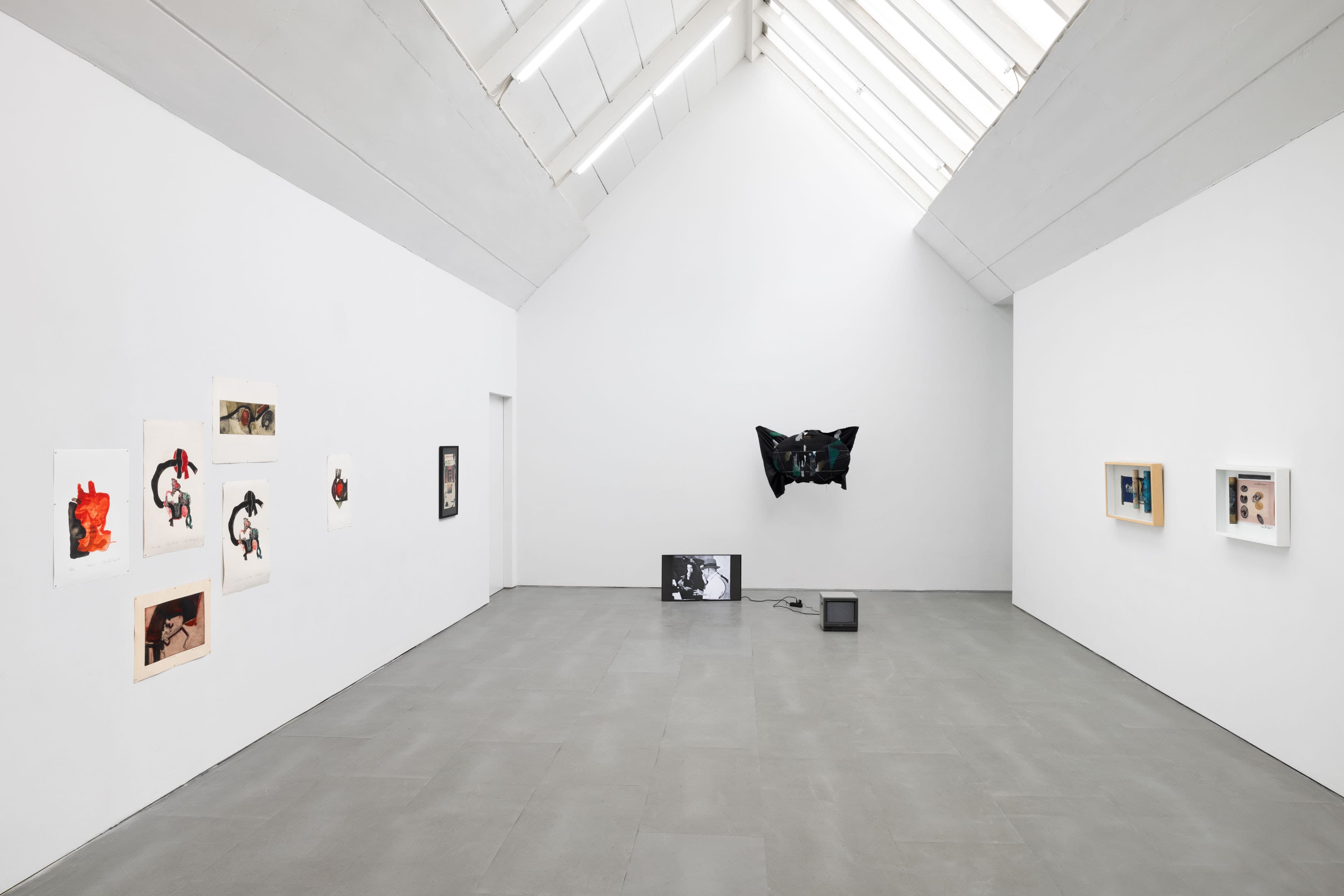
Carlier GebauerCarlier Gebauer, Berlin, is pleased to present Typus Terra Incognita, Anna Bella Geiger's first solo exhibition in Germany. This show spans more than 50 years of Geiger's artistic production, bringing together seminal historical works as well as recent ones. Born in 1933 in Rio de Janeiro, Geiger remains since the beginning of her career and until the present day as one of Brazil's pioneering artists. She studied drawing and painting with Fayga Ostrower, whose teachings and works—expressions of her "respect for art as the eternal language of humanity"—were influential for a generation of Brazilian artists. Turning early on to abstraction in her work, in 1954 Geiger was already invited to participate in the First National Exhibition of Abstract Art. Geiger does not confine herself to the medium of painting, she continues to push her practice to draw from technical innovations as well as systems alien to art. Her oeuvre spans video, painting, drawing, engraving, textile, embroidery, collage, photography and installation. However, as Estrella de Diego, the Spanish art critic and curator, notes, Geiger does not abandon any of her media, she rather alternates from one to another. Even to the first drawing and etching, Geiger returns during what she calls her visceral phase. The medium she employs is merely a tool to explore the political dimensions of the world, as well as her interest in anthropology and geography. The map emerges as a sort of leitmotif in the practice, sometimes making appearances as neat miniatures, sometimes as deconstructed and distorted fragments. With this alteration Geiger precisely opens up the space, by transforming representations of space, to question cartography as a transparent, verified knowledge. To map is to name, thus expressing a mode of knowledge production full of hegemonic implications. Historically the domain of the man, the explorer cum colonizer, map-making and the map itself seek to inscribe themselves upon a heterogeneous reality, establishing one perspective dominant over others. Mapping implies also omission and erasure. Geiger counters these with her intuitive, poetic approach, a form of "geopoetics". Her maps become expressive containers, relinquishing the quest for objectivity and omnipotence, in favor of a subversive, situated and even personal knowledge. Rather than representations these maps can be described as translations, which challenge the notions of control and command representation carries with it. In the series Scrolls (Rollos), and Little Scrolls (Rollinhos), created in the 1990s, Geiger continues what can be essentially described as an epistemological approach and analysis. These sculptures, which simultaneously function as graphic objects, resemble the oldest forms of knowledge preservation and transfer, the scroll. In The Book of Ester we encounter another form of knowledge organization, indexation and classification, as the scroll is made up by pages from an antique encyclopedia. Ambitiously aimed at a total reconstruction of knowledge on particular subjects as sciences, arts, and occasionally all human knowledge, encyclopedias can be viewed as maps of knowledge. Geiger deconstructs these by making the pages unreadable, only leaving visible certain elements, such as the syllables "ester". The knowledge contained in the encyclopedia becomes therefore fractured, and almost as with automatic writing, another meaning emerges as from the subconscious of the text. Further, these scrolls are not presented fully unrolled, rather they show that they also hide. The transparency of knowledge is once more revealed as ephemeral in itself. Instead of rejecting this, Geiger fully embraces these uncertainties as a method in her ever-changing, innovative life's work. Anna Bella Geiger (b. 1933, Rio de Janeiro) lives and works in Rio de Janeiro. Selected solo exhibitions include Museu Judaico (MUC), São Paulo, Brazil (2025); Museu de Arte Contemporânea da Universidade de São Paulo (MAC-USP), São Paulo, Brazil (2024); Franz Gaks Museum, Haarlem, The Netherlands (2022); Mori Art Museum, Tokyo, Japan (2022); S.M.A.K., Ghent, Belgium (2021); Museu de Arte Moderna, Río de Janeiro, Brazil (2019); MASP, São Paulo, Brazil (2019); Zachęta, National Gallery of Art, Warsaw, Poland (2018); La Casa Encendida, Madrid, Spain (2017); Centro Andaluz de Arte Contemporáneo, Sevilla, Spain (2016); Museu de Arte Contemporânea (MAC), Niterói, Brazil (2012); Instituto Tomie Ohtake, São Paulo, Brazil (2004); Museum of Modern Art, New York, USA (1978); Museu de Arte Moderna (MAM), and Río de Janeiro, Brazil (1975). Selected group exhibitions include Paço Imperial, Rio de Janeiro, Brazil (upcoming 2026); Centro Cultural Banco do Brasil, São Paulo, Brazil (2026); Projeto Maravilha, Rio de Janeiro, Brazil (2026); Museo de Arte Latinoamericano de Buenos Aires, Buenos Aires, Argentina (2025); Kunstverein Bielefeld, Germany, (2024); MUDAM, Luxembourg City, Luxembourg (2024); Museum of Modern Art, New York, USA (2023); 1st Amazon Biennial, Belém, Brazil (2023); Palazzo Bollani, Venice, Italy (2022); 16th Istanbul Biennial, Istanbul, Turkey (2019); Brooklyn Museum, New York, USA (2018); Tate Modern, London, UK (2018); Hammer Museum, Los Angeles, USA (2017); Fundação Iberê Camargo, Porto Alegre, Brazil (2015); The Modern Institute, Glasgow, Scotland, UK (2015); Foundation Cartier, Paris, France (2013); Zentrum für Kunst und Medien (ZKM), Karlsruhe, Germany (2012); Centre Pompidou, Paris, France (2012); MACBA, Barcelona, Spain (2009); Museo Centro de Arte Reina Sofía, Madrid, Spain (2006); and Museum of Contemporary Art Beijing, Bejing, China (2000).