
West, London
Habuba Farah
Vibrations
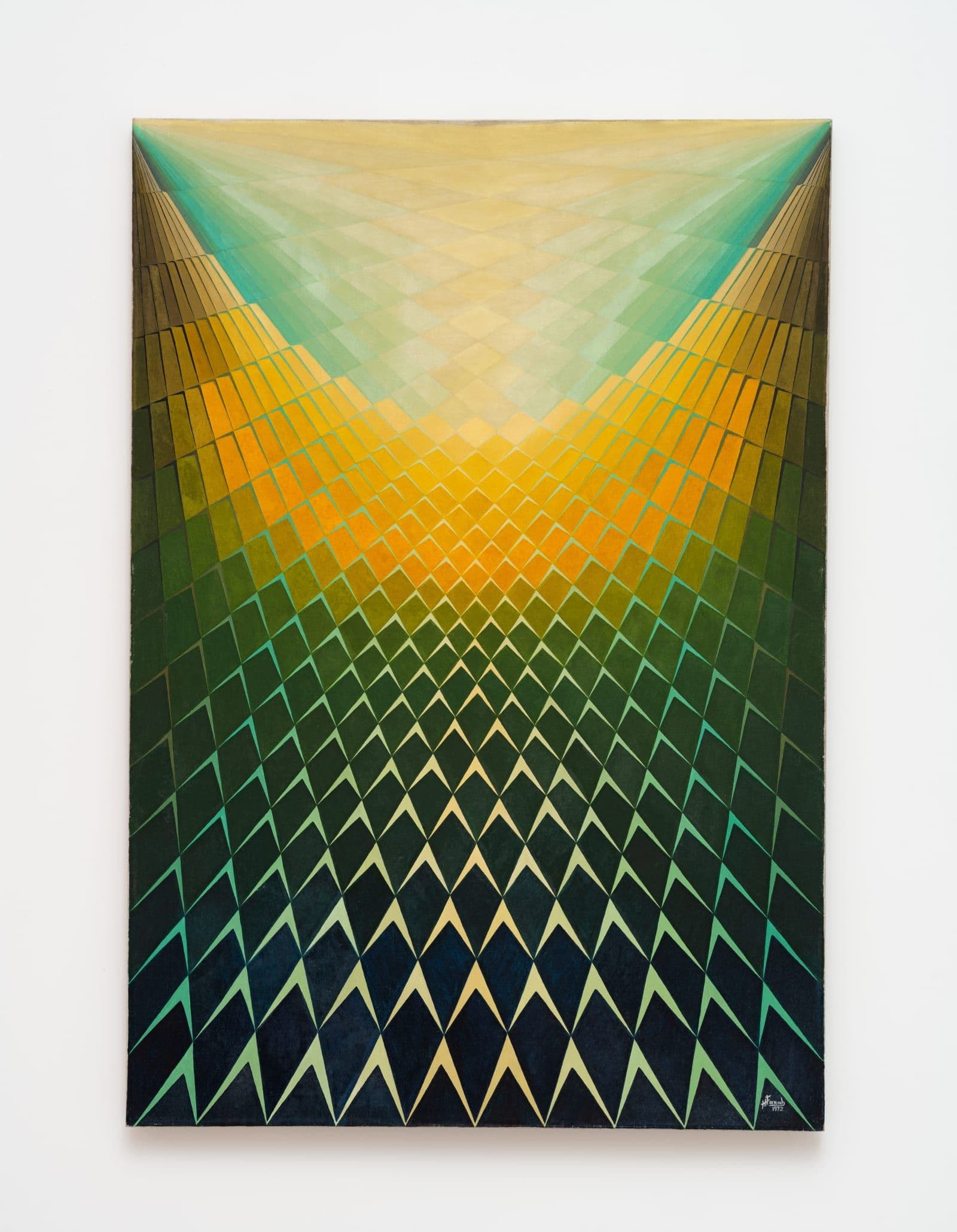
Jeremy ScholarI never wasted time! I always had my desk filled with materials, and I wouldn’t let anyone clean it. These words were spoken by the abstract artist Habuba Farah (b. 1931). Born to Lebanese parents who had emigrated to Brazil, Farah was drawn to art from a young age. At five she was scribbling and drawing with the same passion and commitment that still moves her today. With a consistent focus on colour Farah has ‘never wasted time.’ Like many women artists of her generation her domain was circumscribed to a desk. No studio, just a desk of her own, which explains why she was so adamant for it not to be touched by anyone. The nature of her practice required a great dose of concentration, experimentation and precision – traits that arguably underpin her pictorial oeuvre with a scientific approach. Colour formed the basis of her geometrical compositions, as well as being a subject of study for Farah who between 1958 and 1961 wrote a treaty titled Neutros da teoria da cor (Neutrals of Colour Theory) based on the book On the Law of Simultaneous Contrast of Colours published in 1839 by Michel Eugène Chevreul (1786-1889). Farah’s analysis of colour and how it behaves is exacting and lyrical. Her astute technical observations are accompanied by illustrations of her own making. She tests her own theories with scientific accuracy. The same method is applied to all of her work, be it painting, drawing or more recently collage and cut-out. ‘Harmony is the exact relationship between two or more colours – their combination,’ Farah says. This pursuit of a lyrical chromatic spectrum akin to a musical symphony characterises her work and led to its description as ‘lyrical geometric abstraction’ by Brazilian art critic and physicist Mario Schenberg in 1971. By then Farah was exhibiting regularly – mostly in Brazil – and her work was well-received by fellow artists and critics. However, its emphasis on vibration of colour made it hard to align Farah’s practice with dominating Brazilian artistic currents of the time, like the Neo-Concrete movement. Farah’s sensibility was closer to the school of ‘kinetic art’ emerging in Europe and the United States in the 1960s. Victor Vasarely who was associated with this aesthetic of flicker form took an interest in Farah’s work when he came across it in the early 1970s; conceivably the intense optical sensation produced by Farah’s compositions appealed to him. While points of contact may exist between Farah and kineticism it would be deceiving to think of her just in those terms. The mosaic of coloured spectrum that she creates is set in motion by straight, orthogonal, or diagonal lines. ‘I play with geometry as if it were a toy made of various pieces. I throw its lines where I want,’ Farah says pointing to the playful element in her work. And carries on by explaining that ‘Because my geometry is not rigorous, it is not faithful. It’s free, ludic, it fluctuates.’ It is the oscillation between playfulness and a methodical and controlled study of colour that truly defines Farah’s work. The varying depths of colour painstakingly achieved through concentrated study and execution create the illusion of three-dimensional form by swelling some areas and shrinking others. To impart vibration to a colour, Farah tunes it so that it ‘gradually darkens or lightens, resembling a symphony.’ Colour is imbued with lyricism, and it controls form so as to create a ‘warmth of expression,’ lending feeling to rigorous geometry. —Dr. Flavia Frigeri