
Hannam, Seoul
Mark Bradford
Keep Walking
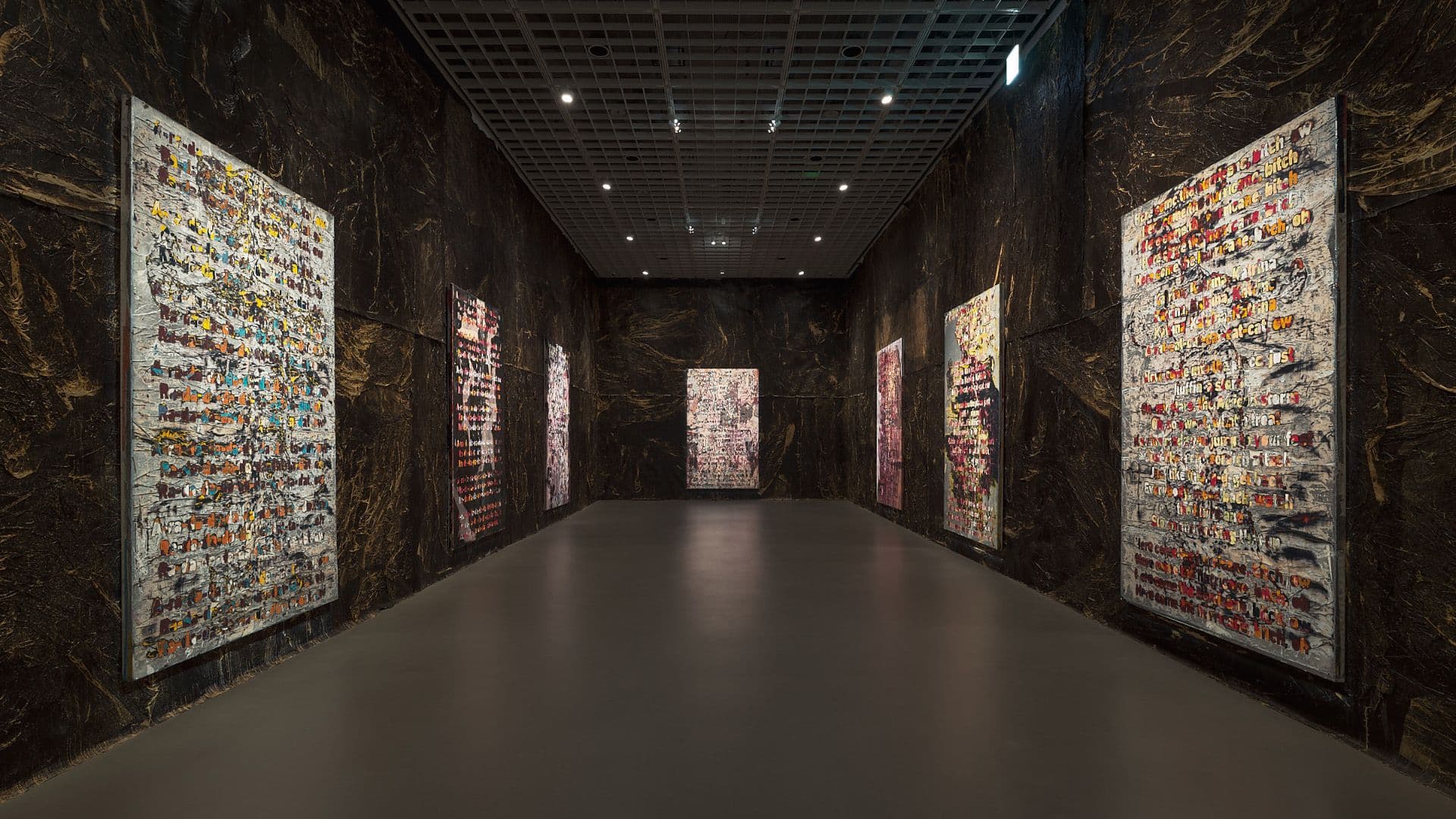
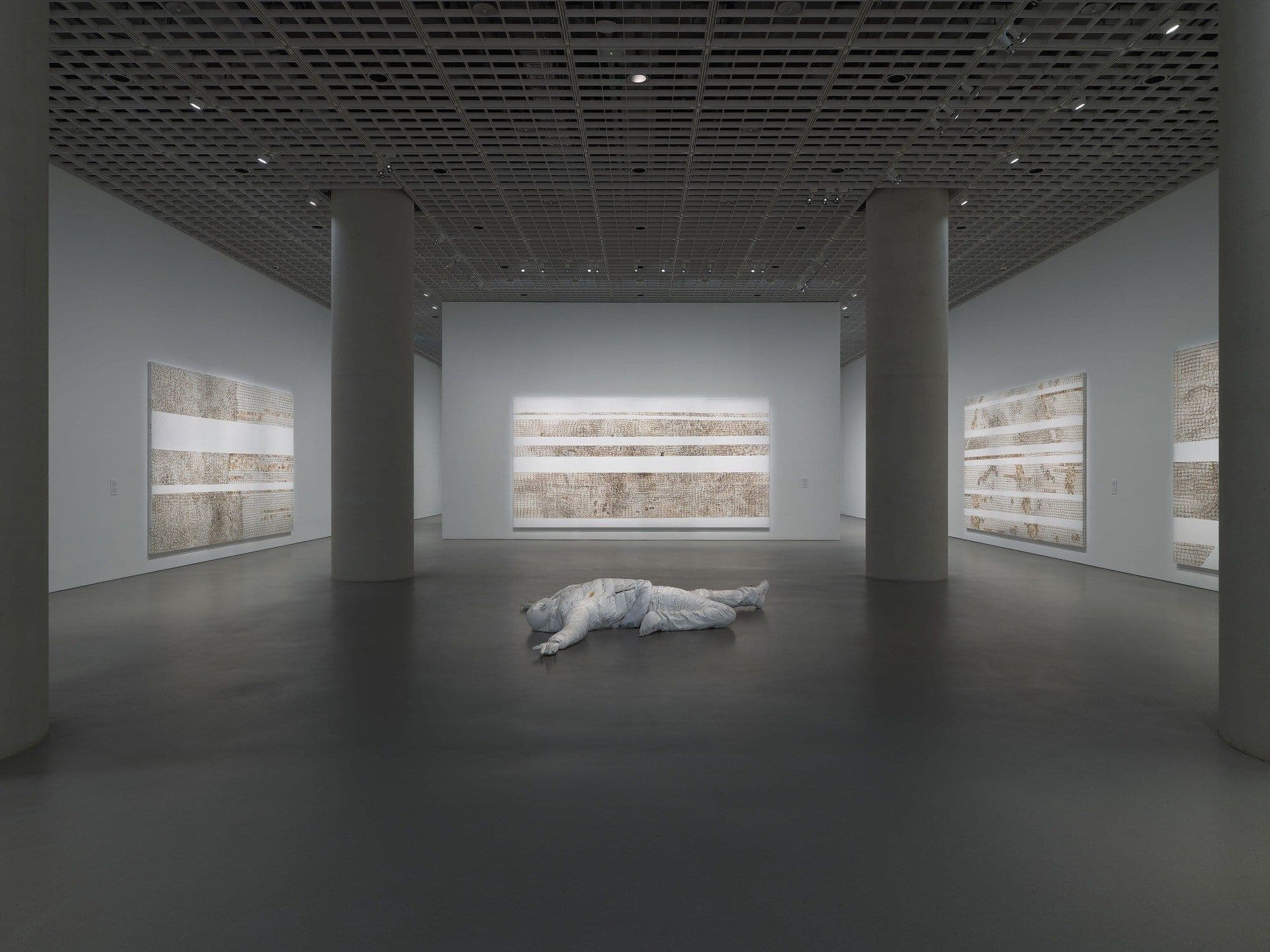
Amorepacific Museum of ArtIn Bradford’s practice, this engagement with the pictorial surface of the work finds early expression in the End Papers series, where painting becomes a site of memory, identity, and structural critique. This series, Bradford’s earliest body of work, takes its name from the thin tissue paper used in hair salons during the process of creating permanent waves—materials Bradford encountered and frequently used while working in his mother’s beauty shop. The hair salon, a space of Black female care and labor, informed Bradford’s understanding of how personal and political narratives can be embedded in material. These tissue papers were collaged by hand onto the canvas in row after row to form dense grids that were often supplemented with hair dyes and pigments. To give more concrete structural form to the overall composition, the edges of each translucent sheet were carefully burnished with matchsticks—later with a small blowtorch—to define the edges. The results were compositions that hover between material intimacy that hold personal resonance and formal precision. Indeed, the emergence of the grids as the key element of early works was a statement that placed Bradford in an immediate dialogue with the modernist lineage of abstraction. The motif of grids—the intersection of horizontals and verticals used as a primary compositional aid—became a subject of inquiry in its own right by the mid-twentieth century. As art-historical theories fashioned the grids as one of the central tenets of modernism, it is worth noting that to artists including Piet Mondrian, Kazimir Malevich, Ad Reinhardt, Robert Ryman, Frank Stella, and Agnes Martin—each of whom stood at the very forefront of this endeavor towards greater abstraction and very much well-admired by Bradford—it was the point of arrival, reached after years of paring back compositional elements. What is striking about Bradford’s approach is that he takes the grid not as an endpoint, but as a point of departure. Though his visual language is often considered to continue the legacy of American Abstract Expressionists from the 1950s, championed by Jackson Pollock and Willem de Kooning, in their use of all-over composition and the gestural mark-making, he also found affinity with artists like Asger Jorn and other European artists who integrated social content into the pictorial field. It was this very medium specificity that he was so interested in and its potential to evoke the context beyond the pictorial plane to situate it in a wider web of references. Bradford, therefore, was able to introduce the contextual elements—first from his own autobiography and next from his local community—into the works through the very medium of end papers themselves. The paper, fragile yet persistent, carries an imprint of a specific community while connecting to a broader art-historical discourse. Blue (2005) is an iconic example of Bradford's early work that demonstrates the artist's interest in further pushing the motif towards a cartographic register. Belonging to the Proto-Map series, the painting features a stencil of a map in vibrant blue laid atop a substrate of layered end papers. Fragments of newsprints are collaged on the top part of the map charting the city blocks in grey. This introduction of cartography anticipates his later engagements with mapping, zoning, and spatial politics, where the grid becomes a visual language for exploring histories embedded in the streets, mobility, and structural inequality. Blue also signals his evolving understanding of abstraction as a porous form—one that can accommodate the contradictory registers of personal history and systemic critique. In its vibrant overlay and recessed textures, the work enacts a spatial metaphor where the physical location and its locational engagement with the surrounding work becomes important. Through this reimagining, Bradford charted a distinct path within the history of abstraction, defined as much by his material processes as by the philosophical commitments they enact. By transforming the grid from a symbol of formal purity into a site of contestation, rupture, and reclamation—and resisting the myth of modernist neutrality—he asserts that abstraction, too, is a terrain of struggle and survival, teeming with life, history, and socio-political implication.