
Tribeca, New York
Feliciano Centurión
Sol Naciente
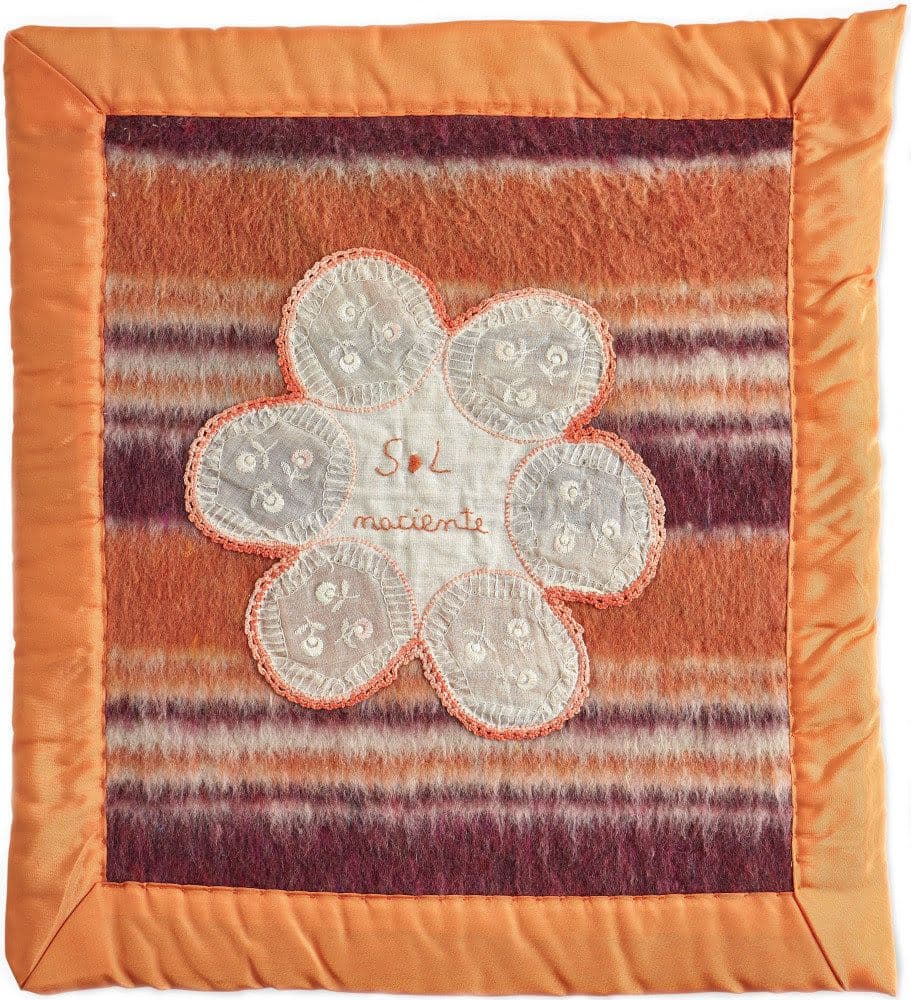
OrtuzarOrtuzar is pleased to present Feliciano Centurion: Sol naciente, a solo exhibition exploring the work of Paraguayan artist Feliciano Centurion (1962-1996), which takes its title, meaning "rising sun," from a textile work on display. In a short but prolific career, Centurion emerges as a significant figure in Buenos Aires's cultural scene in the 1990s, mingling regional folk arts with queer aesthetics and humor. Centurion summarizes his practice in a letter to a friend: "I embrace ... the banal, the ironic, the playful, happiness, and amusement. Images from dreams, from the everyday, obvious, with a taste of kitsch, all of which confirm to me that painting is simply an act of faith." By employing historically feminine crafts and incorporating found kitsch elements, Centurion challenges traditional gender norms and celebrates self-expression. Ortuzar's first exhibition with the artist's estate features Centurion's frazadas, readymade blankets with embroidered, painted or collaged elements, including ñanduti, an Indigenous Paraguayan lace technique; early erotic drawings; and sculptures from his "Familia" series, in which he clothed toy animals in handmade outfits; all executed in the brief period between 1988 and 1994. Born in San Ignacio, Paraguay, and raised in a matriarchal household, Centurion's use of craft is inspired by his mother and grandmother, who taught and encouraged him to knit, sew and crochet. After enduring a series of catastrophic floods in Alberdi and fearing the actions of Paraguayan dictator Alfredo Stroessner in the early 1970s, Centurion's family relocated to Argentina, where he remains for the rest of his life. By 1980 Centurion settled in Buenos Aires, joining the city's bohemian scene and the burgeoning LGBT liberation movement of post-totalitarian Argentina. He also becomes involved with the Centro Cultural Ricardo Rojas (El Rojas), a cultural hub established in 1984 that becomes a pivotal platform for his artistic exploration and hosts over thirty exhibitions of Centurion's work during his lifetime. Centurion repurposes household items, toys and other mundane objects purchased from local markets into his work. In his frazadas, Centurion treats cheap, patterned blankets as canvases, using embroidery, applique, lace, painting and collage to create playful yet profound scenes. Several untitled textile works feature traditional ñanduti, a lace-making technique originating from Guariani culture that translates to "spider web." A craft passed down through his family, the humble materials become radiant suns, evoking the generational passage of time. Through their relationship to the body and touch, Centurion's frazadas--many originally used as moving blankets--are metaphors for the refuge the artist sought throughout his life as an immigrant and a queer man. In other works, the artist incorporates toy animals, plating a fake herring on a painted dish or making a small plastic crocodile lie along a depicted river bank. His "Familia" series comprises a family of plastic toy animals eccentrically dressed in hand-knit and crocheted outfits. These material choices imbue Centurion's art with humor, a childlike joie de vivre and sense of play, expressing the pleasure and fantasy possible in our everyday lives. Centurion's textiles are rich with personal and cultural narratives, adorned with diaristic texts, coded patterns and mystical symbols rooted in South American traditions. Often Centurion enhances or modifies the blankets' existing designs: overpainting animal motifs, adding in foliage to create an environment, or blanking out areas with paint to emphasize individual elements. Appropriation becomes a breakthrough strategy for the artist: "... to work on a support that was anything but neutral, with edges, with an identity all its own, something other than a canvas on a stretcher, something with its own presence." His transformation of these kitsch commodities elevates an otherwise humble medium into banners bearing powerful cultural symbols. The tiger, for example, is often associated with power and ferocity in Latin American political and literary contexts, while the crocodile represents fertility in Aztec cosmologies. By reinscribing these figures through feminized crafts, Centurion subverted their traditional meanings, queering both the objects and their symbolic associations. Following his HIV diagnosis in 1992, during a period of limited medical treatments, Centurion began to incorporate references to his illness in his work. The frazadas, now more intimate in scale, became a space for self-expression, where Centurion could explore and assert his identity, mortality and resilience. The seemingly cheerful embroideries began to carry more weighted meditations: his phrasings--like Que en nuestras almas no entre el terror(May terror not enter our souls)--function both as personal mantras and political protests. Through these works, Centurion invites viewers to find the meaning in the everyday, transforming his pain into a nuanced celebration of the complexity of both life and death.