
Tiergarten, Berlin
Lotus L. Kang
Borne
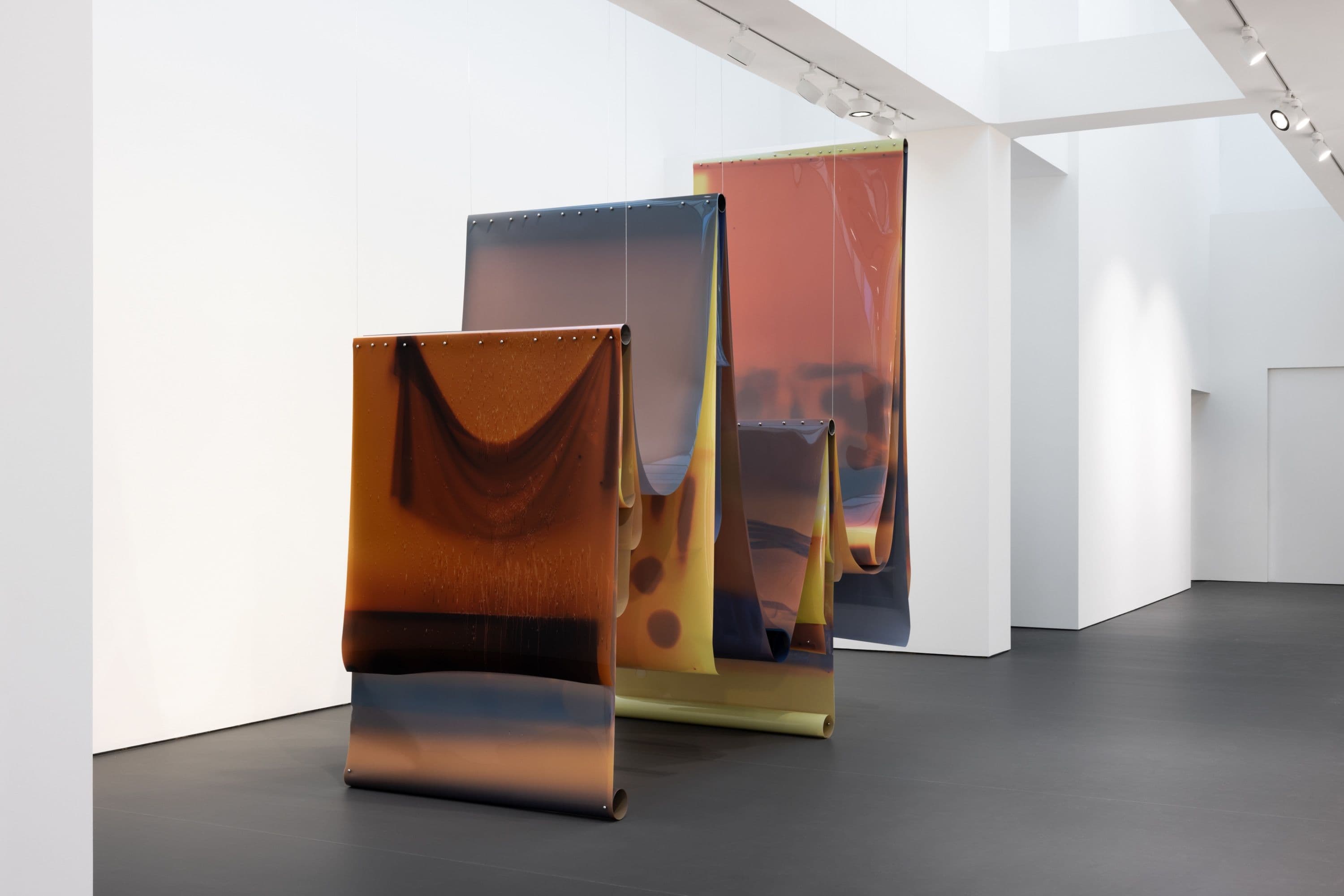
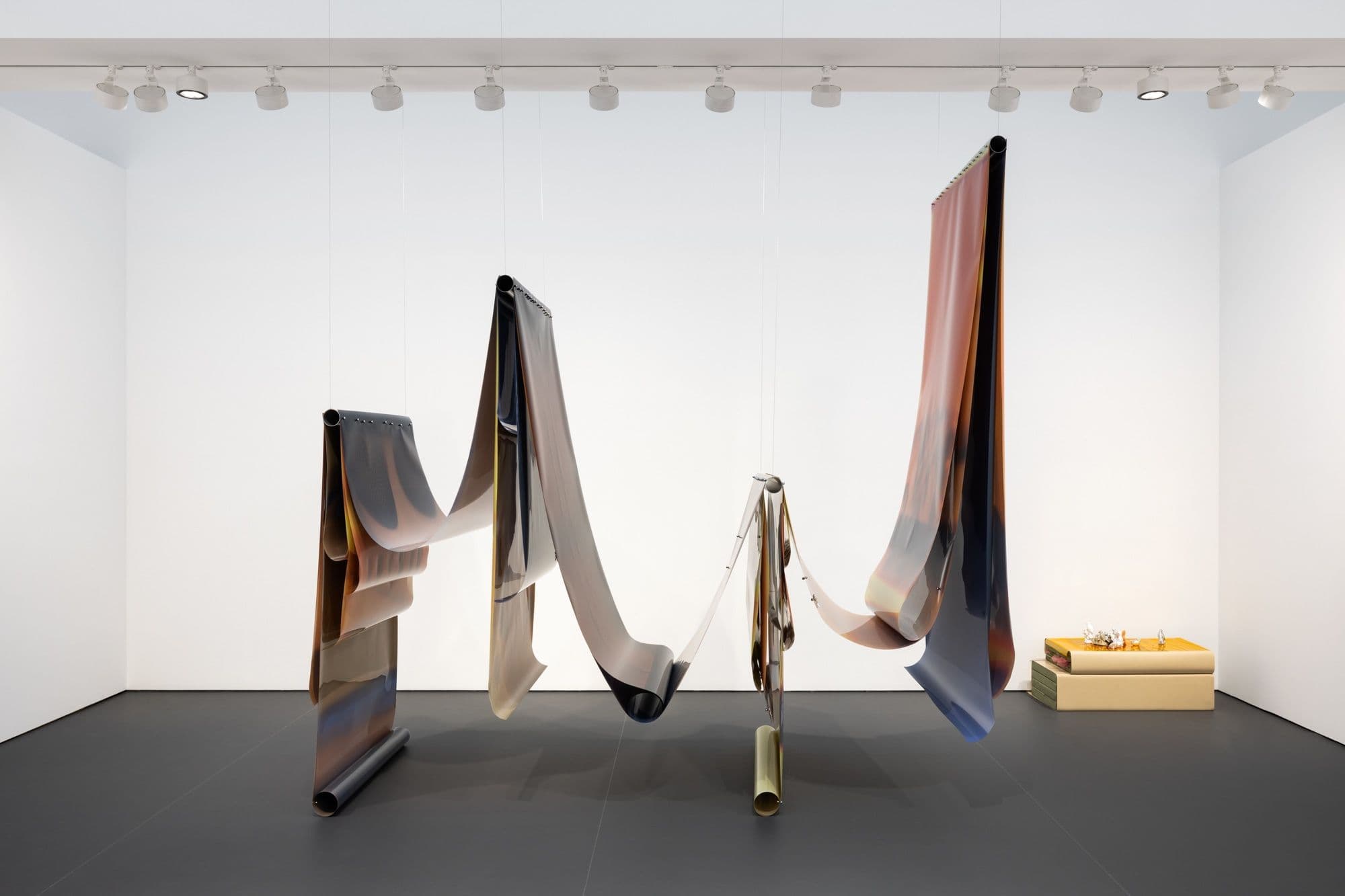
Esther SchipperEsther Schipper is pleased to present Borne, Lotus L. Kang’s first solo presentation with the gallery. On view is a large-scale Molt work from her series of photographic sculptures, and a floor-bound sculpture from the series Receiver Transmitter. Conceived especially for this presentation, Kang's work expands across the exhibition space, inviting visitors into intimate proximity with the installation. Lengths of unfixed industrial film— “skins” as Kang refers to them—are draped over raw steel tubes suspended from the ceiling. The shadowy markings on the film create layered timescales that speak to organic, visceral and leaky forms, rendered in a palette of yellow, orange, red, purple and brown. By exposing the material to sunlight and manipulating the exposure in both planned and unforeseen ways, the artist has invented modes of inscribing her process, making the sheets of film representations of overlapping durations. Wooden pallets, mesh fabric, cardboard cut outs, cast aluminium objects, splashes of rainwater, and the films' own folding and touching leave the sheets with cryptic, shadowy traces, their glossy surfaces marked by experimentation and duration. While bearing the traces of the artist’s manual manipulations, the tanned and unfixed film is reflective, implicating the viewer and environment in their installation. This quality lends the work an almost cinematic quality, as it changes and presents reflected and distorted mirror environments as the viewer moves around it, pulling one's gaze into a trance usually provoked by moving images. The photographic sculpture’s confrontation of light and movement brushes against the gravitational pull that appears to, at-once, ground and elevate it. Radiating a somewhat poised levitation, the installation steps into relation with sculptural elements brought into its orbit. Nearby, two tatami mats are folded and stacked, wrapped in industrial rubber which occludes immediate legibility of their objecthood; objects such as cast aluminium perilla leaves, yellow cellophane, bottles of spirits and photographs hidden in the tatami’s folds are arranged in and around the mats. Continuing the artist’s interest in the body without representation, the mats allude to a modular, migrating body in horizontal states of rest, dreaming or death, while speaking to layered histories that contend notions of a singular origin. A chorus of plaster and metal cast birds, crying open mouthed and awaiting nourishment sit atop the sculpture. The birds, exposed and new, are both full of life and yet close to death in their vulnerable state. They index a volatile in-between stage of development and stand as symbols of inheritance, regurgitation, transformation and renewal, and an unceasing longing for the “mother” body in all its expansive forms. Retaining the indexical quality of analogue film, the raw material Kang harnesses for her photographic sculptures maintains the attribute that made early photography an instrument of modern documentation. However, Kang employs the properties of photography to deconstruct the medium itself, subverting such associations by using the material in an alchemistic and visceral way. To Kang, the unfixed film sheets resemble all kinds of membranes: organic, cellular, plastic, textile, or synthetic. And, as her own wording, “skins,” suggests, the film sheets are akin to the tactile organ worn on the outside rather than inside. Strong and vulnerable, skin is an active vessel, a connective, porous membrane between a body’s interior and exterior. With their associations to bruise, blood or bile, the colors of the cascading film invoke the body’s fragility and leakiness. The exhibition’s title Borne is twofold, implying both birth or a new beginning - each finely tied to death and transformation - and to carry, endure or support. In this work, Kang draws attention to the ongoingness of the body beyond its physical containment, suggesting that we are carriers of multiple durations, in perpetual cycles of life and death. Lotus L. Kang’s practice unfolds across sculpture, photography and site-responsive installation. Using an acute sensitivity towards process and space, her work reflects on impermanence, inheritance, memory, and time. Taking up questions of “becoming” on expansive terms, she often uses unstable and unfixed materials in a visual language that melds structural, organic and entropic forms to explore self and environment as contingent, continuous and inseparable.