
Chinatown, New York
Julia García
A Sweetening
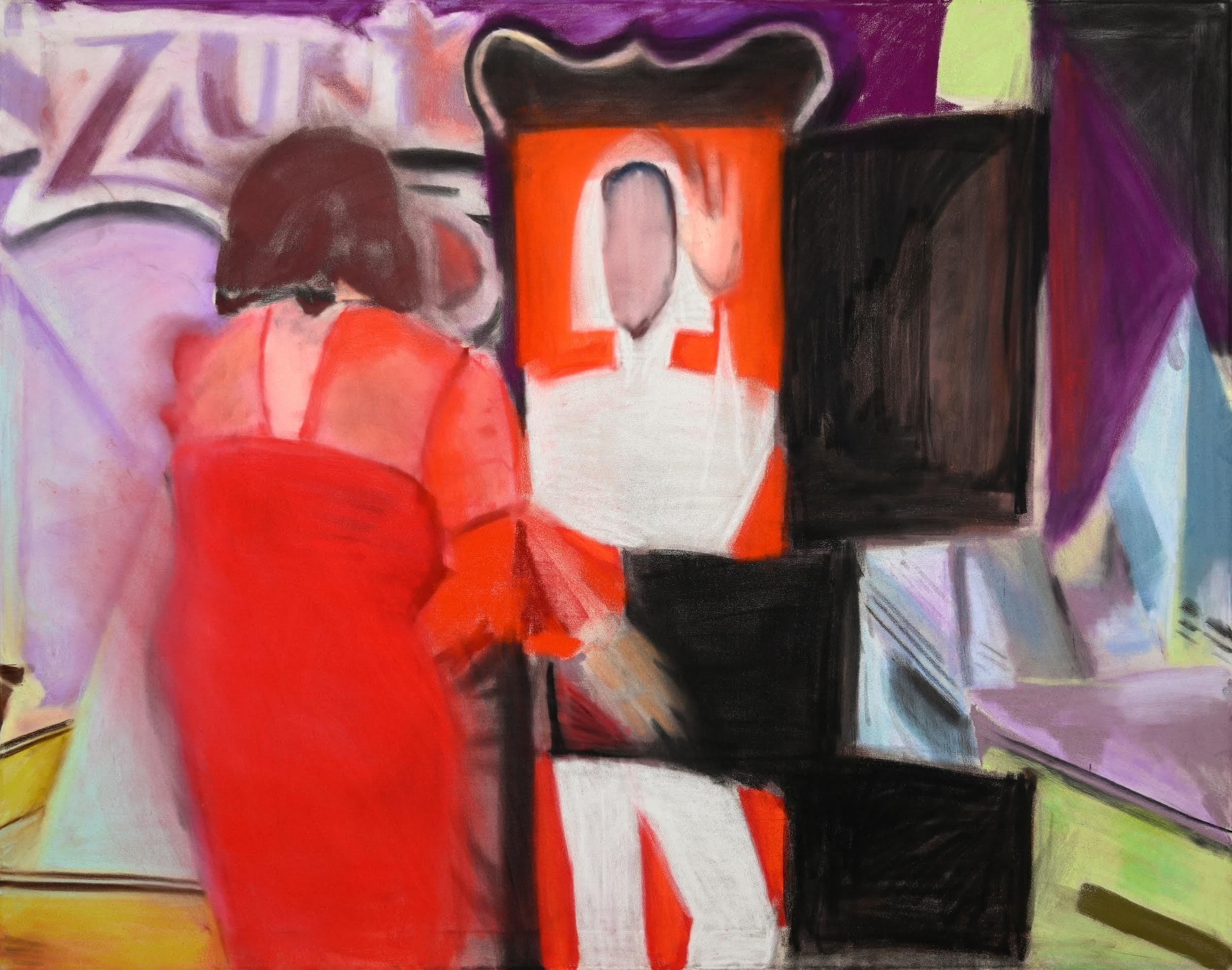
Hair + NailsHair + Nails is thrilled to present Julia García's, A Sweetening in both their Minneapolis and New York City galleries this spring. García grew up in Florida, settled in Minneapolis in 2023, and first exhibited with Hair + Nails in “Chimera — Christina Ballantyne, Emma Beatrez, Rachel Collier, Julia García” in 2023 and since then in six shows with the gallery in New York, Los Angeles, Miami, Minneapolis, and Rochester MN. Across these three venues, Julia García will share new paintings in her distinctive wet-on-wet style with acrylic, ink, and dye on canvas as well as pastels on canvas in vibrant saturated colors and ghostly graphite rubbings on paper. García’s range has expanded greatly this year with new techniques, materials and expressive capacity. Images of dancers, tv game show contestants, theatrical proscenium arches and other architectural details swirl and pop. A push/pull of both oozing and staccato marks elicits a cinematic rack focus experience. The artist dares to control her gestures both less and more. “Painting with taping is a balance of slow and methodical structure building and fast paced application. The boundaries of the tape are able to hold the open ended quality of ink, dye, and diluted acrylic which spreads out into the soaked surface. Water is a largely unpredictable collaborator which disperses pigment in accordance with its own flows and saturation levels. A subtle tilt in the floor can determine how the medium moves and settles, and in this way the taping acts as a kind of channel, like a waterway constructed to redirect flows and overflows in a landscape. The canvas, itself un-gessoed, has an incredible memory. Absorbing layers of fluid and color with a record of where boundaries existed or didn’t, so that ghostly lines are still visible even if edges of forms bleed into each other and merge. A balance is struck, of patient preparation and then a fast paced application which is determined by the evaporation of water as the canvas dries. In contrast, the shift to drawing with pastel feels like a full embracing of force, building the surface more opaquely and with a higher concentration of pigment. The application, direct and without a build out of structure, is a more agile act of composing while in process. The action of smudging or rubbing the material into the canvas still calls back to the overflow or melding of form which is present in the paintings, but in a way which is much more tethered to the hand. It is connected directly to the movement of drawing — an ending point which is concurrent with the body’s disengagement, while in the paintings there is a slower unfurling which occurs after material is applied. A sense of finishing and shifting in which material has dominant agency. The wall rubbings made in an old brownstone apartment in Bed-Stuy felt similar to the pastel in their connection to the body, to the motion of drawing, but also connected to painting on the wet surface in that they were a negotiation with an outside force. The surfaces beneath the paper push back against the hand, upending the hierarchy of mark maker, so that the paper becomes a mediation translating between things which don't ever make contact. The textures, an image, a record, all emerge through the action and pressure of the graphite, an equal tension between what the body can determine and what it can not. In recent works, paintings made without any taping, there is a sense of these different practices meeting. A composition formed in process, but an un-static quality to the marks being made, an unpredictable rearranging and unfocusing which pushes back against the act of rendering, asserting material and its properties so that they are in tension with depiction. When making these, the entirety of the surface is gently wet with a sponge, and the whole image and canvas are worked simultaneously. Layers of dye, ink, and acrylic applied so that the darkest areas hold the forms left in raw canvas. The absence of material constituting the most visible parts of an image, an overexposure of information. The process is similar to watercolor, where often the light emanates from the white of the page left untouched.” —Julia García