
Germain, Paris
Brett Goodroad
Bells
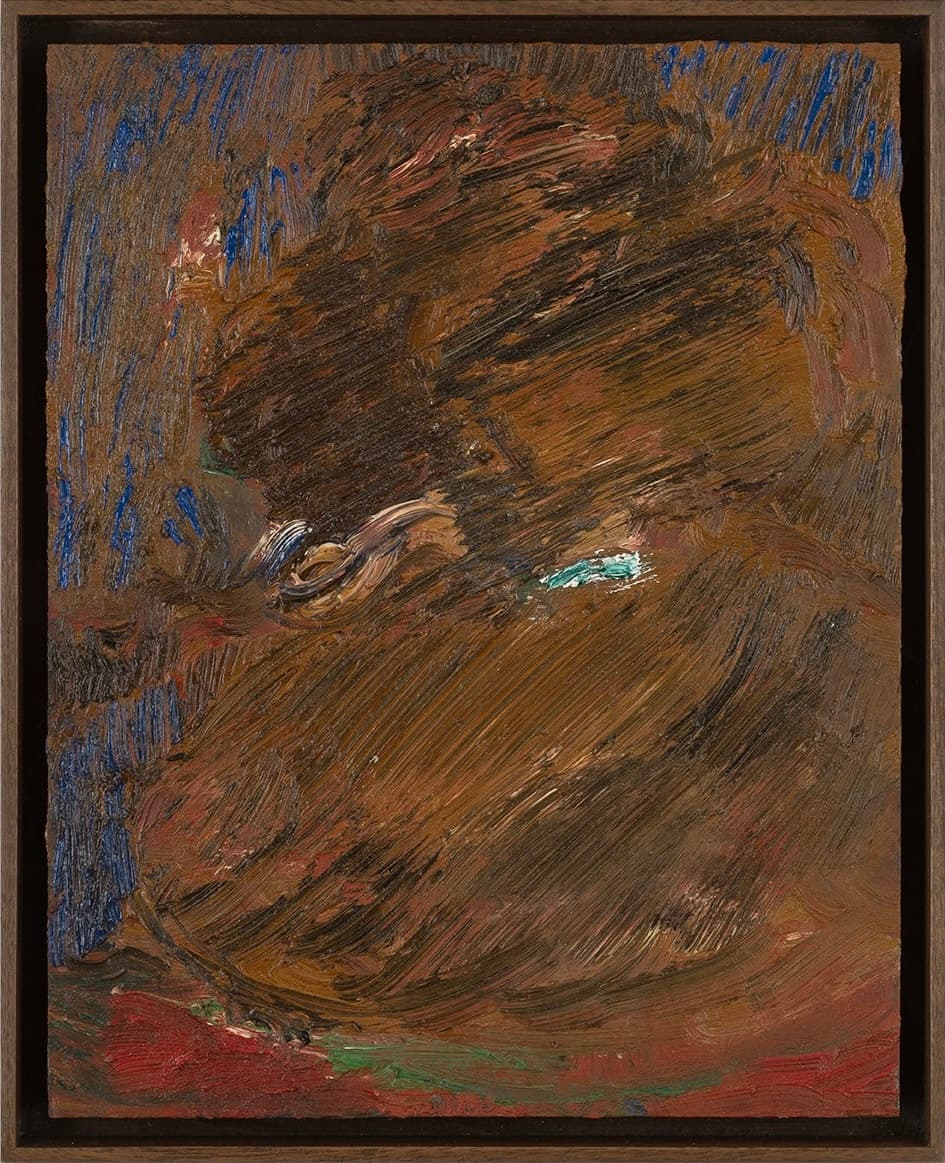
CrèvecœurBrett Goodroad moved to San Francisco to study art. After graduating, he drove large trucks for a company that hauled organic produce across the American Southwest—from the Pacific coast to New Mexico and back. He’d leave on Saturday around midnight, and drive for five days with relatively little rest before returning home, his bones still rattling in his frame. The open road informed his painting: his landscapes, like the views through the front windshield, were indeterminate and headlong. He painted in his backyard, which was generally overgrown. In 2021 he decamped from San Francisco to the high desert of Arizona, where he painted full-time. I visited him there on several occasions, flying into Sky Harbor and climbing more than 5,000 feet through red-brown mountains and saguaro cacti in tinny rental cars. Once I drove through a lightning storm that felt like the first storm ever made. Brett took good care of me in Arizona; there was always a big meal waiting after a long day of travel. By day we’d look at paintings and go for hikes; after dark, grab a cone at the local ice creamery. The town square had a large bronze sculpture of a man on horseback that Brett had rendered many times in his notebook. The sculptor’s name was Solon Borglum—his brother Gutzon carved Mount Rushmore. One morning we drove to a place called the Dells, a lunar landscape of rippled granite boulders more than a billion years old. As we approached, I asked—rhetorically, I thought—what is art? Like, “What is art, anyway?” Quite a riddle! “Oh, I don’t know,” he said, more seriously than I expected. “But I know it’s non-violent.” Few artists, in my experience, actively relinquish authority over the things they make—given what’s at stake, who can blame them? Most want to control how their work goes about the business of making meaning in the wide open world. But across the arc of Brett’s work, meaning slides into something closer to being, and each painting becomes an event—the way that weather is an event. I’ve stood with Brett and others in front of his paintings many times. “I see a face,” someone says, and the artist agrees—yes, there it is. “And a donkey!” another proclaims. Even better, wonderful. “Is that Ophelia?” someone wonders aloud, half incredulously. Things are really heating up. I’ve also had him guide me through certain paintings, showing me what he sees—tracing, for example, the modest crescent of a character’s hunchback. See it? Sometimes I do, but other times I don’t, and thank goodness. The poet Charles Olson wrote that “to be in different states without a change / is not a possibility.” These paintings—fixed as dirt—embody the belief that change is possible, and signal renewal again and again. In fact, many surfaces appear to depict motion itself: brushstrokes caught on a strange wind, as if the picture just blew in. Brett is a landscape painter, but the mind is a landscape, and so is a rock. His earth and its matter—paint included—are animate and in concert with each other. They are a sediment. Viceroys and kings, serfs and clowns, faceless heads and headless faces. Clothes made from lichen, cliffs like waves. Sometimes a painting reveals the raw texture of whatever surface he’s working on—canvas, linen, silk, copper—and in this way the work is about mortality. Many paintings are untitled, though several are called “Kiss,” the place where the singular is scrambled. Open letters. Brett is back in California now, living in the northeasternmost county in the state, close to the border of both Oregon and Nevada. His work has never before been shown in Paris. In some sense, California is quite free—there is very little past crowding one’s rearview, and artists contend with the high cost of gas far more than aesthetic lineage. Art history is something that largely happened elsewhere, to other constituencies. There is a painting in the exhibition that I’m convinced depicts several nudes descending a giant outdoor staircase. Did he have Paris in mind while making it? I don’t suppose so, and I don’t ask. Volcano lips mouth butthole animal explosion. His recent work takes up temporary residence across three storefront galleries at Crevecoeur. One of the spaces was a former antique shop. Spring is around the corner. Old clocks, new time. A donkey. Bells. The weather. —Jordan Stein