
Marais, Paris
Corentin Grossmann
Astres
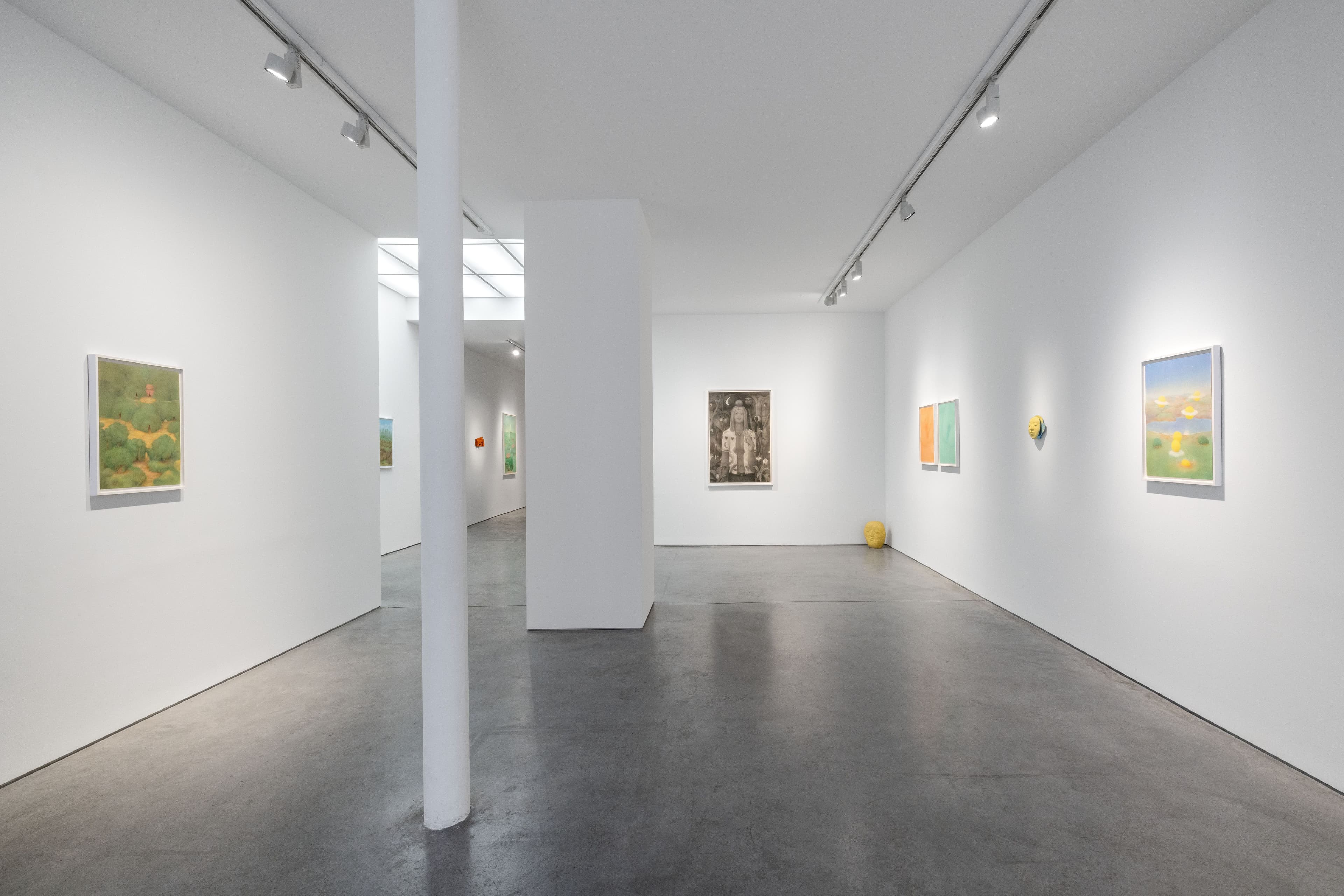
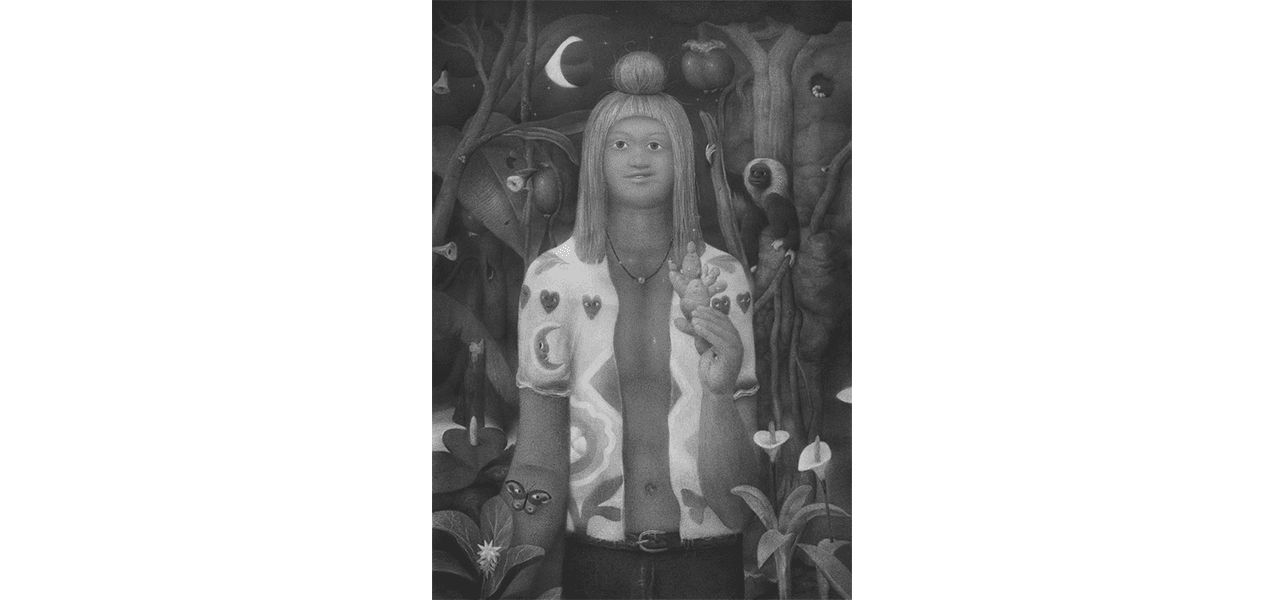
Art : Concept[Scroll down for French version / Veuillez trouver ci-dessous la version française] With this fifth solo exhibition, the artist further develops the sensory component of his work, which has been present since the beginning of his career, experimenting with the infinite possibilities of contrasts, vibratory phenomena linked to color frequencies, correspondences, dissonances, interferences, and echoes. Intimately connected to the iconographic content and chosen themes, this exploration of a new dimension—reminiscent of a musician’s approach (Corentin Grossmann studied music at the conservatory until the age of 15) — results in a complex body of work that resonates in groups as one progresses through the exhibition. Celestial bodies—stars, moons, and suns—are omnipresent, reflecting the ambiguity of suspended time, acting as a unifying element. These celestial bodies, with their distinct revolutions, speeds, and trajectories, are arranged and rearranged like Corentin Grossmann’s drawings. Anthropologist Gilbert Durand even uses the word ‘constellations’ to describe the structures of the imagination and their ability to combine infinitely. Given the diversity of themes addressed, Astres also evokes distance and the establishment of an ‘atmospheric long time’ (the dawn of time?), where the old and the new overlap. Representing the infinitely large, these celestial bodies signal a macrocosm, the cosmos in which potential microcosms are nestled. The drawing Astres perfectly embodies these interlocking scales, playfully extending to the ultimate inversion of interior and exterior. The celestial bodies rest in a sort of cosmic shelter, smoking hookah, etc. The cat symbolizes domesticity, a somewhat unsettling familiarity due to its darkness, while the flies and other insects orbiting one of the ‘floating butt-planets’ mimic the revolutions of small planets around larger ones, providing a perfect example of the transition from microcosm to macrocosm. As one moves through the exhibition, distinct sets and spaces with different tones and themes emerge, following an idea of ‘progression. The first set, characterized by a meditative or even spiritual atmosphere, presents a vision of the cosmos through the prism of physical and bodily sensations, which may constitute an initial stage within the exhibition. The drawings La toundra and La mer represent the quest for apparent simplicity through the stripping down and focus on the atmospheric dimension desired by the artist. The reflections of the moon or sun in the water, the vibration of the celestial body’s contour, and the saturation of sand or grass by water. The multi-layered Man, a ceramic with primitive accents, shows us a serene face turned inward, while Le fœtus (ultrasound) raises the question of the visible and the invisible, the shown and the hidden, the full and the empty. It also stands at the intersection of several important themes of the exhibition: the aquatic origins of life (or the importance of water, its rationing, its conservation, or even its access with Le château d’eau), science (Lord of the Depth III), and finally, the future of humanity in constant transition. Leonardo and Mona more explicitly introduce sexuality as one of the means of understanding the world and the other. Facing each other, they observe one another, their senses alert, possibly expressing sexual desire but also curiosity directed outward or inward. The title Leonardo refers to Leonardo da Vinci, an exceptional investigator, while Mona refers to the model, hence the subject of observation (as with the famous painting Mona Lisa). The symmetry of the face-off, down to their positions, suggests an idea of gender equivalence. The issue of power dynamics between the feminine and the masculine will recur throughout the exhibition, notably with the ambiguous drawing Les broyeuses, which may echo the feminist movement and its challenge to patriarchy, or The power of ginger, which plays with the codes of virility. These works depict power dynamics in the process of being redefined and, beyond these issues, the search for balance. The final space, where larger-format drawings are concentrated, calls upon a range of figures and themes that, far from any affirmative statement, amplify harmonies and dissonances, with more ‘frontal’ works such as Les broyeuses and The power of ginger, comforting ones like the hedonistic Midnight Bath, mysterious ones like the surrealistic Paysage français that evokes the smell of Roquefort with the underlying question of national identity, and finally, if Lord of the Depth III is considered the end of the journey, a return to the question of vision introduced by Le fœtus, but with an anticipatory dimension: the submarine depicted probes the depths, searching for resources such as oil or rare metals to meet humanity’s needs, yet it also bears great similarities, in mission and aesthetics, to space exploration. This drawing demonstrates the artist’s ability to merge what we typically categorize as two distinct domains, the real and the imaginary. Corentin Grossmann drew from scientific facts (recent Chinese and American submarine missions) and was inspired by photos to evoke themes of conquest, territory, and appropriation. The ceramic La roquette Boulava draws a belligerent axis, while on the opposite side, Le petit train à vapeur represents slowness and the past. ***** Avec cette cinquième exposition personnelle l’artiste développe la composante sensorielle de son travail, présente depuis ses débuts, expérimentant les possibilités infinies des jeux de contrastes, des phénomènes vibratoires liés aux fréquences de la couleur, correspondances, dissonances, interférences et rappels. Intimement lié au contenu iconographique ainsi qu’aux thématiques choisies, la recherche de cette nouvelle dimension, qui évoque l’approche d’un musicien (Corentin Grossmann a étudié la musique au conservatoire jusqu’à l’âge de 15 ans) aboutit à un ensemble complexe d’œuvres qui entrent en résonance par groupe au fur et à mesure que l’on progresse dans le parcours de l’exposition. Astres, étoiles, lunes et soleils omniprésents reflètent l’ambiguïté d’un temps suspendu en opérant tel un liant. Ces corps célestes, avec leurs révolutions, vitesses et trajectoires distinctes s’agencent et se réagençent à l’image des dessins de Corentin Grossmann. L’anthropologue Gilbert Durand utilise d’ailleurs le mot de « constellations » pour évoquer les structures de l’imaginaire et leur capacité à se combiner à l’infini. Face à la diversité de thèmes abordés, Astres évoque aussi la distance et l’instauration d’un « temps long atmosphérique » (la nuit des temps ?), où l’ancien et le nouveau se superposent. Représentants de l’infiniment grand, ces astres signalent un macrocosme, le cosmos dans lequel viennent se loger d’éventuels microcosmes. Le dessin Astres représente bien ces jeux d’imbrications de différentes échelles allant avec amusement jusqu’à l’ultime renversement intérieur/extérieur. Les astres se reposent dans une sorte d’abri cosmique, fument le narguilé etc… Le chat symbolise ici la domesticité, une familiarité un peu effrayante de par sa noirceur tandis que les mouches et autres insectes qui gravitent autour de l’un des « astres-fesses » en lévitation, reproduisent les circonvolutions des petites planètes, autour des plus grandes nous donnant ici un parfait exemple de passage du microcosme au macrocosme. En parcourant l’exposition on distingue des ensembles, des espaces aux tonalités et aux thématiques différentes selon une idée de « progression ». Un premier ensemble présente dans une atmosphère que l’on pourrait qualifier de méditative, voire spirituelle, une vision du cosmos au travers le prisme des sensations physiques et corporelles qui peuvent constituer une première étape au sein de l’exposition. Les dessins La toundra, La mer représentent bien la quête d’apparente simplicité, par le dépouillement et la concentration sur la dimension atmosphérique voulue par l’artiste. Les reflets de la lune ou du soleil dans l’eau, la vibration du contour de l’astre, l’imprégnation du sable ou de l’herbe par l’eau. The multi layered Man ou « l’homme multicouche », céramique aux accents primitifs nous montrant un visage serein tourné vers son intériorité tandis que Le fœtus (échographie) soulève la question du visible et de l’invisible, du montré-caché, du plein et du vide mais se trouve aussi à l’intersection de plusieurs thèmes importants de l’exposition que sont les origines aquatiques de la vie (ou l’importance de l’eau, de son rationnement, de sa conservation voire son accès avec Le château d’eau), la science (Lord of the depht III) et enfin, l’avenir d’une humanité en constante transition. Leonardo et Mona introduisent plus explicitement la sexualité comme l’un des moyens de connaissance du monde et de l’autre. Tournés respectivement l’un vers l’autre, ils s’observent, les sens en alerte et peuvent exprimer un désir sexuel certes mais aussi une curiosité tournée vers l’extérieur ou l’intérieur. Le titre Leonardo fait référence à Léonard de Vinci qui est un exemple exceptionnel d’investigateur, tandis que Mona fait référence au modèle, donc au sujet d’observation (avec son célèbre tableau Mona Lisa). On notera la symétrie du vis-à-vis, jusque dans les positions, qui suggère ici l’idée d’une équivalence des sexes. La question des rapports de force du féminin et du masculin se retrouvera tout au long de l’exposition notamment avec l’ambigu dessin Les broyeuses qui peut faire écho au mouvement féministe et sa remise en question du patriarcat ou encore The power of ginger qui joue des codes de la virilité. Ces œuvres montrent des rapports de forces en train de se redéfinir et au-delà de ces enjeux la recherche d’un équilibre. Le dernier espace où se concentrent des dessins de plus grand format, fait appel à un ensemble de figures et de thèmes, qui, loin de toute énonciation affirmative amplifient harmonies et dissonances, avec des œuvres plus « frontales » comme Les broyeuses, The power of ginger, réconfortantes comme l’hédoniste Midnight Bath, mystérieuse avec le surréaliste Paysage français qui convoque l’odeur du roquefort avec en filigrane la question de l’identité nationale, et enfin si l’on considère Lord of the depth III comme la fin du parcours, un retour à la question de la vision introduite entre autre par Le fœtus, avec ici une dimension anticipatrice : le sous-marin représenté, sonde les abysses, à la recherche de ressources telles que du pétrole ou des métaux rares pour répondre aux besoins de l’humanité mais présente aussi de grandes similitudes de par la mission, jusqu’à l’esthétique, avec l’exploration spatiale. Ce dessin montre la possibilité de l’artiste de confondre ce que l’on catégorise habituellement en deux domaines distincts, le réel et l’imaginaire. Corentin Grossmann est parti de faits scientifiques (missions sous-marines récentes chinoise et américaines) s’est inspiré de photos pour évoquer les thèmes de la conquête, du territoire, et de l’appropriation. La roquette Boulava, en céramique, dessine un axe de manière belliqueuse tandis qu’à l’opposé Le petit train à vapeur, serait plutôt une figure de la lenteur et du passé.