
Marais, Paris
Pierre Huyghe
Camata
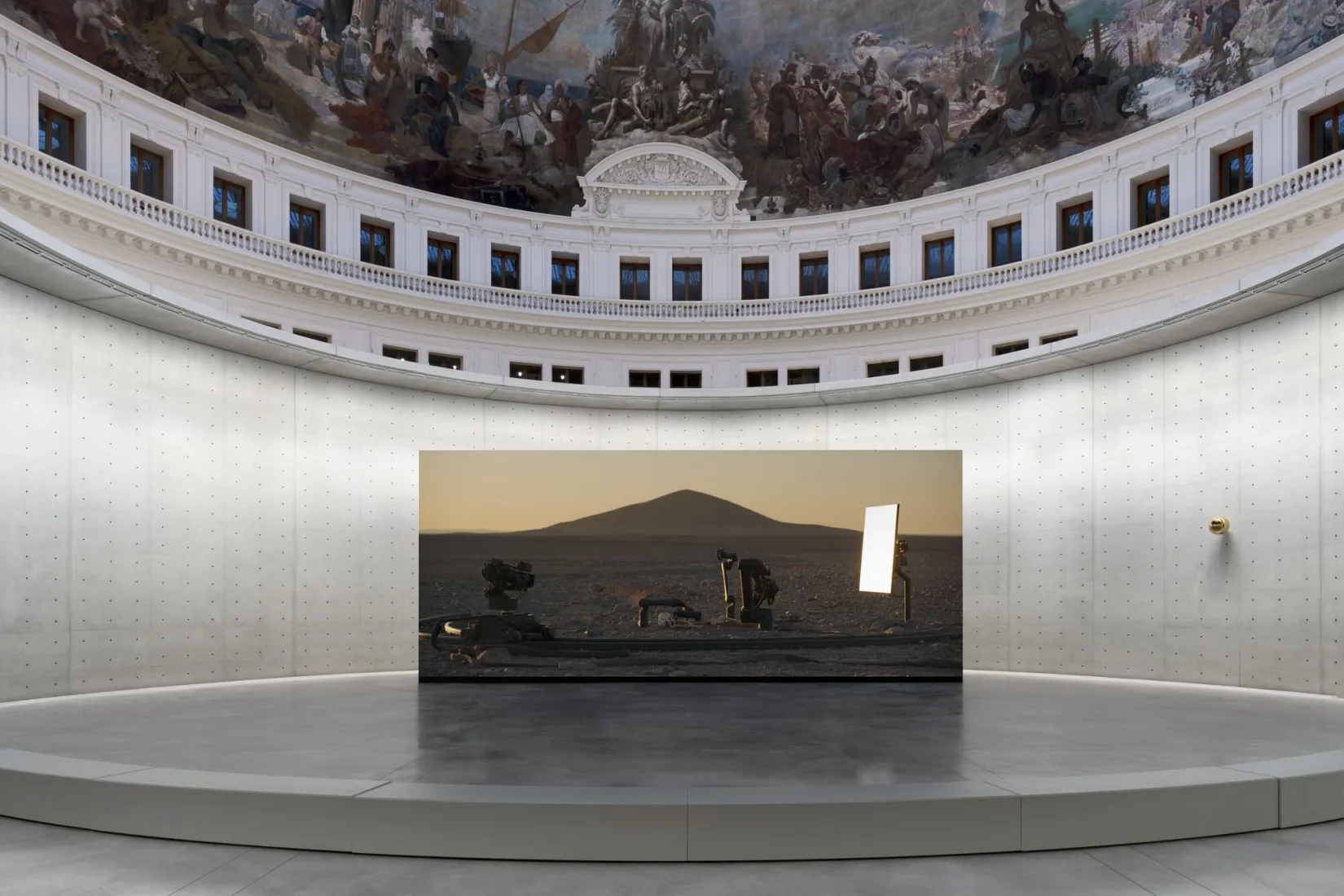
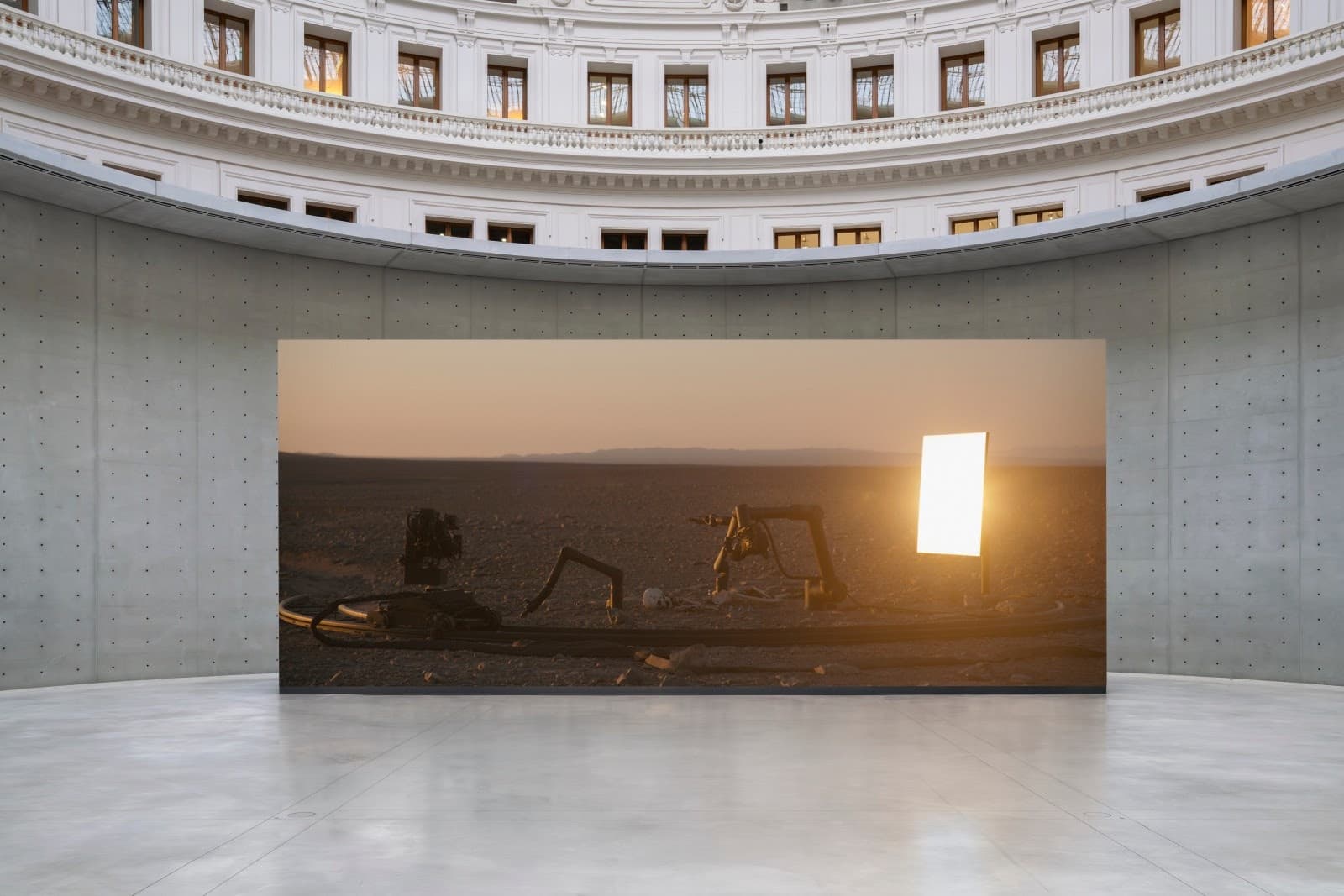
Bourse de CommerceTickets available at tinyurl.com/7ruc64a3 The film Camata (2024) by Pierre Huyghe (b. 1962, France) is presented in majestic form at the heart of the museum, inviting a meditation on the place of the human within a world governed by technology. The hybridisation of death and life, reality and fiction, body and landscape, past, present and future, night and day, shadow and light, earth and sky, ritual and cosmos, human and non-human unfolds there in a continuous loop. “In the Rotunda, Camata reveals a landscape between day and night, where a strange robotic ballet takes shape. Driven by machine-learning algorithms, the rhythm of the images is in constant transformation. A group of machines performs a ritual of unknown origin around a human skeleton discovered without burial in the Atacama Desert in Chile. Haunted by the presence of this body lying between the ground and the infinity of the cosmos, Pierre Huyghe devises here a ritual that is at once archaic and technological, in which mechanical arms powered by solar panels animate themselves around the skeleton in a slow, precise choreography reminiscent of an autopsy. They delicately manipulate glass spheres and amulets, carrying out the gestures of a funerary and metaphysical ceremony, inviting reflection on the place of humanity within a world in mutation, shaped by technology.” —Emma Lavigne “In 2015, I came face to face with this body; it was an image that existed in reality before it was photographed. It was in a very particular place, the oldest and driest desert in the world — the one furthest from any form of life. NASA tests life‑detection instruments for exoplanets there, and the largest astronomical telescope and the largest solar power plant in South America are installed nearby. Amid these instruments oriented toward other stars, a skeleton lies on the rocky desert ground, blending into it, in the position of a sleeper beside a dried‑up stream. While thinking of an entity capable of self‑constructing and self‑presenting through a film, the idea emerged of an operation, a set of actions performed around this body. Beside it, robotic arms rise from the ground, initiating gestures, picking up elements and objects to assemble them into configurations, geometries, symbols that surround or traverse the body, now turned stage. Their actions produce sounds, musicalities. This repeats over several days and nights—ideally over several years—in real time. A set of sensors, including cameras, records while a heliostat redirects the light or captures what unfolds. One quickly thinks of something akin to a funerary rite, a surgical operation, or an anatomical theatre; or perhaps the formation of a new subjectivity in the process of learning, or the birth of a strange metaphysical transaction between different realities. It is a symbolic and enigmatic exchange between the nonexistent and the vanished, a game that produces nothing—no result, no meaning.” —Pierre Huyghe, excerpt from an interview with Anne Stenne published in the exhibition catalogue "Liminal", Punta della Dogana, Venice, 2024, Pinault Collection. Curated by Emma Lavigne, general director and curator, Pinault Collection Pierre Huyghe seems to have taken philosopher Michel de Certeau’s philosophy "fiction is a means of capturing reality" to heart. Since the early 1990s, the artist has been reinventing ways of creating and questioning the many links between the work, the viewer and reality. Although his works come in a variety of forms (videos, performances, objects and photographs), they focus on the same issues. The relationship to time and collective memory is sometimes explored through exhibitions, a means of expression in their own right that reveal the hidden side of creation. Huyghe conceives of his works as "event initiators". "They’re more about exposing someone to something than exhibiting something to someone,” he says. Born in Paris in 1962, Huyghe studied at the Ecole Nationale Supérieure des Arts Décoratifs from 1982 to 1985. His work has been exhibited in many museums and at international events such as the Venice Biennale and the Documenta in Kassel. His Pinault Collection works were introduced at the 2006 show "Where Are We Going?" at the Palazzo Grassi in Venice.