

Germain, Paris
Magdalena Abakanowicz
The Thread of Existence
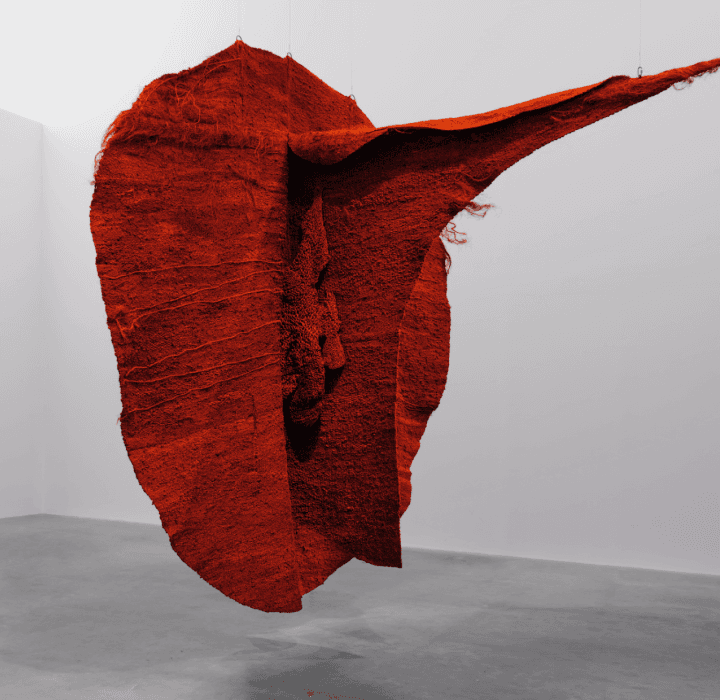
Musée BourdelleTickets available at tinyurl.com/58tmncfn A pioneer in contemporary sculpture and textile art, Magdalena Abakanowicz (1930-2017) is a major artist on the Polish and international scene in the 20th century. After London Tate Modern in 2023, the Bourdelle museum presents the first major exhibition in France dedicated to the artist. A major artist on the Polish scene in the 20th century, Magdalena Abakanowicz experienced war, censorship, and deprivation imposed by the communist regime from an early age. She produces immersive, poetic, sometimes disturbing and often political sculptures and textile works. Inspired by the organic world, by seriality and monumentality, her work possesses an undeniable power and presence, resonating with contemporary issues—environmental, humanistic, and feminist ones. Radical and pioneering, Abakanowicz's work has been regularly exhibited abroad, from the United States to Japan and Europe, and more recently at the Tate Modern in London and the Musée cantonal des Beaux-Arts in Lausanne. The Musée Bourdelle is presenting the first major exhibition dedicated to the artist in France, offering biographical and political insights through a chronological and thematic journey of 77 ensembles—33 sculptural installations, 10 textile works, drawings, and photographs. In the 600m² Portzamparc wing, whose concrete walls have been renovated for the occasion, the exhibition focuses on her monumental sculptural production, in order to restore the artist to her place among the great sculptors of the 20th century. The subtitle of the exhibition, "the Thread of Existence" combines two terms used by the artist to define her work. She considered fabric to be the elementary cell of the human body, marked by the vagaries of its destiny. © Fondation Marta Magdalena Abakanowicz-Kosmowska et Jan Kosmowski © Marek Holzman "I consider fiber [...] the greatest mystery of our environment. All living organisms, plants, leaves, and ourselves are built from fiber." Magdalena Abakanowicz Introduction In the corridor of the Portzamparc Wing, the first section offers an overview of Abakanowicz's prolific output: early textile pieces, small-scale (often anatomical) sculptures, drawings, and designs for public spaces. Initially trained as a painter, she turned to tapestry, which she soon subverted beyond its traditional craft and decorative roles. At the crossroads of artistic disciplines, Abakanowicz blended textile materials with sculptural techniques to question one central theme: what place does humankind occupy within its environment? (c) Fondation Marta Magdalena Abakanowicz-Kosmowska et Jan Komsowski (c) Piotr Ligier Section 1: Abakans The exhibition continues with the monumental cycle of works she began in the mid-1960s: the Abakans, spectacular textile sculptures suspended from the ceiling. Despite the scarcity of materials, she weaved these large, organic forms from natural fibres, ropes, and salvaged fabrics stored beneath her bed. The 1969 Fourth International Tapestry Biennale in Lausanne marked a turning point: liberated from the wall, her Red Abakan (4 meters in diameter) unfolded fully into space. Floating and suspended, the Abakans both conceal and reveal the "secrets" of their material nature. Their fissures and folds evoke a range of organic associations: the flayed flesh of wood, animal fur, or the folded lips of female anatomy. Closely linked to the society in which the artist lived, the genesis of the Abakans constitutes an act of resistance. The space they inhabit becomes a form of political refuge, in which restrained rage reconnects the fabric of a territory and the thread of a history. Abakan orange, 1971, Magdalena Abakanowicz. Tate, Présenté anonymement, 2009. Photo: © Magdalena Abakanowicz Section 2: The Human Condition In the 1970s, Abakanowicz's practice turned toward the human figure and adopted the principle of seriality, which she developed in Backs and Dancing Figures. Using life casts of the human body, she lined the inside of the mold with strips of burlap hardened with resin and glue. The result was a shell whose texture recalls skin or bark. The artist repeated this process but individualized each new figure by creating folds and hollows, emphasizing seams, or adding cords to the surface. The third part of the exhibition focuses on these anonymous shells that question presence and disappearance. The artist and her work Backs, Venice Biennale, 1980 © Fondation Marta Magdalena Abakanowicz-Kosmowska et Jan Kosmowski © Jan Kosmowski Section 3: Organic Metamorphoses The fourth section opens with her emblematic installation Embryology, first shown at the Venice Biennale in 1980. Positioned between body, organic matter, and stone, these clustered cocoons immerse the viewer in an ambiguous, hybrid space. A mass of cells seen under a microscope, tissues, or skins—Embryology draws the gaze into the mystery of living matter. A striking graphic counterpoint to the Embryology series, the group of works titled Compositions was created in 1981. On sheets laid flat and animated by a slow rotational movement, ink thickens and gathers before the artist disperses it across the paper with a wash. Accompanied by drawings and the raised Landscapes reliefs, this part of the exhibition highlights the materiality of Abakanowicz's work and her enduring fascination with transformation. © Fondation Marta Magdalena Abakanowicz-Kosmowska et Jan Kosmowski © Piotr Ligier Section 4: Graphic Series Early in her career, Abakanowicz occasionally turned to drawing to depict the plant and animal worlds. From the 1980s onward, she intensified her graphic practice. The charcoal series Flies (1993–1994) translates observations of dead or pupal flies into a monumental format. Abakanowicz enlarges their bodies as if seen through a microscope, revealing their structure. Far from expressing any fear of decay, the artist conveys a visceral curiosity about organic reality. ©Fondation Marta Magdalena Abakanowicz-Kosmowska et Jan Kosmowski © Piotr Ligier Section 5: Installations In the museum's concrete alcoves, visitors encounter the groups Mutants and The Crowd V. While Mutants occupy space in an indeterminate way, the anonymous and unsettling figures of The Crowd V embody Abakanowicz's reflection on "the crowd acting as a brainless organism." From life casts of a standing man with arms at his sides, she produced a series of figures. These works, titled Crowds, succeeded one another between 1986 and 1997. The process itself, pressing resin-soaked burlap into a plaster mold, embodies submission: the individual yields, quite literally, to the mold. Headless and often armless, this faceless multitude, which the artist set up as "a barrier" between herself and "all those who frighten her," takes on a ritual power of protection. © musée d'Art moderne de la Ville de Paris, Don de l'artiste, 1997 Section 6: War Games The exhibition concludes with the monumental series War Games, composed of massive tree trunks bound by steel hoops. The work echoes the destructive power of war. Abakanowicz created this series between 1987 and 1995, a period marked by the collapse of the communist regime and the emergence of a new political and social order. The unsettling oxymoron of the title War Games is reflected in the combination of contrasting materials, where the organic, cellular nature of wood confronts the cold rigidity of metal. © Fondation Marta Magdalena Abakanowicz-Kosmowska et Jan Kosmowski © Jan Kosmowski The result of three years of work, the project benefits from the active support of the Marta Magdalena Abakanowicz Kosmowska and Jan Kosmowski Foundation (Warsaw), the Polish Institute, and the Adam Mickiewicz Institute. The main lenders are the Marta Magdalena Abakanowicz Kosmowska and Jan Kosmowski Foundation in Warsaw, the Toms Pauli Foundation in Lausanne, the Central Museum of Textiles in Łódź, Tate Modern in London, the National Museum in Wrocław, and the Musée d'Art Moderne de Paris. In collaboration with Marta Magdalena Abakanowicz Kosmowska and Jan Kosmowski Foundation, Warsaw