
Tiergarten, Berlin
Konrad Klapheck
Konrad Klapheck
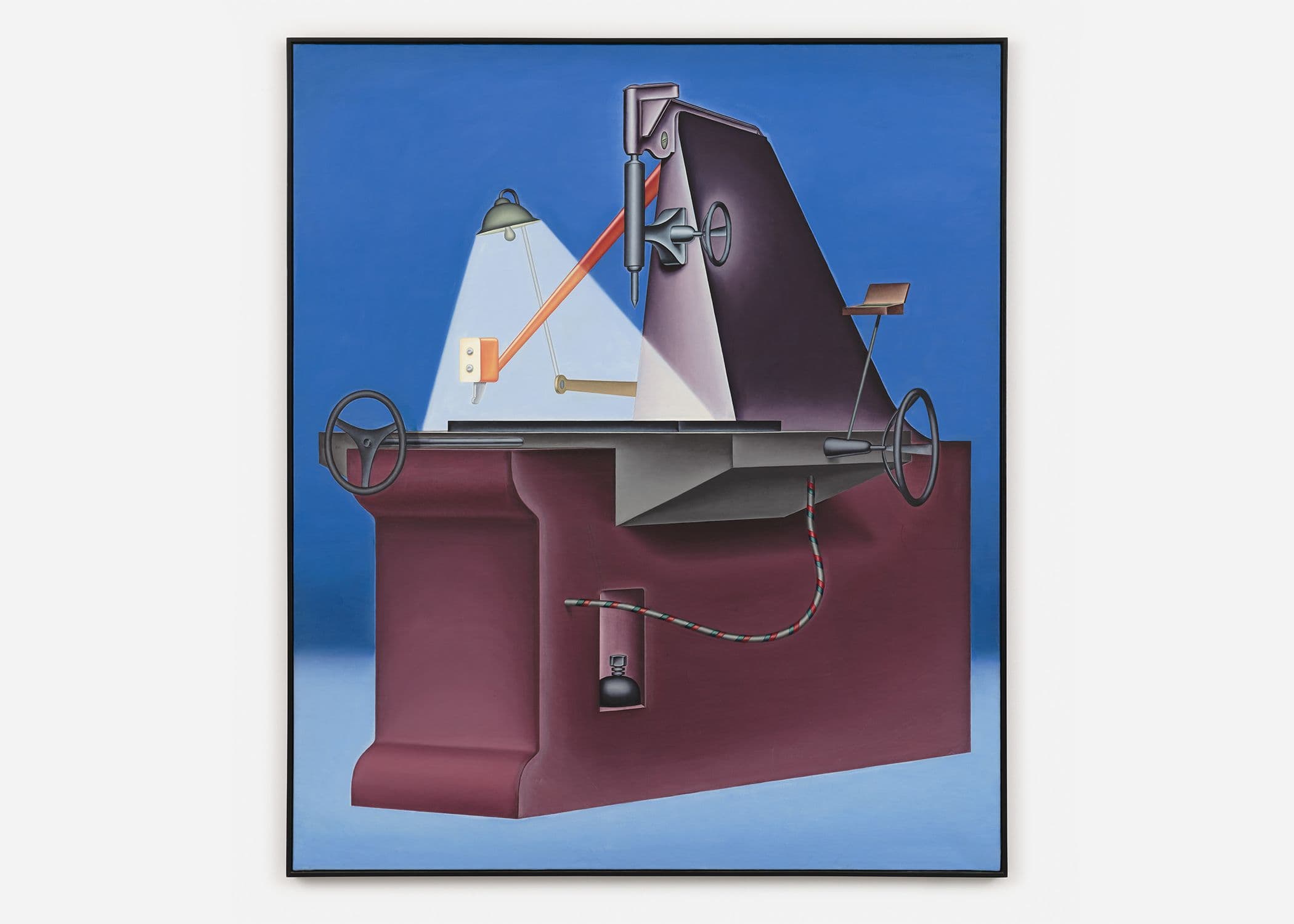
Max HetzlerGalerie Max Hetzler, Berlin, is pleased to present a solo exhibition of paintings by Konrad Klapheck. This is our first presentation of the artist's work. Across his oeuvre, Klapheck creates an exceptional body of paintings, whose significance extends well beyond the context of German post-war art. At a time when many international artists painted abstractly in the 1950s, Klapheck turns against the trend and towards figuration. Between 1954 and 1958, he studies painting at the Dusseldorf Art Academy under Bruno Goller, an influential figure in the German postwar art scene whose enigmatic, figurative painting offers an alternative to the dominant Informel. It was perhaps through the encouragement of his teacher and mentor that Klapheck painted his first typewriter in 1955, inaugurating the 'Machine Paintings' which shape his artistic practice for the next four decades. The seemingly banal everyday objects that Klapheck renders in a precise, realist style comprise an entire genealogy of domestic appliances and ordinary things: motorcycles, radios, hairdryers, chairs, and other familiar devices. Works from this series dating 1963-1993 are on view in the exhibition. Stylistically poised between Surrealism, New Objectivity and Pop art, Klapheck develops a visual language entirely his own. Through isolation, simplification, and the exaggerated use of perspective, he transforms his objects into imposing, uncanny presences. An object painted by Klapheck is instantly recognisable for its monumental appearance and cold metallic sheen. An otherwise realistically rendered bicycle or motorcycle is almost always missing a crucial functional component, whilst ordinary utilitarian objects are detached from their original context. Transformed into surreal and symbolic images, his works become metaphors for human relationships, power, sexuality and alienation. Abstracted, defamiliarised, aestheticised and personified, they withdraw from the logic of the consumer world. For each painting, Klapheck meticulously develops a preparatory drawing in charcoal or pencil, through which he establishes the proportions, precision and psychological charge of his images. Two such preliminary drawings on canvas are on view in the exhibition. Through his decades-long engagement with machines, Klapheck aligns himself with the Surrealists, whose circle and intellectual atmosphere he closely inhabits. One might think of Francis Picabia's subversive paintings of mechanisms with no practical use; or Marcel Duchamp, who challenges traditional notions of artistic authorship, function and value with his readymades. Indeed, the upside-down bicycle in Klapheck's Die Fragwurdigkeit des Ruhmes (The Questionable Nature of Fame), 1978, seems reminiscent of Duchamp's readymade Bicycle Wheel from 1913. Running beyond this shared motif, echoes of Duchamp's work can be traced throughout Klapheck's oeuvre. Andre Breton, whom Klapheck first met during a stay in Paris in 1961 and subsequently befriended, likewise drew a connection to Duchamp in a text written for Klapheck's 1965 solo exhibition at Galerie Ileana Sonnabend. Yet, Breton emphasised that Klapheck's work was not merely a continuation of Surrealism, but an independent position situated between precision, irony, and unease. A disjunction emerges between Klapheck's depicted objects and their titles, opening up an additional layer of interpretation for the viewer. Using names such as Die Gastgeberin (The Hostess), Die Verfuhrerin (The Seductress) or Der mutterliche Vater (The Motherly Father), the artist assigns gendered identities to his objects: sewing machines are cast as female, typewriters as male. Other titles, including Die Jagd nach dem Gluck (The Pursuit of Happiness), Die Fragwurdigkeit des Ruhmes (The Questionable Nature of Fame), and Der Erfolg und sein Preis (Success and its Price), reference Klapheck's personal memories, encounters with his peers, and situations that resonate with broader human experience. Leaving them intentionally open-ended, the artist believes that explaining a title is akin to explaining the punchline of a joke. Through the charged interplay of form, title and association, his machines become psychologically and socially resonant presences: transcending mere depiction, they embody lived experience, fear and desire. As familiarity and strangeness merge, Klapheck's unique objects resonate with universality, drawing on the viewer's own memories and emotional responses. Galerie Max Hetzler would like to thank all lenders for their generous support of the exhibition. Konrad Klapheck (1935-2023) lived and worked in Dusseldorf. From 1979 he taught as professor for painting at the Staatliche Kunstakademie Dusseldorf. As early as 1959, his work was shown at Galerie Schmela, Dusseldorf. Further solo exhibitions at prominent galleries include Galleria Arturo Schwarz, Milan (from 1960); Galerie Rudolf Zwirner, Essen/Cologne (from 1963); Galerie Beyeler, Basel (1976); Galerie Lelong, Zurich/Paris (from 1985); and Galerie Michael Haas, Berlin/Zurich (from 2011) among others. Klapheck's work has been presented in institutional solo exhibitions at the Kunsthaus NRW, Aachen; Museum Schloss Cappenberg, Selm (both 2025); Musee des Beaux-Arts, La Chaux-de-Fonds, Switzerland (2019); Museum Kunstpalast, Dusseldorf (2013 and 2002); Kunstverein Ulm (2007); Kunsthalle Recklinghausen (2006); Musee d'art moderne et contemporain de Strasbourg; Sala Alcala 31, Madrid (both 2005); Rheinisches Landesmusuem, Bonn (2003); Central Institute of Fine Arts, Beijing (1994); Hamburger Kunsthalle, Hamburg; Staatsgalerie Moderner Kunst, Munich (both 1985); Palais des Beaux-Arts, Brussels (1975 and 1965); Stadtische Kunsthalle Dusseldorf (1975); Musuem Boymans Van Beuningen, Rotterdam (1974); Kunst- und Museumsverein Wuppertal; Kunst- und Gewerbeverein, Wuppertal (both 1967); Kestner-Gesellschaft, Hanover; Von der Heydt-Museum, Wuppertal (both 1966); and Haus am Lutzowplatz, Berlin (1964). Klapheck's work is in the collections of Centre Pompidou, Paris; Fondazione Prada, Milan; FRAC - Picardie, Amiens; Hamburger Kunsthalle, Hamburg; Hessisches Landesmuseum, Darmstadt; Kunstsammlung Nordrhein-Westfalen, Dusseldorf; Museum of Contemporary Art, Budapest; Museum Folkwang, Essen; Museum Ludwig, Cologne; Neue Nationalgalerie, Berlin; The Museum of Modern Art, New York; Pinakothek der Moderne, Munich; Sprengel Museum, Hanover; Stadel Museum, Frankfurt am Main; Weserburg, Museum fur moderne Kunst, Bremen; and ZKM | Zentrum fur Kunst und Medientechnologie, Karlsruhe, among others. Klapheck's painting Glanz und Elend der Reformen, 1971-1975, is currently on view at the Neue Nationalgalerie, Potsdamer Straße 50, 10785 Berlin, until April 2027, as part of the collection presentation Extreme Tension. Art between Politics and Society.