

Collateral, Venice
Group Exhibition
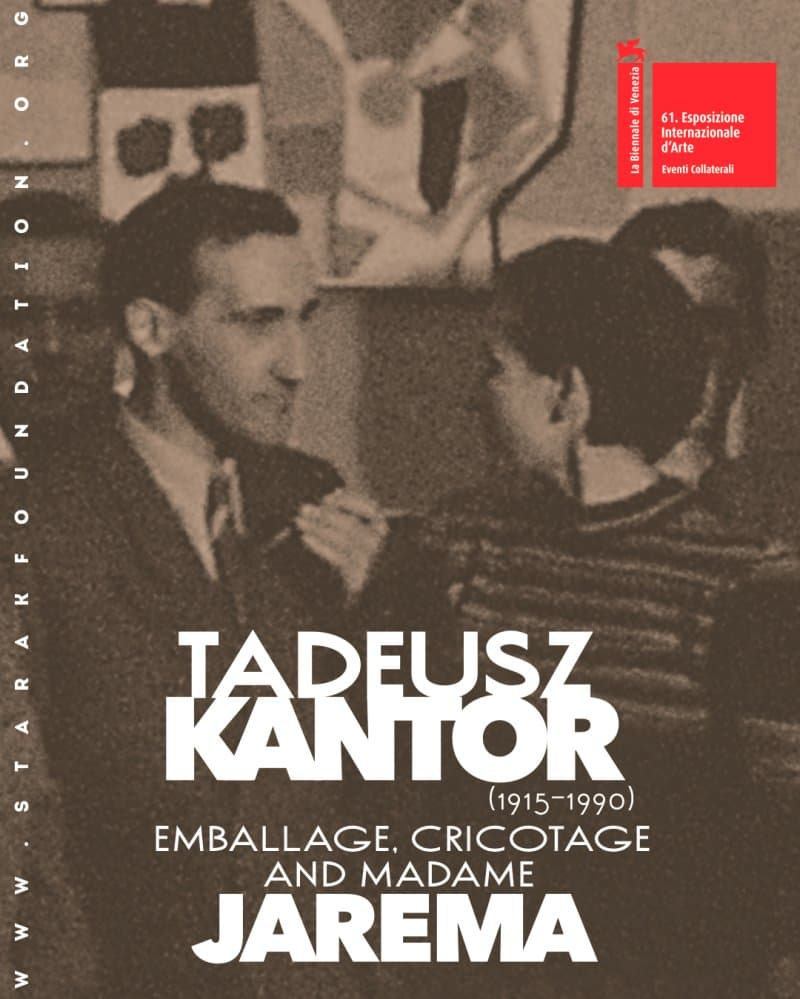
Tadeusz Kantor (1915-1990): Emballage, Cricotage and Madame Jarema
Procuratie VecchieOpens Saturday, May 9 Anna and Jerzy Starak are among the most important and distinguished patrons of culture in Poland. Established in 2008, The Starak Family Foundation, pursues a consistent, long-term mission to promote education and disseminate Polish artistic heritage in Poland and abroad. They also own one of the most valuable collections of post-war Polish art, distinguished not only by its impressive scale but, above all, by its museum quality, coherence, and historical importance. The Starak Collection offers a unique record of key artistic phenomena of the second half of the 20th century and is fundamental to understanding contemporary Polish culture. The exhibition Tadeusz Kantor (1915 -1990): Emballage, Cricotage and Madame Jarema is the fifth presentation of Polish art organized by the Starak Family Foundation in Venice including presentations of the work of Ryszard Winiarski (2017), Ewa Kuryluk (2022) and Andrzej Wroblewski (2024) as Collateral Events of the Venice Biennale. The exhibition, as a further Collateral Event, takes place in the historic and highly prestigious venue of the Procuratie Vecchie in St. Mark's Square, the heart of Venice. Tadeusz Kantor (1915-1990): Emballage, Cricotage and Madame Jarema is an exhibition devoted to the relationship and work of Tadeusz Kantor and Maria Jarema, leading representatives of the post-war avant-garde. Internationally acclaimed, Tadeusz Kantor was an artist whose work defined Polish identity in his impressive "Theater of Love and Death," giving it the dimension of a universal spectacle that seduced and fascinated audiences from Europe to Asia and the Americas. His theater, stage designs, and directing, his modern understanding of acting combined with extraordinary sensitivity touch on the most subtle strings of the human condition and make the experience of his art interpreted with equal intensity regardless of where it is performed. Tadeusz Kantor received numerous awards and honors for his artistic achievements. He received the international Rembrandt Prize awarded by the jury of the Goethe Foundation in Basel for his significant contribution to the development of contemporary art (1978) and the Italian "Targa Europea" award, given to outstanding representatives of culture and science in Europe (1986). He was awarded the French Legion of Honor (1985), the Order of Arts and Letters in the rank of Commander (1989), and the Grand Cross of Merit of the Federal Republic of Germany for his significant impact on contemporary art in Europe and for his contribution to the revival of the cultural image of the Federal Republic of Germany (1990). His theatre productions won international recognition and numerous awards. An important theme of the exhibition is the presentation of the work of Maria Jarema (1908-1958). As a co-founder of the pre-war avant-garde theatre Cricot and co-founder of Cricot 2, she was one of the key formative figures for Kantor. Maria Jarema, an outstanding painter and sculptor, awarded a prize at the Venice Biennale in 1958, remained the only person whose opinion Kantor fully trusted. Their relationship—a fascination and intellectual partnership—became the basis for the formation of Cricot 2. The exhibition's content supporter is Cricoteka - Centre for Documentation of the Art of Tadeusz Kantor. Cricoteka was founded in Krakow in 1980 at the initiative of Tadeusz Kantor to serve as a living archive of the Cricot 2 Theater. Cricoteka stores, presents, and safeguards the collection of theatrical works from Tadeusz Kantor's performances. Cricoteka is a museum, an archive, a gallery, and a research center all in one. Curator: Ania Muszyńska