
Chelsea, New York
Group Exhibition
Chryssa & New York
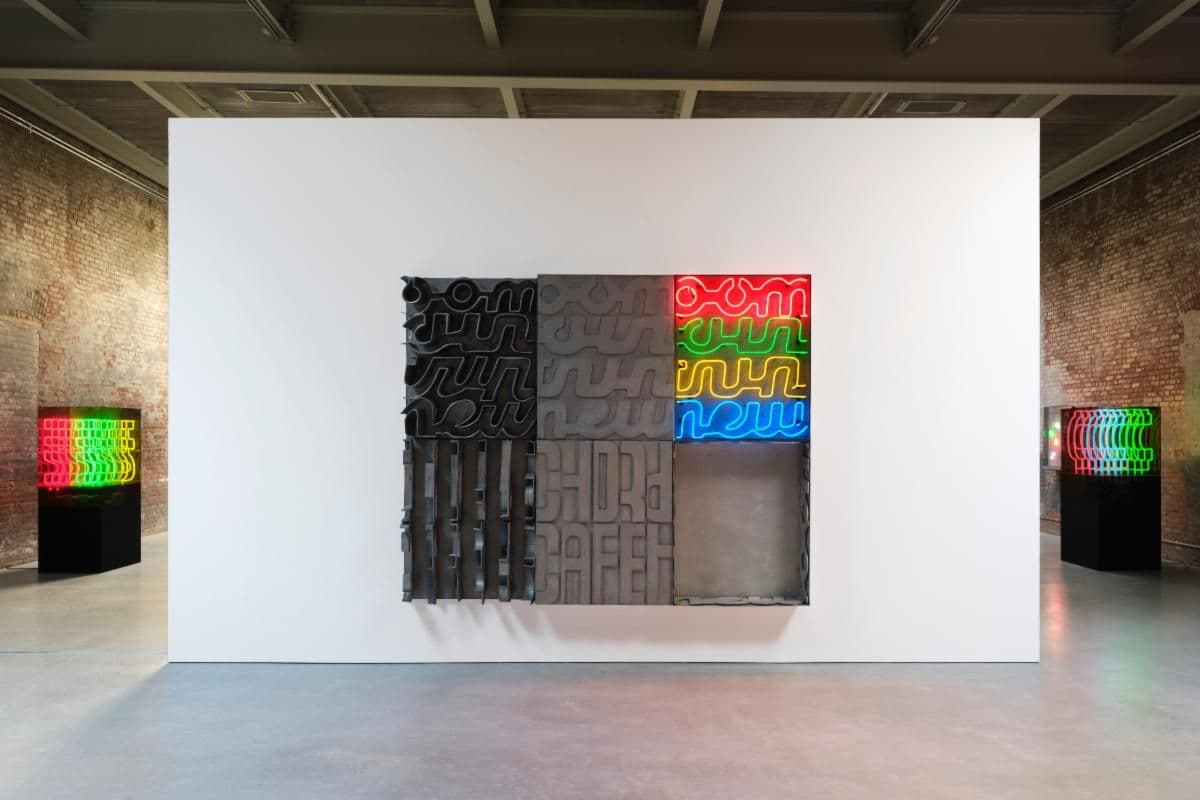
Dia ChelseaCo-organized by Dia Art Foundation and the Menil Collection by Chryssa & New York is the first comprehensive survey of works by Greek-born artist Chryssa (1933–2013) to take place in North America since 1982. A leading figure of the New York art world in the 1950s and ’60s, Chryssa developed an innovative approach to activating sculptural surfaces through subtle manipulations of light and shadow. Pathbreaking in its use of signage, text, and neon, her vastly underrecognized body of work bridges Pop, Conceptual, and Minimalist ideas of art making. Chryssa & New York presents the full breadth of Chryssa's dynamic oeuvre, including early works such as the enigmatic Cycladic Books series (1954–57) as well as numerous reliefs in plaster and metal that deftly capture the phenomenon of passing natural light. The newly restored The Gates to Times Square (1964–66) is displayed alongside works detailing Chryssa’s processes in realizing that monumental sculpture. The exhibition is cocurated by Megan Holly Witko, External Curator, Dia and Michelle White, Senior Curator, the Menil. It is accompanied by the first major publication about Chryssa in more than thirty years. Chryssa & New York is made possible by lead support from the Henry Luce Foundation. The Dia presentation is made possible by major support from Irene Panagopoulos and Stavros Niarchos Foundation (SNF). Significant support by the Brown Foundation, Inc. of Houston, and additional support by Kelley and Christopher Bass, James L. Cahn and Jeremiah J. Collatz and D.Daskalopoulos Collection. Special thanks to Lite Brite Neon. The publication is made possible by generous support from the Anthony E. Comninos Foundation, and additional support by Katherine Embiricos, Christos Papazis, and those who wish to remain anonymous. Public programs are made possible by support from Consulate General of Greece in New York. All exhibitions at Dia are made possible by the Economou Exhibition Fund. — When the Greek-born artist Chryssa moved to New York City in the late 1950s, she was immediately struck by the commercial landscape of her newly adopted home. In particular, she was profoundly moved by her first encounter with Times Square. This famous illuminated intersection (and later, transient urban space) would go on to serve as a key source of inspiration for her pathbreaking embrace of industrial processes and found commercial materials, most recognizably neon. Chryssa was at the forefront of adopting new technologies and ways of thinking about the intersection of art and everyday life in the United States following World War II. Chryssa & New York presents works that exemplify the artist’s practice during her formative years in the city. Key among an influential group of artists introducing industrial methods and electric light into the visual arts (including Stephen Antonakos, Dan Flavin, and François Morellet), Chryssa began working with neon in the early 1960s. She incorporated neon elements and repurposed urban signage into works such as Times Square Sky (1962) and Americanoom (1963), and this combination of materials would soon define her work. She often gleaned discarded letters from sign “graveyards” or worked in partnership with professional sign makers and neon fabricators to create her sculptures. Chryssa’s interest in unconventional materials culminated in the large-scale and encompassing work The Gates to Times Square (1964–66), which measures ten feet deep, wide, and tall. Structured on the form of a bisected capital A and composed of a complex set of layers, The Gates is an homage to the density and energy of Times Square. A small set of red letters from scrapped signs, sliced into fragments and enclosed in plexiglass boxes on each side of the work, serve as building blocks. Chryssa refabricated these forms in metal and neon, repeating and stacking them throughout the structure, to create a dense array of letterforms that paradoxically do not convey meaning. Rolls of cut-out paper fragments—the same shapes used by the artist in her process—are encased in plexiglass at the apex of the sculpture. The artist further investigated these forms in a series of Studies for The Gates, which she made during and after completing the titular work. In each study, she positioned a neon sculpture in a gray-tinted plexiglass box that evokes the atmospheric effect of urban illumination after sunset. She also displayed the electrical mechanisms that power the work. The formal elements of her sculptures are paramount, and Chryssa believed they would endure beyond the limited life span of their technology. “Fortunately, there is the sun and the moon, day and night,” she said. “Without electricity my sculpture will still survive.” [1] While the first gallery displays Chryssa’s later work in neon, the second half of the exhibition examines her early practice, beginning with the Cycladic Books, which she made in three different materials: plaster, terracotta, and marble. The reductive surfaces of these Books are activated by what the artist termed “static light,” that is, the interplay of depth and shadow caused by shifting natural light. [2] Chryssa serendipitously created the first of her Books while casting forms in an open cardboard box. The raised ridges created by the folds and creases nod to the austere forms of the pre-classical Greek figures referenced in the series’ title. Much of Chryssa’s work with natural light was created while she was in dialogue with a loosely connected group of artists living at Coenties Slip in Lower Manhattan. Through her relationship with Agnes Martin, Chryssa was on the fringes of this contingent, who lived and worked in the neighborhood near the South Street Seaport in the late 1950s and early 1960s. [3] The cohort included Robert Indiana, Ellsworth Kelly, Lenore Tawney, and Jack Youngerman, whose varied practices, deeply influenced by nature and the artists’ proximity to the light and reflections of the East River, set the stage for new strategies of abstraction. Chryssa’s interest in capturing light is evident in a series of relief sculptures known as the Projections, which draw on her fascination with the signs and symbols of mass communication. Depicting arrows, as used in street signage, and bold individual letters, these works feature three-dimensional protrusions—or pegs—that catch and activate changing light. The resulting shadows complicate and obscure the clarity of the otherwise recognizable forms. Chryssa’s focus on obfuscation within works that take systems of legibility and communication as their point of departure connects these early efforts to nascent Pop and Conceptual movements. She interrogated other forms of communication in her Newspapers series. For the largest of these works on canvas, Chryssa created grids of letters by repeatedly stamping the surface with printing plates salvaged from newspapers including the New York Times, then based in Times Square. The quasi-mechanical method she used to reproduce stock indices, weather reports, advertisements, and classified ads predates the repetitive use of everyday images that would come to define Pop art. By obscuring the legibility of text and letters across media, Chryssa sought to ques- tion the limitations of language and draw attention to the poetic potential of form and light. In a lecture delivered at New York University in 1968, she stated: “I have many doubts about words that have been established and used in the vocabulary of art. I am desperate because, although they include so many possibilities of interpretation they finally establish a limited understanding.” [4] —Megan Holly Witko 1 - Chryssa, “A Lecture by Chryssa Given on January 10, 1968, at New York University,” Chryssa & New York (New York: Dia Art Foundation, 2023), p. 31. 2 - Ibid, 27. 3 - Megan Holly Witko, “Chronology,” Chryssa & New York, 165. 4 - Chryssa, “A Lecture by Chryssa,” Chryssa & New York, 27.