
Mitte, Berlin
Serban Savu
Golden Ages
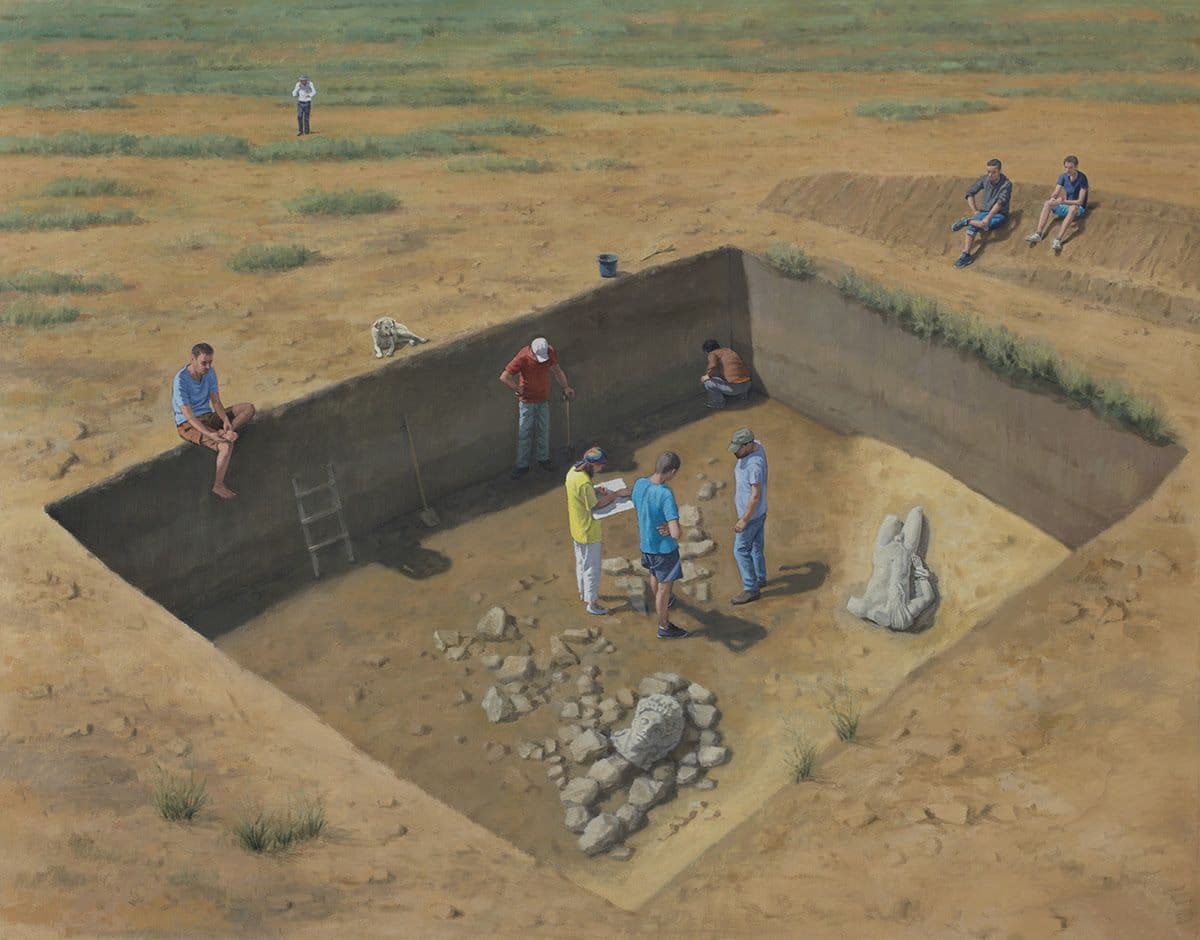
Plan B[Please scroll down for German version / Für Deutsch bitte scrollen Sie nach unten] For Gallery Weekend 2025, Galeria Plan B is pleased to present Serban Savu's sixth solo exhibition with the gallery. Interested in the multiple meanings of visible reality, Savu paints the world around him as reflected through the lens of art history. Characterized by empathy and a keen sense of observation, his paintings employ synthesis and re-composition to invite viewers to reassess the present within a broader historical context. For his solo exhibition, Golden Ages, Serban Savu continues his investigation of history and art history, revisiting and reinterpreting themes such as myths, ruins, and hunting. In a narrative where each epoch is built on the ruins of its precursors, Savu reflects on how we relate to the past, inviting us to view the present as though it already were the past—a continuous sequence of construction and destruction. Underlying these motifs is a deeper meditation on the fragile boundary between the world shaped by human ambition and the elusive remnants of a reality beyond our control. This tension animates the works in Golden Ages, where scenes like archaeological digs unfold with uncanny stillness—moments caught between excavation and entombment, presence and absence. Through such images, Savu constructs a world in which the contemporary and the ancient are not neatly separated by time, but layered—coexisting in silence, as if waiting to be reinterpreted. In contrast to the succession of man-made worlds—each rising from the ruins of the one before it— there still lingers a vestige of untouched nature, a realm that evades not only human intervention but even our imagination. This "real world," elusive and unscripted, stands in stark contrast to the ordered fictions of civilization. Yet since the dawn of history, this unclaimed space has steadily diminished, increasingly shaped and absorbed by human thought and design. Today, it faces near- total assimilation—subsumed by the power of our projections, ideologies, and ambitions. This tension between the fabricated and the untouched resonates deeply in Savu’s latest body of work. While rooted in a realist tradition, his paintings often slide into the surreal, with an erratic logic that disrupts linear narratives and conventional temporality. Figures drift through landscapes that seem at once familiar and estranged, anchored in a present that feels already archaeological. His canvases become contemplative spaces—both scene and artifact—where viewers can sense the quiet echo of tomorrow’s relics. It is said that the past contains all the seeds of the future, including the patterns of decline and rebirth that shape civilizations. Savu’s Golden Ages captures this cyclical rhythm with a delicate irony: the golden age is never now, always just behind or just ahead, its glow both nostalgic and foreboding. Through his painterly synthesis of the everyday and the uncanny, he asks us to look at our own world as if through the eyes of posterity—poised on the edge of transformation, or ruin. Serban Savu (b. 1978 in Sighisoara, Romania) lives and works in Cluj. He graduated from the University of Art and Design, Cluj, in 2001. Recent solo exhibitions include: What Work Is, The Romanian National Pavilion at the 60th Venice Biennale, Giardini della Biennale, Venice (2024); Makeovers, National Museum of Contemporary Art (MNAC), Bucharest (2021); Serban Savu – Echinoctiu, Kunsthalle Bega, Timisoara (2020); Serban Savu - En dérive, Le Lait Centre D’art Contemporain, Albi (2019); Heroes, Saints and Other Figures, Plan B, Berlin (2018); Serban Savu, Museo Pietro Canonica a Villa Borghese, Rome (2018). Selected group exhibitions include: The Twist: Failing Empires, Triumphant Provinces, National Museum of Contemporary Art (MNAC), Bucharest (2024); Reenactment – Recostituire il passato, Galleria D’Arte Accademia di Romania, Rome (2024); Remembering Peace, Kyiv Biennial, Augarten Contemporary, Vienna (2023); Looking Anew and Beyond, Taubman Museum of Art, Roanoke (2023); Lost in the Moment That Follows, Ways of Collecting: Ovidiu Șandor Collection, Kunsthalle Prague, Prague (2023); The Influencing Machine, Ujazdowski Castle Centre for Contemporary Art, Warsaw (2022); Art and The City 1974-2021, Museum of Recent Art (MARe), Bucharest (2021); Geta Bratescu, Adrian Ghenie, Ciprian Muresan, Serban Savu, Fondazione Nicola Del Roscio, Rome (2019); Ciprian Muresan and Serban Savu, L’entretien infini, Centre Pompidou, Paris (2018- 2019); La Brique, the Brick, Caramida, La Kunsthalle, Mulhouse (2019); Landscapes After Ruskin: Redefining The Sublime, Hall Art Foundation, New York (2016); Tracing Shadows, Plateau, Samsung Museum of Art, Seoul (2015); Defaced, Boulder Museum of Contemporary Art, Boulder, Colorado (2014); Romanian Scenes, Espace Culturel Louis Vuitton, Paris (2013). ***** Galeria Plan B freut sich, anlässlich des Gallery Weekend Serban Savus sechste Einzelausstellung in der Galerie zu präsentieren. Im Zentrum von Savus Werk steht das Interesse an den vielfältigen Bedeutungen sichtbarer Realität, die er durch das Prisma der Kunstgeschichte betrachtet. Seine Arbeiten, geprägt von Empathie und einem feinen Beobachtungssinn, nutzen Synthese und Re-Komposition, um die Gegenwart im Lichte historischer Zusammenhänge neu beleuchten. In seiner Ausstellung Golden Ages setzt Serban Savu seine Auseinandersetzung mit Geschichte und Kunstgeschichte fort und wendet sich Themen wie Mythen, Ruinen und Jagd zu. In einer Erzählung, in der jede Epoche auf den Trümmern ihrer Vorgänger aufgebaut ist, reflektiert Savu unser Verhältnis zur Vergangenheit und lädt dazu ein, die Gegenwart zu betrachten, als sei sie bereits vergangen – ein kontinuierlicher Kreislauf aus Aufbau und Zerstörung. Den Motiven liegt eine tiefere Meditation über die fragile Grenze zwischen der von menschlichem Ehrgeiz geformten Welt und den schwer fassbaren Überresten einer Realität jenseits unserer Kontrolle zugrunde. Diese Spannung durchzieht die Werke in Golden Ages – Szenen archäologischer Ausgrabungen entfalten eine unheimliche Stille, eingefangen zwischen Freilegung und Begräbnis, zwischen Anwesenheit und Abwesenheit. In solchen Bildern konstruiert Savu eine Welt, in der sich Gegenwart und Antike nicht klar zeitlich voneinander trennen lassen, sondern als sich überlagernde Schichten koexistieren als warteten sie auf eine neue Deutung. Im Kontrast zur Abfolge menschengemachter Welten – jede erbaut auf den Ruinen der vorherigen – verbleibt ein letzter Rest unberührter Natur: ein Raum, der sich nicht nur menschlicher Einflussnahme, sondern auch unserer Vorstellungskraft entzieht. Diese „wirkliche Welt“, flüchtig und unbeschrieben, steht in starkem Gegensatz zu den geordneten Fiktionen der Zivilisation. Doch seit Anbeginn der Geschichte schrumpft dieser freie Raum, wird zunehmend vom menschlichen Denken und Gestalten geformt und vereinnahmt. Heute droht er nahezu vollständig von unseren Projektionen, Ideologien und Ambitionen verschlungen zu werden. Diese Spannung zwischen dem Konstruierten und dem Unberührten durchzieht Savus jüngstes Werk. Verwurzelt in einer realistischen Tradition, berührt seine Malerei oft die Grenzen zum Surrealen – getragen von einer sprunghaften Logik, die lineare Erzählweisen und konventionelle Zeitlichkeit durchbricht. Figuren treiben durch Landschaften, die zugleich vertraut und fremd erscheinen, verankert in einer Gegenwart, die bereits archäologisch anmutet. Seine Leinwände werden zu kontemplativen Räumen – zugleich Szene und Artefakt – in denen der leise Nachhall künftiger Relikte spürbar wird. Es heißt, die Vergangenheit enthalte alle Keime der Zukunft, auch jene Muster von Verfall und Erneuerung, die Zivilisationen prägen. Golden Ages fängt diesen zyklischen Rhythmus mit feiner Ironie ein: Das goldene Zeitalter ist nie jetzt, sondern liegt stets knapp hinter oder vor uns, sein Glanz ist zugleich nostalgisch und unheilvoll. Mit seiner malerischen Synthese aus Alltäglichem und Unheimlichem fordert uns Savu dazu auf, unsere eigene Welt mit den Augen der Nachwelt zu betrachten – im Moment zwischen Verwandlung und Verfall.