
Ridgewood, New York
Rose Malenfant
Sun-Dried
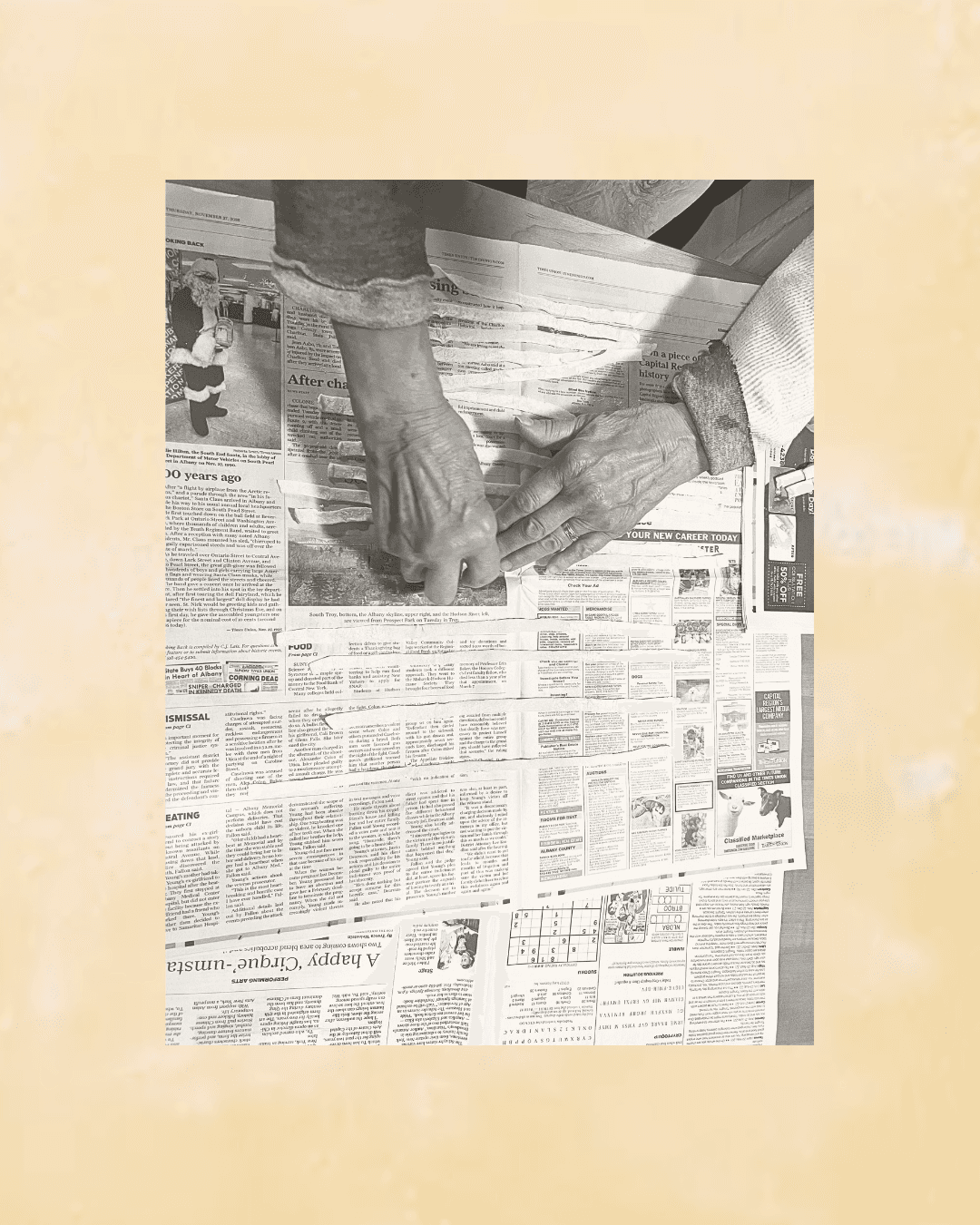
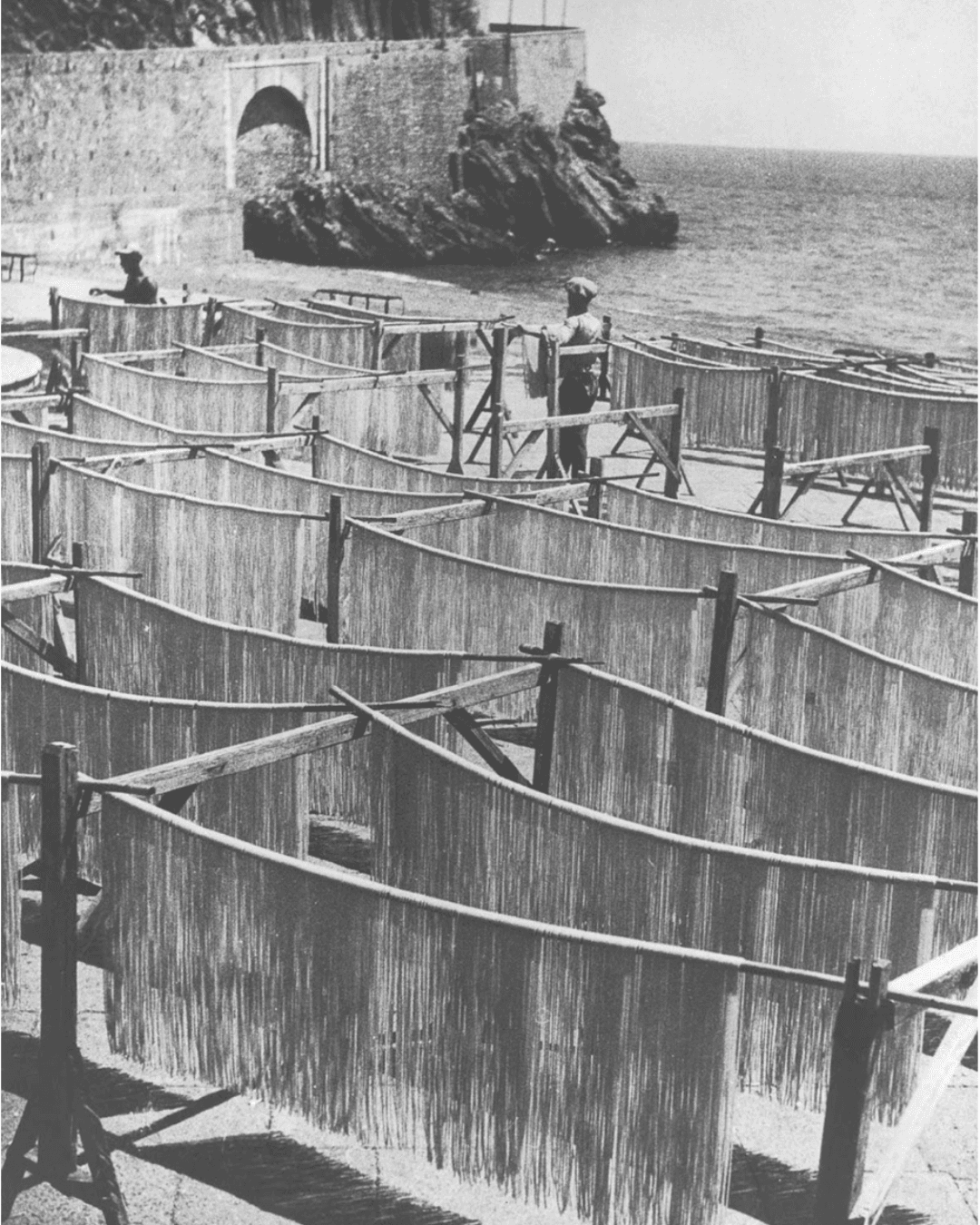
TempestWhen I ask my grandmother how her mom made handmade pasta, she describes the treatment of the dough rather than the recipe. She distinctly recalls the act of folding and cutting the dough in thin strips. She tells me that her mom would lay newspaper over the bed to have enough surface area for the pasta to dry and rest. How poetic that the little hand cut noodles are resting in the same place we rest and sleep. And how beautiful that a bed becomes an extension of the table, in order to have enough space to cook for the whole family. I learned this ritual was derived from how newspaper was put under the wooden drying racks to catch fallen pasta in Southern Italy. A makeshift tool for catching fragments, migrating from the ground to a bed oceans apart. In trying to recreate the Italian drying racks of pasta by the ocean, I learn how interdependent the drying process is on the ocean air, the climate and environment. I assumed it was all accomplished by the sun- but all elements need to cooperate for the pasta to dry without becoming too brittle and cracking. To try and recreate this relationship without the environment brings these encounters of grappling with various truths on change and loss. The pursuit asks for a mix of reverence, being humbled, open, and curious. I think it’s funny how food sneaks throughout the house, and the ocean seems to follow my family home. My grandma tells a story about how her uncles put live fish in the bathtub to keep fresh for cooking the next day. Her mom went to the bathroom at night unaware of this dinner scheming, and screamed at the unexpected sloshing in the dark! There is a saying in Italian to know when pasta dough is ready- that it is rolled thin enough to be able to see the church out the window. A reminder that the process of preparing food comes in proximity to faith. Simple acts of making food and recalling tradition bring us to meet the contrasting cycles of change and loss. Outside my grandmother’s childhood home was a church that was demolished. This changes the landscape of home. In its place, a large industrial supermarket was built- “Price Chopper.” When what you see out the window when making pasta dough changes, the ritual changes. When pasta was laid out to dry on wooden poles in southern Italy, it was accompanied by the ocean. When imitating the process without the climate laden with moisture from the ocean’s salty breeze, this too changes the simple food ritual. The handmade dough dries too quickly, becomes brittle and breaks.. My work underscores that rituals cannot be performed in isolation. Small acts like these; peering through dough at the church, realizing that the presence of the ocean has everything to do with the process; help us to remember that some parts will always be missing, yet we can reimagine a more tactile, conglomerate truth. Synthesizing unity from fragments, in gestures of reverence. —Rose Malenfant Rose Malenfant is an interdisciplinary artist based in Brooklyn, NY. Her practice reinterprets rituals of textiles, the kitchen, and family memories, to de-industrialize our relationships with our bodies/ earth. Rose is a recipient of the 2026 Powerhouse Arts Artist Subsidy Program and has completed residencies with Textile Arts Center and Beam Center. Her work has been exhibited throughout the country including at the World Trade Center, Silver Arts Projects, El Barrio Art Space, and Tempest Gallery. She has received awards from The Art Students League of New York, Agrichampions in food innovation, and the International Society of Experimental Artists. Rose continues to invest in her practice with the Textile Study Group of New York and Women Sculptors Group NY. Rose also works mentoring young artists through climate projects and public art with Beam Center, and has hosted public programming at the Brooklyn Museum, Arts Letters and Numbers and Pratt Institute. Rose's curatorial work includes exhibitions "Semi-Permeable" at Living Skin, "Propagation- Suspended Roots" at Studio 9D, and “Body as a Conduit” at Textile Arts Center. Caitlin Reid is a Brooklyn-based painter whose practice bridges collage, representational oil painting, and deep archival research. As Program Director of Tempest Gallery, where she has interviewed over thirty contemporary artists, and co-founder of the artist collective Immaterial Projects (2023–25), her studio work is deeply informed by curatorial thinking and cross-disciplinary dialogue. Reid is currently developing love is a force of nature, a major body of paintings synthesizing fifteen years of personal diaries, classical Greek mythology, and spiritual experience.