
SoHo, New York
Group Exhibition
Earth and Accident
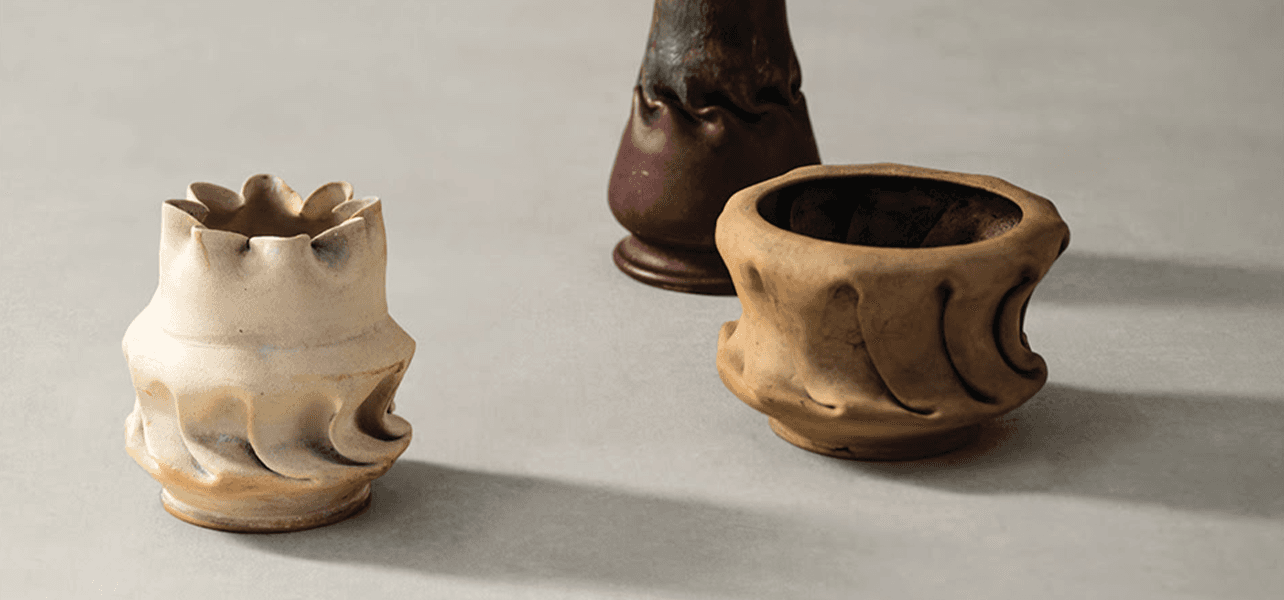
Guild GalleryLudmilla Balkis, Peter Callas, Rick Hintze, Akiko Hirai, Eisuke Morimoto, Hitoshi Morimoto, George Ohr, Toshiko Takaezu, Peter Voulkos, Casey Zablocki Guild Gallery is pleased to present a group exhibition of ceramic mastery that expands on the gallery’s début presentation at Frieze Masters 2023. Earth and Accident, curated by Luke Syson, Director of the Fitzwilliam Museum at the University of Cambridge, celebrates the formal qualities that can transform clay by happenstance of nature and heat, and marks the first time the gallery is showing historic works alongside works by contemporary masters. In defiance of the industrialization of inexpensive, abundant china in the 19th century, the ethos of the British studio pottery movement influenced generations of American and Japanese ceramicists. These artists embraced the movement’s deep interest in the aesthetics and formal qualities of a ceramic work in addition to its function. The exhibition features examples by some of the most renowned practitioners of 20th-century studio ceramics, including George Ohr, Peter Voulkos, and Toshiko Takaezu—all of whose work crossed the divide between ceramic craft and fine art—as well as the next generation of ceramic artists, including Rick Hintze, Peter Callas, Ludmilla Balkis, Eisuke Morimoto and his son Hitoshi Morimoto, Casey Zablocki, and Akiko Hirai, who continue to define studio ceramics today. Ludmilla Balkis (b. 1981, France) has been defining sumptuous minimalism for decades, first as a fashion designer for houses including Phoebe Philo’s Céline, and now as a ceramicist, manipulating clay like fabric for her swirling, gently folded vessels. Building on her background in fashion and art history, Balkis studied ceramics with Freya Bramble Carter in 2014 in London. Initially she drew inspiration from the distinctive approaches of pioneering ceramicists Lucy Rie, Hans Copper, and Jennifer Lee. Then, after returning to France in 2017, she was introduced to Japanese and Korean approaches to clay. Based in Basque country, daily contact with soil and the area’s raw, natural splendor have become central to her practice, breathing new life into her search for imperfection and unequivocal devotion to minimalism. Balkis has exhibited in galleries and museums across Europe, including Paris, Biarritz, and Berlin. Peter Callas (b. 1952, USA) is one of the foremost American sculptors working in clay today, he forges large-scale, abstractexpressionist sculptures using a traditional wood-fired anagama kiln. After an extensive period of studying anagama kilns in Japan early in his career, he built one of his own in America, the first ever constructed in the country. Callas’s inventive creations possess an ancient quality, seemingly battle-worn and scarred, as if they live and breathe, whisper and sigh—but within them pulses an undercurrent of tension, energy, and passion, reflecting the artist’s inner life and aesthetic vision. Callas has exhibited work in Australia, France, Germany, Brazil, China, Korea, Japan, Norway, and throughout the United States. In 2017, he was elected to the International Academy of Ceramics, and in 2018, he received the prestigious Pollock-Krasner Foundation Grant. His work is found in museum collections in America and around the world. Rick Hintze (b. 1944, USA) makes monumental sculptures, striking coiled vessels, and functional pots out of humble, natural materials, often working with clay, iron oxide, and wood ash. Their surfaces are indelibly marked by the focused, deliberate movement of his hand, and their textures are born from spontaneous interactions with the natural elements: earth and air, fire and water. A recipient of the National Endowment for the Arts Individual Artist Fellowship, among other awards, Hintze received a B.A. in art from Knox College, an M.A. in Art History from the University of Iowa, and an M.F.A. in Ceramics from the University of Notre Dame. His work is in the collections of the Racine Art Museum, the Cedar Rapids Museum of Art, Southeastern Louisiana University, Ripon College, and various regional and national private collections. Born in Shizuoka, Japan, Akiko Hirai (b. 1970) evidences the unstable and unpredictable nature of clay and fire in the imperfections of her signature heavily textured vessels. Made by hand on a wheel in London, Hirai’s work reflects Japanese tradition, honoring chance and nature through the formation of clay and ash, the surface tension between rough and refined she draws with her fingers, and the marks gathered in the firing process. Hirai studied ceramics at the University of Westminster and Central Saint Martins. She was shortlisted for the Loewe craft prize in 2019, and her work can be found in the collections of Germany’s Keramikmuseum Westerwald and England’s Victoria and Albert Museum. The Japanese ceramicist Eisuke Morimoto (b. 1941) is a modern master of Bizen-yaki, the oldest living form of pottery in Japan and one of the six forms adapted from Korea’s stoneware tradition during the Heian period roughly 1,200 years ago. Morimoto still uses the four-chamber Nobori-kama wood-fired kiln he built a half century ago, as does his son Hitoshi Morimoto, to whom he has passed on this ancient tradition, and an internationally acclaimed sculptor in his own right. The soil used to form Morimoto’s clay is mined from the fields of Inbe, near his home in Bizen. To achieve his signature Bizen-yaki finishes, Morimoto uses no glazes or paints of any kind; instead, the hues of his work are born from preexisting qualities found in his clay, brought out under extreme heat during the firing process. The Japanese ceramicist Hitoshi Morimoto (b. 1976) is an emerging master of Bizen-yaki, ushering the oldest living form of pottery in Japan into a revolutionary new era. Working with local soil mined from the fields of Inbe and firing his pieces in a 50-year-old kiln hand-built by his father, the celebrated Bizen artist Eisuke Morimoto, Hitoshi forges works of unglazed clay and ash marked by their intricate textures, bold colors, and expressive finishes. The self-proclaimed “Mad Potter of Biloxi,” George Ohr (b. 1857, d. 1918) transformed the traditional folk aesthetic in pottery into a pioneering form all his own. The self-taught American ceramicist’s vessels are technical tours de force, unrivaled in the thinness of their bodies, the control with which they are shaped—and, crucially, the ways they are misshapen. Ohr threw technically perfect vessels, then folded and twisted them into unique, unconventional forms. Though he claimed to have made more than 20,000 ceramic pieces, his work remained largely unknown at the time of his death in 1918. For decades, his pots sat in a garage in Mississippi, behind a gas station owned by his sons, before being unearthed and recognized for their preeminent, groundbreaking importance: Ohr’s work is now seen as a harbinger of the American abstract sculpture and pottery movement, a significant chapter in the history of American ceramics that rose to prominence in the mid-20th century. Toshiko Takaezu (b. 1922, d. 2011) was an American ceramic artist, painter, sculptor, and educator who is known for her rounded, closed forms that helped push ceramics, long regarded merely as functional vessels, into the realm of fine art. Born in Hawaii to Japanese parents, Takaezu studied painting at the University of Hawaii and ceramics at the Cranbrook Academy of Art, where the influence of modernism took hold in her work. She traveled to Japan in 1955, exploring Zen Buddhism, tea ceremony, and the techniques of traditional Japanese pottery, all of which manifested in her pieces. Known as a profoundly influential teacher and mentor, Takaezu indelibly shaped generations of younger artists at the Cleveland Institute of Art and Princeton University. Her work is found in the collections of the Metropolitan Museum of Art in New York, the Museum of Fine Arts in Boston, the Los Angeles County Museum of Art, and the Philadelphia Museum of Art, among dozens of other museums. A legendary figure in the history of American ceramics, Peter Voulkos (b. 1924, d. 2002) was a Greek-American artist renowned for his abstract expressionist sculptures, which crossed the traditional divide between ceramic crafts and fine art, helping to revolutionize the form. He established the ceramics departments at the Los Angeles County Art Institute and at UC Berkeley, where he became known for the live sculpting sessions he held in front of his students, demonstrating his intense, even unforgiving approach to working with raw material while simultaneously showcasing his mastery of craft. His work is found in more than 100 museum collections around the world, including the Metropolitan Museum of Art and the Museum of Modern Art in New York; the Smithsonian in Washington, D.C.; the Philadelphia Museum of Art; the Stedelijk Museums in Amsterdam and Eindhoven; and the Tokyo Folk Art Museum and the Kyoto National Museum of Modern Art in Japan. Portraits of time and deterioration, Casey Zablocki’s (b. 1982) functional sculptures are born from consistent experimentation with clay recipes and wood ash combinations. Inspired by the convergence of five mountain ranges at his home in Missoula, Montana, Zablocki’s magnificent surfaces evoke the surrounding wood, earth, water, and fire, blooming from extreme and prolonged heat exposure within the large anagama kilns in which the works are fired - often for up to twelve days at a time. Zablocki has spent decades immersed in creative practice: he grew up in a family of makers in the Upper Peninsula of Michigan, studied at Montana State University, and apprenticed for world-renowned sculptors Peter Callas and Hun Chung Lee.