
Marais, Paris
Soufiane Ababri
Si Nous ne Brûlons Pas, Comment Éclairer la Nuit?
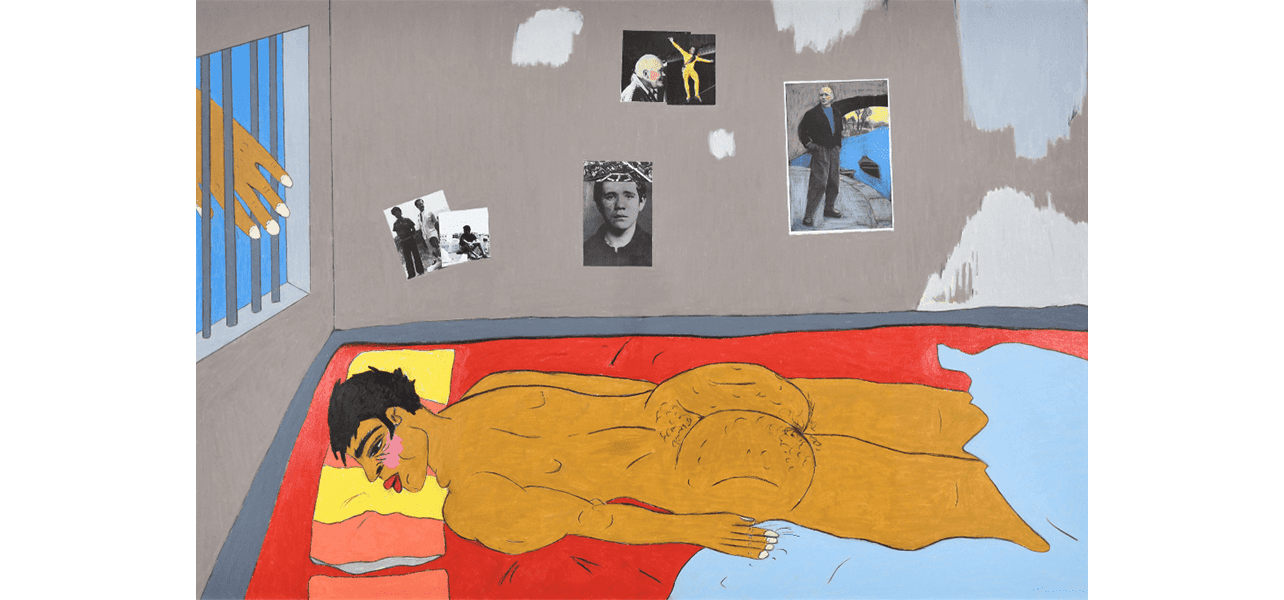
Praz-Delavallade[Scroll down for French version / Veuillez trouver ci-dessous la version française] "if I don’t burn if you don’t burn if we don’t burn how will the light vanquish the darkness" —Nâzım Hikmet Praz-Delavallade is pleased to present Si Nous ne Brûlons Pas, Comment Éclairer la Nuit?, Soufiane Ababri's second personal exhibition with the Paris gallery. These words taken from a poem written by Nâzım Hikmet in 1930 have been reinterpreted by Soufiane Ababri for the title of his new exhibition. The Turkish poet was imprisoned several times because of his political activities and was obliged to live in hiding and in exile, before being stripped of his nationality, which would only be restored after his death. In “Kerem Gibi”, the poem from which these lines are taken, Hikmet takes a traditional 16th century folk tale telling the story of a forbidden love and transforms it into a call for revolutionary action. Ababri revisits the subversive nature of eroticism, bringing together various works that address, each in their own way, the theme of a fall from grace. At the origin of the project are two long, horizontal drawings on remnants of paper from the large rolls that Ababri uses for his drawings, pieces that he put aside for a long time because of their atypical format. In one of them, a naked figure is being dragged along the ground as if the victim of physical punishment, unless he is trying to prevent a man who has lost interest in him from leaving. In the other, a man who has obviously stayed too long in the sun flops drunkenly on a table. These scenes of humiliation and woe feature characters who have fallen from grace; not only do they evoke the nature of the paper on which they have been brought to life – scrap paper – but also the characters’ marginal status. Starting from this observation, Ababri sets out to study the notion of the fall. Whether the fall is physical, moral or social, falling is a recurrent theme in Western art. In the mid 16th century for example, Pieter Bruegel the Elder painted several works on the subject that have since become famous, such as the fall of Icarus or of the rebel angels, however the most exemplary painting is The Blind Leading the Blind (1568). Using a diagonal composition, it portrays six characters (who embody spiritual blindness) falling in progression, the last collapsing to the ground. More recently, the existentialist filmed performances of Bas Jan Ader – falling from the roof of a house, into a canal in Amsterdam or from the branch of a tree – evoke a quest for the absolute and a desire to sacrifice everything for the moment. The figure of Jean Genet – considered emblematic by Ababri – exemplifies such a romantic conception of the fall. In one of the works on show, Ababri references Genet by means of a collage of various images on the wall of a cell where a prisoner is lying on his bed. The scene is reminiscent of the first paragraphs of Our Lady of the Flowers(1943) in which Genet describes the photos of the men he fantasises about that he has taped to the walls of his cell. In the collage, Ababri uses pages that have fallen out of an old biography of the French writer. The images include a portrait of a young Genet with an aerial view of one of the prisons in which he was incarcerated. In another photo he is older and seems to be looking at the tightrope walker Abdallah Bentaga, his partner for several years who committed suicide at the age of 28. On another photo, we can see Ababri himself sitting on Genet’s grave, which is in Morocco not far from where the artist grew up. Like the characters in his books, Genet always refused to fit in the mould. Abandoned as a child and then adopted, he often ran away from home preferring to live on the run. His life was one of constant reinvention, however for Genet reinventing himself was not synonymous with sublimation or social mobility. Throughout his life Genet fought against the diktats of success, bearing witness on the contrary to the temptations of evil and a life considered by some to be seedy and disreputable. Another non-conformist literary figure present in the exhibition is Oscar Wilde, who is lying in a Christ-like pose in the middle of a large drawing surrounded by young Algerians. Once again, this is not an illustration but rather a reinterpretation of Wilde’s biography that was inspired by André Gide’s account of how Wilde took him to Algeria and introduced him to what is known today as sex tourism. Wilde indisputably personifies the fallen man. At the height of his success, he was sentenced to two years’ hard labour for being a homosexual and all his property was seized. In Ababri’s portrait, the young men encircling Wilde as golden coins rain down are far from being loyal followers kneeling before him with tears in their eyes. They seem instead to be joyous. Rather than being subjected to sexual colonialism, they revel in the freedom of their bodies and desires. Ababri belies the clichés associated with homoeroticism and the Orient, not so much to do away with them entirely, but rather to complexify them. The same goes for the ensemble of drawings on pink paper that draw inspiration from the Turkish film Hammam(Ferzan Özpetek, 1997). Throughout the illustrated sequence, the main character is separated from reality by a sort of fog (as in the steam bath), a device which keeps the homoerotic relations portrayed therein at a distance as if to reappraise them. This challenging of preconceived ideas continues in Ababri’s preference for cheap everyday materials purchased in supermarkets and the like rather than artist materials. Eschewing academic hierarchy, his approach aims to be more egalitarian. In the same vein, when designing each exhibition, he paints the walls in colours with a more homely feel to get away from the image of the sacrosanct white cube. In this exhibition he has opted for purple, a colour often associated with the gay community. The colour is the exact same shade as seen in Suicide (Purple Jumping Man), a 1963 silkscreen print by Andy Warhol based on a press photo of a man jumping out of a window. This tragic scene has completely disappeared and only the mauve colour remains in the form of speech bubbles signifying a fall or a disappearance. Warhol is one of these “faggots” of whom Ababri has produced numerous portraits and which are assembled under the title Yes I am. In this series Ababri has been portraying the queer community for several years, bearing witness both to the kinship between and the unique nature of its members. In this exhibition, the series only appears in residual form with reference images recycled to create a spiral composition. In addition to Warhol, this work includes James Baldwin, Tom Ford and Jimmy Sommerville, as well as John Waters and his muse Divine, who was so called by the Baltimore-born filmmaker in a tribute to the drag queen in the aforementioned novel by Jean Genet. Just like the art of drag of which Divine is an icon, voguing is an art form that exaggerates everyday attitudes. From the 70s on, this dance style became a new form of expression and means of recognition for people marginalised because of their gender identity, sexual orientation, ethnic origins or social class. Voguing has since been a tool of empowerment. One of the basic movements in voguing is the “dip”: a theatricalised fall in which the performer flamboyantly collapses on the ground in a move that turns the action of falling into a sublime and quintessential physical performance. Soufiane Ababri describes his creations as “bedworks”, because they are drawn while the artist is lying on his bed. The importance of this inverted perspective - a posture that contradicts the myth of the virile artist painting in his studio in a standing position - has already been analysed. Here our attention is drawn to the word “embedded” written on one of the exhibited drawings. A text written to either side of an erect penis reads: “Something between fear and desire has become embedded in me since I tasted the depth of your night”. Night, which evokes the darkness in Nâzım Hikmet’s poem, is a time when anything goes, a moment that gives rise to different connections with oneself and others in which fear and desire prevail. Once revealed, these contradictory feelings appear “embedded” and therefore inalienable. In exploring the fall, Ababri reminds us of the importance of taking risks and possibly falling, like the tightrope artist walking on the rope, to come into being in the world and to oneself. —Devrim Bayar ***** «Si je ne brûle pas si tu ne brûles pas si nous ne brûlons pas comment les ténèbres deviendront-elles clarté ?» —Nâzım Hikmet Praz-Delavallade est heureux de présenter Si Nous ne Brûlons Pas, Comment Éclairer la Nuit?, seconde exposition personnelle de Soufiane Ababri à la galerie parisienne. C’est en 1930 que le poète turc Nâzım Hikmet écrit ces vers que Soufiane Ababri réinterprète pour le titre de sa nouvelle exposition. Condamné à plusieurs reprises en raison de son activisme politique, Hikmet a longtemps vécu emprisonné, connu l’exil et la clandestinité, avant d’être déchu de sa nationalité turque qui ne lui sera rendue que de manière posthume. Dans le poème « Comme Kerem » d’où sont tirées ces quelques phrases, Hikmet transforme un conte traditionnel du 16ème siècle, qui relate un amour interdit, en un appel à l’action révolutionnaire. Ababri reprend ce thème de la portée subversive de la force érotique et rassemble ici différents travaux qui traitent, chacun à leur manière, de déchéance. Deux dessins allongés sont à l’origine du projet. Réalisés sur des chutes de grands rouleaux de papier qu’Ababri utilise pour ses dessins, ils ont longtemps été laissés de côté par l’artiste à cause de leur format atypique. Dans l’un, un personnage nu est traîné à terre comme s’il subissait une punition physique, à moins qu’il n’essaie de retenir un homme qui ne veut pas de lui. Dans l’autre, un homme vraisemblablement resté trop longtemps au soleil s’affaisse à table, saoul. Ces scènes d’humiliation et de déboire présentent des sujets déchus, qui rappellent non seulement le support sur lequel ils prennent forme – à savoir des résidus de papier – mais aussi leur statut marginalisé. Partant de ce constat, Ababri entreprend une épistémologie de la chute. Dans l’histoire de l’art occidental, la chute, qu’elle soit physique, morale ou sociale, est un thème récurrent. Au milieu du 16ème siècle, Pieter Brueghel l’Ancien, par exemple, a peint plusieurs tableaux, aujourd’hui devenus célèbres, qui traitent de la chute, comme celle d’Icare ou des anges rebelles, mais c’est sa Parabole des Aveugles (1568) qui est à cet égard exemplaire. Dans une composition en diagonale, il divise en six phases le mouvement de chute des personnages qui incarnent l’aveuglement spirituel et s’écroulent. Plus près de nous, les vidéos-performances existentialistes de Bas Jan Ader, qui se laisse tomber du haut d’une maison, dans un canal d’Amsterdam ou d’une branche d’arbre, évoquent la quête d’absolu et le désir de tout sacrifier à l’instant. C’est probablement à cette conception davantage romantique de la chute que la figure de Jean Genet, emblématique pour Ababri, peut être rapprochée. Dans une des œuvres exposées, Ababri introduit Genet à travers un collage de différentes images sur le mur de la cellule d’un prisonnier couché sur sous lit, qui n’est pas sans rappeler un passage inaugural du livre Notre-Dame-des- Fleurs (1943) dans lequel Genet décrit les photos d’hommes à propos desquels il fantasme et qu’il accroche au mur de sa cellule de prison. Pour son collage, Ababri a utilisé des pages tombées de la biographie de l’écrivain français, dont la reliure s’est défaite avec le temps. On y voit un portrait de Genet jeune, surmonté d’une vue aérienne d’une des prisons où il fut incarcéré, et un autre de lui plus âgé qui semble regarder en direction du funambule Abdallah Bentaga, son compagnon pendant plusieurs années qui se suicidera à l’âge de 28 ans. Sur une autre photo, c’est Ababri lui-même qui apparaît, assis sur la tombe de Genet au Maroc, non loin de là où l’artiste a grandi. Comme les personnages de ses livres, Genet a toujours résisté au moule social. Enfant abandonné puis adopté, il devint fugueur et vécut souvent en cavale. Son parcours fut celui d’une réinvention constante. Mais pour lui, se réinventer n’était pas synonyme de sublimation ou d’ascension sociale. Au contraire, Genet résista toute sa vie au dictat positiviste de la réussite et témoigna, au contraire, de la séduction du mal et des mondes interlopes. Un autre figure littéraire non-conformiste présente dans l’exposition est celle d’Oscar Wilde. Couché tel un Christ en croix au centre d’un grand dessin, il est entouré de jeunes algériens. A nouveau, il ne s’agit pas d’une illustration mais d’une réinterprétation de la biographie de Wilde, pour laquelle Ababri s’est inspiré du récit qu’en a fait André Gide, à qui Wilde fit découvrir l’Algérie où il l’initia à ce qu’on appelle aujourd’hui le tourisme sexuel. Sans conteste, Wilde personnifie l’homme déchu. Condamné pour son homosexualité alors qu’il était au pic de sa gloire, l’écrivain se vit contraint à des travaux forcés et à deux ans de prison, tandis que tous ses biens furent confisqués. Dans le portrait d’Ababri, les jeunes hommes qui encerclent Wilde sous une pluie de pièces d’argent sont loin d’être des fidèles agenouillés en pleurs. Au contraire, une joie semble les animer. Les assujettis du colonialisme sexuel affichent ici l’autonomie de leurs corps et de leurs désirs. Ababri déjoue les clichés associés à l’homoérotisme oriental, non pas tant pour en annihiler l’existence que pour les complexifier. Il en va de même dans l’ensemble de dessins sur papier rose qui s’inspire du film turc Hammam (Ferzan Özpetek, 1997). Comme dans le bain de vapeur, le personnage principal qui revient dans la séquence illustrée est enveloppé dans une sorte de brouillard qui le coupe de la réalité. Les rapports homoérotiques représentés sont mis à distance, comme pour mieux les repenser. Cette mise en cause des idées toutes faites se prolonge dans la technique utilisée par Ababri. Aux outils associés aux Beaux-Arts, il oppose des fournitures bon marché, achetées dans des magasins non spécialisés. A rebours de la hiérarchie académique, sa démarche se veut davantage égalitaire. Dans le même ordre d’idée, il scénographie ses expositions en peignant les murs avec des couleurs qui leur confèrent souvent un caractère domestique et déjouent ainsi la sacralité du white cube. Ici, il choisit du violet, couleur couramment associée aux luttes homosexuelles, dont la teinte est identique à celle d’une sérigraphie de Warhol, Suicide (Purple Jumping Man) (1963), faite à partir d’une photo trouvée dans la presse qui montre une personne se jetant par la fenêtre. La scène tragique a complètement disparu, seule la couleur mauve subsiste sous la forme de bulles de comics signifiant un mouvement de chute ou de disparition. Warhol est un de ces « faggots » dont Ababri a réalisé de nombreux portraits rassemblés sous le titre « Yes I am ». À travers cette série, Ababri tisse depuis des années une communauté queer qui témoigne autant de la parenté que de la singularité de ses membres. Dans l’exposition, la série n’apparaît que sous forme résiduelle : des images de référence ont été recyclées pour créer une composition en spirale. Outre Warhol, on y reconnaît James Baldwin, Tom Ford, Jimmy Sommerville, ou encore John Waters et son égérie Divine, nommée ainsi par le cinéaste de Baltimore en hommage à la drag queen du roman de Genet précité. À l’instar du drag dont Divine est une figure iconique, le voguing rejoue sur un mode exacerbé des attitudes quotidiennes. À partir des années 70, ce style de danse devient une nouvelle forme d’expression et de reconnaissance pour des personnes marginalisées en raison de leur genre, leur sexualité ou leur origine ethnique et socio-économique. Le voguing sert ainsi d’outil d’empowerment. Un des mouvements élémentaires du voguing est le « dip », soit une théâtralisation de la chute où les performers s’effondrent au sol dans un élan flamboyant et subliment l’acte de tomber en une performance physique incarnée. Soufiane Ababri qualifient tous ses travaux de « bedworks », dans le sens où ils ont été dessinés alors que l’artiste était en position couchée dans son lit. L’importance de cette perspective inversée et de cette posture qui déjoue le mythe viril de l’artiste qui peint à la verticale dans son atelier a déjà été explicitée ailleurs. C’est ici le verbe « embedded » écrit sur un des dessins qui interpelle. De part et autre d’une verge en érection, on peut lire : “Something between fear and desire has become embedded in me since I tasted the dept of your night”. La nuit, qui rappelle les ténèbres du poème de Nâzım Hikmet, fait tomber les interdits et engendre un autre rapport à soi et aux autres, qui mêle peur et désir. Une fois révélés, ces sentiments antagonistes apparaissent ancrés – embedded – et donc inaliénables. À travers son exploration de la chute, Ababri rappelle la nécessaire prise de risque, comme celle du funambule qui avance seul sur son fil, pour advenir au monde et à soi-même. —Devrim Bayar