
Collateral, Venice
Lucio Fontana / Antony Gormley
Lucio Fontana / Antony Gormley
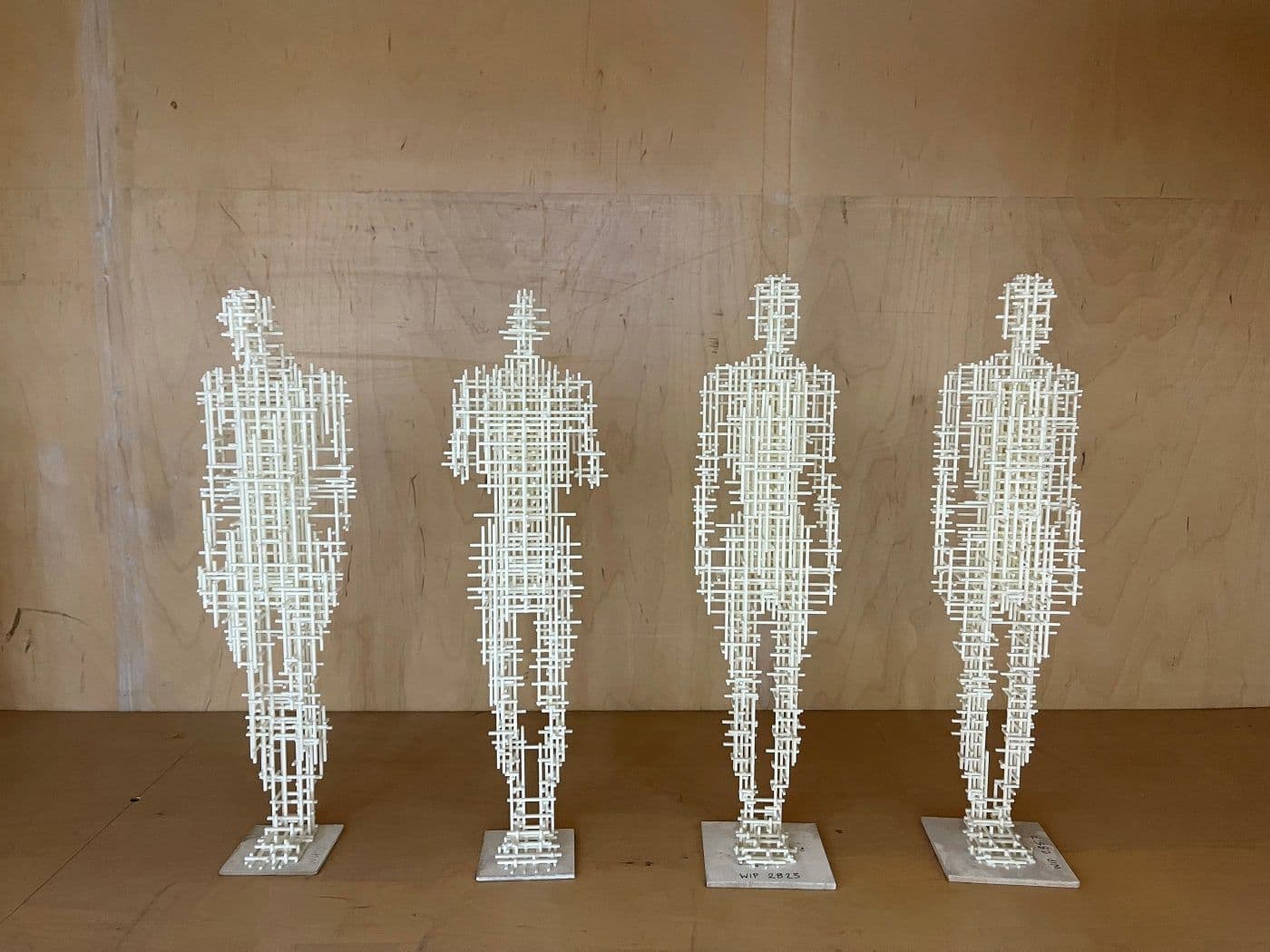
Negozio OlivettiTwo masters of sculpture, Lucio Fontana and Antony Gormley, meet for the first time through a presentation of graphic works, works on paper and sculpture. The exhibition takes shape inside an extraordinary space: the Negozio Olivetti, property of Generali Assicurazioni and entrusted to the care and management of FAI, an architectural jewel completed in 1958 and nestled in the porticoes of Piazza San Marco in Venice and designed by Carlo Scarpa. The exhibition has been conceived and curated by Luca Massimo Barbero, one of the world’s leading scholars of Lucio Fontana as well as a scientific consultant to the Foundation dedicated to the artist. The exhibition is built around a concise association of space and light to be found in the work of both sculptors. It will develop across a selection of drawings made by Fontana between 1946 and 1968 and a series of drawings, workbooks and models that run through all aspects of Antony Gormley's research, together with the presence of some sculptures by both of the artists. Lucio Fontana: "I make holes; infinity passes through, light passes, there is no need to paint ... everyone thought that I wanted to destroy: but that’s not true, I’ve created, not destroyed." Antony Gormley: "Lucia Fontana spent a lifetime revealing the fact that space exists behind appearance and inviting us to experience it. I am thrilled to have this opportunity to have a dialogue with him through objects and drawings in which body and space are continually seen as equivalent mediums of apprehension." Luca Massimo Barbero: "Fontana and Gormley’s work with sculpture goes beyond time. In Lucio Fontana’s works space becomes a timeless and ahistorical place. Sign and body interact intimately in the conceptual path that supports Antony Gormley's research and that leads to the total rupture of the boundaries imposed between inside and outside, space and time." Lucio Fontana (1899-1968) was one of the most influential artists of the 20th century, propelled by a boundless creative outlook which pushed him to experiment across different forms and methods of expression. Known as the father of Spatialism, from the 1930s the work of the Italo-Argentine revolutionised the understanding of sculpture, space and painting, prefiguring the art movements of the 1960s and 1970s, such as Arte Povera, Conceptual Art and Environmental Art. From the outset, Fontana found critical acclaim and his works were the subject of numerous exhibitions in private and public institutions alike. The 1960s mark his international breakthrough, as seen by solo shows at the Walker Art Center (Minneapolis, 1966), at the Stedeljik Museum (Amsterdam, 1967) and at the Moderna Museet (Stockholm, 1967), amongst others. His renown, which saw him win the prize for Italian painting at the 33th International Art Exhibition of La Biennale di Venezia in 1966, is evident today in exhibitions which underscore the significance of his work, including recent solo exhibitions at Hauser & Wirth (Los Angeles, 2020); MaMM (Moscow, 2019); Guggenheim Museum (Bilbao, 2019); The Met Breuer (New York, 2019); Pirelli Hangar Bicocca (Milan, 2017) and Museé d'Art Moderne de la Ville de Paris (Paris, 2014). His works are housed in the collections of the world’s leading art museums. Antony Gormley (b. London, 1960) is widely acclaimed for his sculptures, installations and public artworks that investigate the relationship of the human body to space. His work has developed the potential opened up by sculpture since the 1960s through a critical engagement with both his own body and those of others in a way that confronts fundamental questions of where human beings stand in relation to nature and the cosmos. Gormley continually tries to identify the space of art as a place of becoming in which new behaviours, thoughts and feelings can arise. Gormley’s Collateral Event at the Biennale Arte 2022 presentation will coincide with another solo exhibition in Italy at Galleria Continua’s gallery space in Tuscany: a former theatre and cinema located in the medieval hill town of San Gimignano, a UNESCO World Heritage Site. Body Space Time continues Gormley’s lifelong investigation of the body as place and the structuring of space. The exhibition runs from Saturday 23 April until 4 September 2022. Gormley's work has been widely exhibited throughout the UK and internationally. Gormley was awarded the Turner Prize in 1994, the South Bank Prize for Visual Art in 1999, the Bernhard Heiliger Award for Sculpture in 2007, the Obayashi Prize in 2012 and the Praemium Imperiale in 2013. In 1997 he was made an Officer of the British Empire (OBE) and was made a knight in the New Year's Honours list in 2014. He is an Honorary Fellow of the Royal Institute of British Architects, an Honorary Doctor of the University of Cambridge and a Fellow of Trinity and Jesus Colleges, Cambridge. Gormley has been a Royal Academician since 2003. Luca Massimo Barbero (b. Turin, 1963) is an art historian and critic, Director of the Institute of Art History of the Giorgio Cini Foundation, member of the scientific committee of the Farnesina Collection and Associate Curator for the collections of modern and contemporary art of Intesa Sanpaolo. His exhibitions have been conceived and produced by major Italian institutions, including the Peggy Guggenheim Collection in Venice - of which he was Associate Curator for years - The Modern Art Gallery and the Macro Museum of which he was director in Rome, La Biennale di Venezia and Palazzo Reale in Milan. An author of many publications and exhibitions dedicated to post-war Italian and American art, he has investigated in particular the Italian avant-garde authors of the second half of the twentieth century with considerable attention to the study of the work of Lucio Fontana. In 2013 he published the Catalogue Raisonné of Lucio Fontana's work on paper, the result of over six years of study and research under the aegis of the Lucio Fontana Foundation, with the contribution of prof. Enrico Crispolti. In continuity with the study of documentation undertaken through this publication, he is working now on the forthcoming publication of the Catalogue Raisonné of works on ceramics, under the auspices of the Lucio Fontana Foundation.