
Tribeca, New York
Christopher K. Ho
Waterloo!
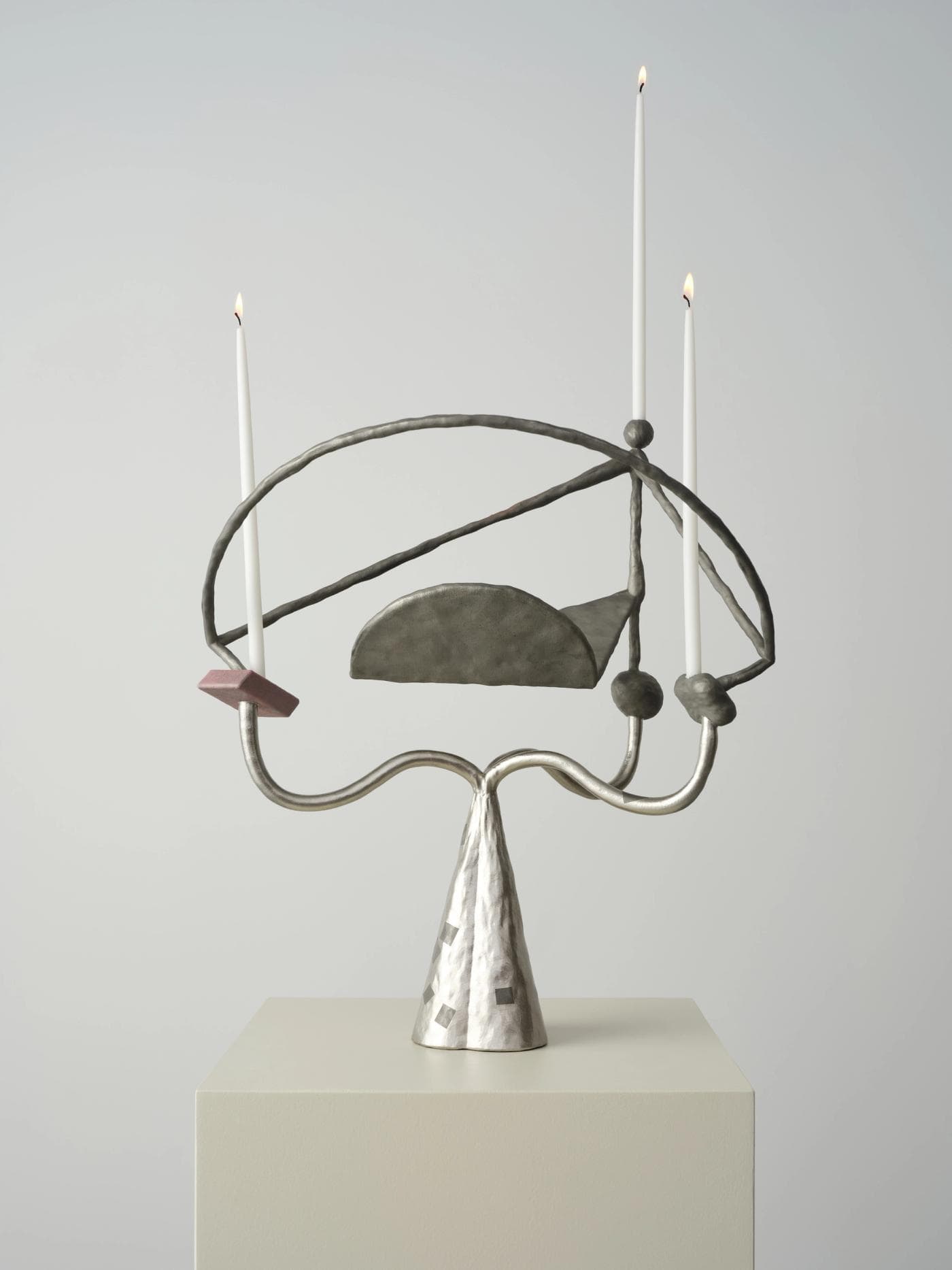
Ellie Rines GalleryEllie Rines Gallery fka 56 Henry is proud to announce its inaugural exhibition, Waterloo!, a presentation of twenty new sculptures by Christopher K. Ho at 46 Walker Street. Marking Ho's third solo show with the gallery, Waterloo! investigates the pivot from the Napoleonic Wars to the insular, middle-class Biedermeier era to formulate a theory of our contemporary moment. Grounded in a reading of art historian T. J. Clark's The Absolute Bourgeois, the exhibition mines the aesthetics and mythologies of historical revolution to conjure how structures of authority, censorship, and domestic retreat operate today. The twenty candelabras are complex, hand-wrought armatures that exist in perpetual tension between delicate utility and raw sculptural assemblage. They are fundamentally historical and fatalistic: they read like relics of a collapsed social order and stand as monuments to a private sphere under siege. Yet, despite their heavy, armor-like presence, they maintain a sense of cosmic balance and musical rhythm. Sweeping metallic lines pulsate like vibrating strings, while counterweights, spheres, and planes hang in gravitational equilibrium. Each candelabra dances to its own internal logic. Stylistically, the sculptures move fluidly across art history, blending decorative arts and high Modernism. The weight of Brutalism emerges in raw, dark metal forms and concrete-like bases; the angular momentum of Futurism cuts through space in sweeping steel arcs; and the fractured, multi-perspective planes of Cubism reconfigure traditional candlestick holders into geometric puzzles. Like Ho's prior work, the objects are indebted to architectural meticulousness and planning. One could understand these candelabras as maquettes for monuments or larger sculptures that reimagine private place as public space. At the center of Waterloo! lies a utopian impulse to palimpsest history and contemporary life. As theorist Fredric Jameson elaborates in Archaeologies of the Future, utopian artistic practices are neither trivial "visions of happy worlds" nor the work of "maniacs and oddballs." Rather, they are born out of a specific "social situation which must admit of such a solution." Ho activates this theory by turning to the nineteenth century, not out of escapist nostalgia, but because, as historian Ernst Bloch writes, "the utopian consciousness wants to look far into the distance, but ultimately only in order to penetrate the darkness so near…." To penetrate our own immediate darkness, Ho transforms the gallery into a candlelit soirée evoking the covert aura and secrecy of a nineteenth-century Schubertiade. In this charged atmosphere, old structures of deference and bourgeois comfort melt under flame or ossify into static emblems. Arranged across the room in triangular configurations in both plan and elevation, Ho's candelabras–quintessential bourgeois objects designed for an intimate, five-foot radius of light–act as a physical barricade, collapsing the domestic sphere and a revolutionary public sphere. Ho embeds ordinary items—golf balls, plumb bobs, marshmallows, light bulbs—into his sculptures, a reminder that Biedermeier chairs were not only furnishings for interiors but also tools for resistance in the streets. Through this aggregation, the mundane object ceases to be merely passive; it takes on a strategic, resistant weight. Stark white pedestals wrapped in schematic facsimiles of Biedermeier furniture reduce historical status symbols such as marquetry, saber legs, and alabaster tops to ghostly shells. Underneath these pedestals lies a custom-woven rug depicting Eugène Delacroix's Liberty Leading the People and Horace Vernet's Barricade on the Rue Soufflot, Paris, 25 June 1848. Grounding the sculptures on these images invokes the barricade, which Clark notes acted as both a real stage and a mythological symbol for the revolutionary bourgeois. The candelabras separate the viewer from the gallery's administrative offices behind. Arrayed in front is a streetscape filled with detritus: the same objects rendered in metal to form the sculptural assemblages. With this procession, Ho compels us to analyze the hierarchies at play in the artworld, a structure that mimics the vertical order of the centerpiece. The by-now stale image of Delacroix's Liberty sits below the stolidness of Biedermeier chastity, which gives way to Ho's candelabras: disruptive and modern emblems of a bygone era. A revolution from above and below. The sculptures' titles are taken from Franz Schubert's 1823 song cycle Die schöne Müllerin. By pairing these raw, domestic candelabras with Schubert's romantic tragedy of interiority and longing from the Biedermeier period, Ho proposes a political art built on old resentments and secret organization, asking what happens when the domestic sphere can no longer contain the revolutionary pressure of history. In the labyrinthine framework of Ho's conceptual installation, melodrama, myth, the prosaic, and revolutionary aesthetics conjure a mysterious answer to the question Ho constantly asks in his practice: what art today can picture our contemporary moment? Christopher K. Ho Born 1975 in Hong Kong. Lives and works between New York and Hong Kong. Ho received his BFA and BS from Cornell University and his MPhil from Columbia University. He has had recent solo shows at the Bronx Museum, Vancouver Art Gallery, Art Basel Hong Kong Encounters, and the Brooklyn Academy of Music; and been featured in group exhibitions at Storm King Art Center, Asia Society Hong Kong, Wave Hill, Bard CCS Hessel Museum, the Queens Museum, RISD Museum, Cranbrook Art Museum, Para Site, UCCA Beijing, the Incheon Biennial, the Busan Biennale, Mass MoCA, the Guangdong Times Museum, and Socrates Sculpture Park, among other venues. He is in the permanent collections of Leslie Lohman Museum, Asia Society Texas, and the Memorial Art Gallery, University of Rochester.