

Tribeca, New York
Matthias Bitzer
An Atom Drip from Your Lip
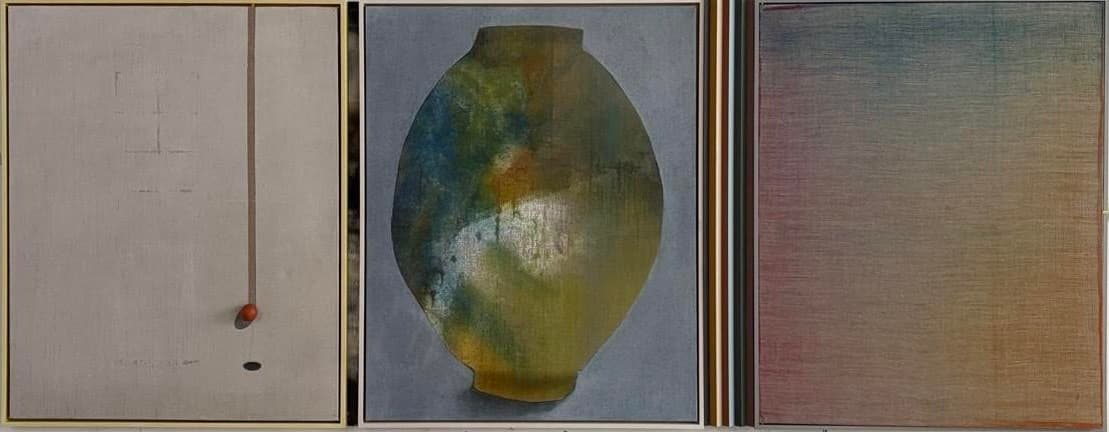
Lohaus SominskyMatthias Bitzer (b. 1975, Stuttgart, Germany; lives and works in Berlin) simultaneously works between painting, sculpture, installation, and writing. In his work, one can notice subtle references from art history, philosophy, and literature. Bitzer's paintings act as organic structures where each piece holds its own meaning, while simultaneously wanting to be part of something larger. A distinctive aspect of Bitzer’s visual language lies in the multiplicity of dimensions his works bring. In An Atom Drip from Your Lip Bitzer shows paintings that can be opened, revealing hidden layers beneath their surface, and making the viewer part of the installation. The viewer can approach and open this first layer like a book, encountering the second layer on the back of the canvas and the third layer, which is positioned in front of the viewer; there is a mirror in which the viewer sees themselves as part of the installation. With these gestures, Bitzer transforms the act of viewing into one of participation and discovery. Each work becomes an homage to the individual viewer, who exists independently yet forms part of a larger, interconnected system. Throughout this process, Bitzer’s works gain another dimension: they resist remaining static; they are in a constant state of change, taking different directions with every encounter. Faces in Bitzer’s works present themselves as clearly defined archetypes; they are portrayed as someone we all recognize, becoming part of the collective memory. They act as universal symbols that appear among different cultures and histories, being so fundamental that each different viewer can recognize them. Many of these figures emerge from what Matthias describes as “long-term relationships” with preexisting images. One such figure traces back to Leopoldo Fregoli, yet has been continually transformed across numerous iterations, as the artist pursues an ongoing process of mutation. The triptych unfolds in three stages. First, a small element, a ball, falls into a dark void. Though the opening seems too narrow, it is determined to fit, and once inside, it cannot be altered. Emerging from the black void, the ball enters a large amphora, the second stage, where everything comes together: movement, thought, action, and the traces they leave behind. The amphora becomes a vessel for all that arrives, holding each element within its embrace. The third stage unveils the interior of the amphora. As the painting opens, a mirrored surface reflects the viewer and their surroundings, hinting at an entire universe contained within the vessel. An elevated box on the wall that contains six works on paper and a mirror, forming part of Bitzer’s multi-year research, and offering the viewer insight into the artist’s archive. The ear, as a motif drawn from the human body, has long fascinated Bitzer and remains central in his oeuvre. Like fingerprints, ears are unique and can be understood as a kind of personal signature. With this work, Bitzer brings together elements of his archive with new pieces, demonstrating how a recurring subject can be developed, transformed, and reconfigured. By placing the mirror inside the box, another of his recurring elements, the artist not only incorporates the visitor into the work, but also invites reflection on the perpetual and eternity, suggested by the seemingly endless reflections of the vertical lines on the wall. Especially today, when so many concepts are ingrained in us, and images and information are consumed at great speed, these works create a bridge of contemplation. One that must be actively crossed. Through the simple invitation to open the first layer, a moment of pause arises: before arriving at a conclusion, one is given a space to stop and reflect on what lies in front of them.