
Downtown, Los Angeles
Christoph Weber
Contact
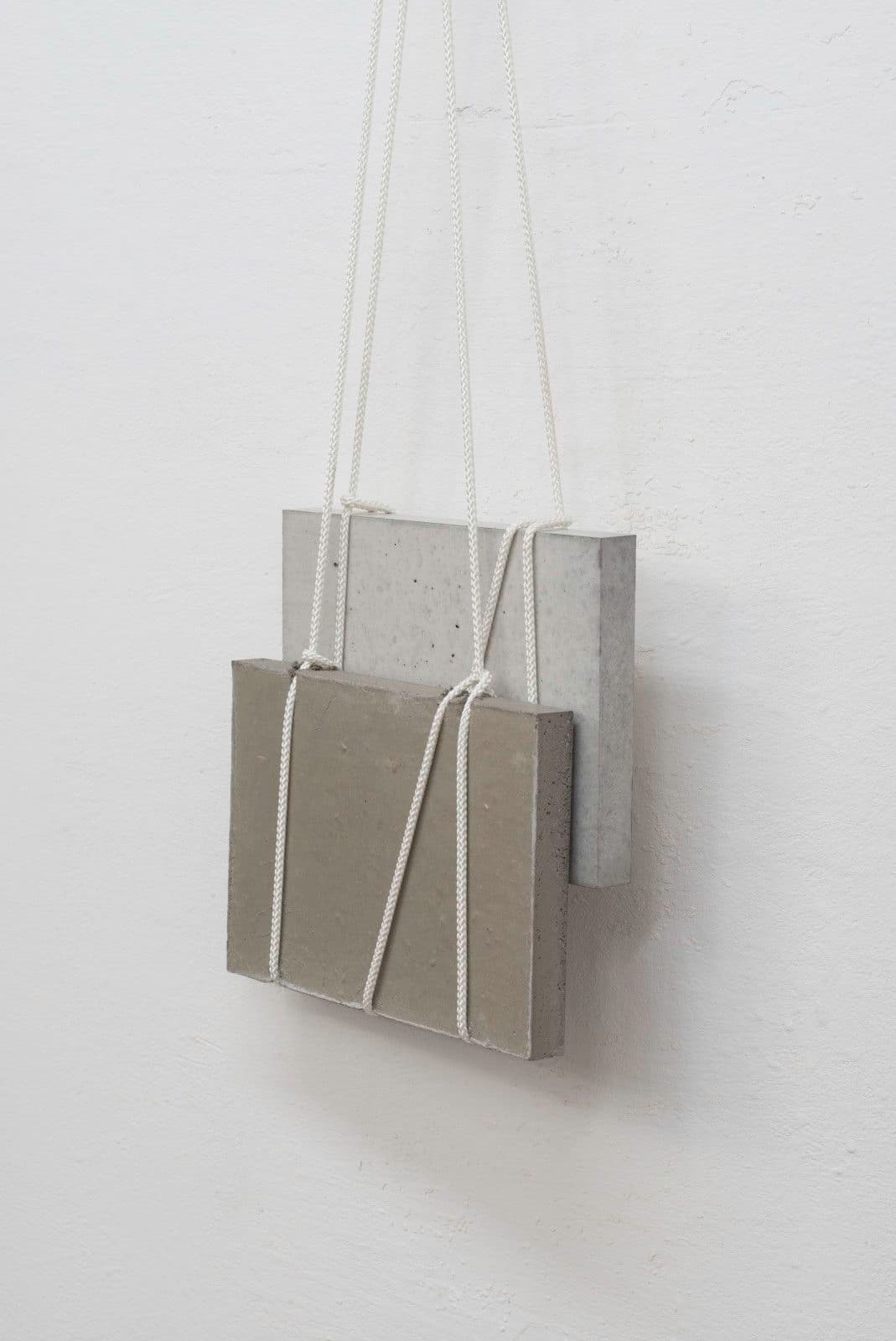
IbidIbid Gallery is pleased to present the debut US solo exhibition of Vienna-based artist Christoph Weber. In the lobby of Ibid Gallery rests the artwork Crack Stop Motion (2018), a three-part plaster sculpture in which the individual blocks appear as a continued extrusion of a single fracture. But when considering its method of production, a common line of inquiry into Weber’s work, it becomes visible that each plaster block represents a cast gap between two broken pieces of concrete. The action of pulling concrete apart resembles an Eadweard Muybridge-style stop motion animation in which plaster becomes the indexical material in Weber’s sculptural practice. Typical for his Gegenstück (Counterpart) series, the seeming simplicity of Weber’s sculptures quickly fades away as their complex relationships to mold and form, cast and uncast, and positive and negative becomes apparent through the sculptures’ interpreted process of making. In Gallery Three, Cast and Uncast (2018) reveals itself as the primary focus of Contact with a pair of concrete slabs connected by rope over an architectural beam. One slab stands balancing on the floor, with a smooth industry-grade finish, with the other slab slightly deformed by the rope from which it is suspended. Having been demolded and pulled up by the rope before the concrete was cured, Weber opens a very direct dialogue between the cast and the uncast. Furthering Weber’s process-as-meaning-navigation, two sign-like objects make up the sculptures in Pulp Signs (2018). Again exhibiting the forms of broken surfaces as with Crack Stop Motion, the elements in Pulp Signs are made of paper pulp mounted on rebar. Opposing an indexical relationship to their original, they make an imprecise copy compared to the plaster, with many small cracks and visible remains of chunks of paper, some with words still readable. Pulp Signs becomes a tautologic play between the “material of language” and the form of the sign and, when considered in relation to the cast plaster gaps of Crack Stop Motion, suggest a nuanced philosophical consideration of the types and varieties of cracks exposed in Weber’s works. The two remaining works in Contact utilize lead as a vehicle for Weber’s dialogue: Blei (gefalzt) (2017) and Etui (2018). In Blei (gefalzt), lead is wrapped around a wood “carrier”, whereas in Etui, a cast of fresh concrete (Weber’s typical ‘uncast’) has been partly slipped into a soft cover made of lead. In a less direct way than before, there appears a contradicting dichotomy to convey Weber’s take on the processes of casting and “material becoming”. Here, the German for “formwork facing” – Schalhaut – is animated into its tautology of shell and skin. The lead, in combination with concrete, becomes a protective skin, marking the space of a volume as a border where the “material becoming” takes place in secrecy – the hidden process between matter and mold beyond our investigative reach. Or, to exchange Weber’s concrete, plaster, and lead for Georges Didi-Huberman’s sense of l’empreinte – what takes place is contact. Christoph Weber was born 1974 in Vienna, Austria. He studied at the Academy of Visual Arts Leipzig, Germany, the Academy of Fine Arts Vienna, Austria, and the Kunstakademie Düsseldorf, Germany. Recent gallery and institutional exhibitions include On fold at ProjectSD, Barcelona, Spain (2017); Judith Fegerl, Christoph Weber at Kunstverein Leipzig (2016); Carton/pierre at Galerie Jocelyn Wolff, Paris, France (2016); Der fremde Raum (Bizarre Spaces) at Museum Marta Herford, Germany (2016); Galerie nächst St. Stephan - Rosemarie Schwarzwälder, Vienna (2015); Post / Postminimal at Kunstmuseum St. Gallen, Switzerland (2014); and uncast, Ibid Gallery, London, UK (2013). The monograph Christoph Weber, Uncast was published in 2015 by Spector Books in Leipzig, Germany. Christoph Weber currently lives and works in Vienna, Austria. Contact was made possible in part to the generous support of Bundeskanzleramt Österreich (the Austrian Ministry for the Arts).