
West, London
Poppy Jones
Solid Objects
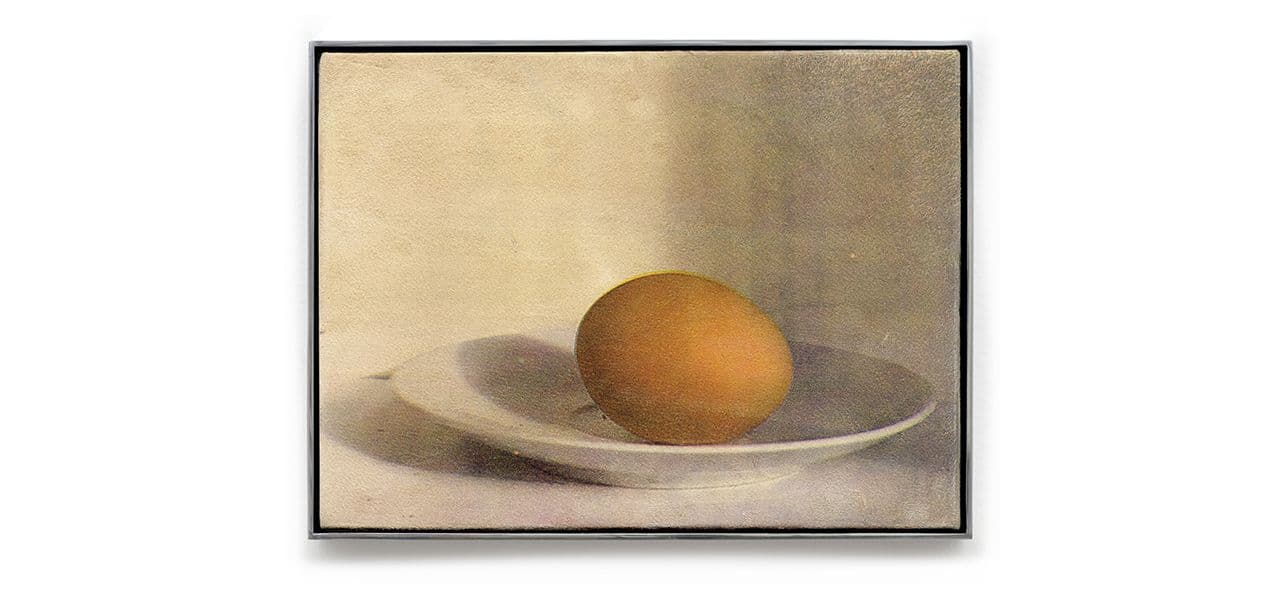
Herald St"Looked at again and again half consciously by a mind thinking of something else, any object mixes itself so profoundly with the stuf of thought that it loses its actual form and recomposes itself a little diferently in an ideal shape which haunts the brain when we least expect it." —Virginia Woolf, Solid Objects (1920) Herald St is delighted to present Solid Objects, Poppy Jones’s frst solo exhibition with the gallery. The presentation features a recent body of work captured in the winter light, and spans the gallery’s two premises in East London and Bloomsbury. Set within their respective industrial and townhouse interiors, the ten or so pieces in each location echo one another like pages of an open book. Rhythmically placed with room to breathe, Jones’s quiet vignettes lie soft and crisp, encasing scenes of stillness and fragments of life. Solid Objects takes its title from a short story by Virginia Woolf, introduced to Jones by the art historian Dr. Hope Wolf. The weaving narrative tells of a politician whose career unravels as he sinks into an obsession with found treasures: a lump of glass polished by the sea, a shard of china shattered into a fve-pointed star, a cold and radiant mass of iron. Despite the title, these fetichised items live in liminal states, man-made and time-worn, carrying physical weight and foating in the beholder’s subconscious, discarded and adored. Such an in-betweenness resonates with Jones’s object-paintings, which start as a photograph which is then printed onto a swathe of second-hand fabric, painted with watercolour, and stretched and placed in an aluminium frame. Academic interpretations of Woolf’s text sublimate the coveted possessions as symbols of birth, life, and death, and similarly Jones’s subjects encapsulate the arc of the living and the dead. Nodding to traditions of still life and vanitas paintings, the artist equates glowing lamp lights with the state of being alive, and fowers with the transience of existence. Several of her largest works frame the same vase of white tulips as they gradually dance and droop over several days, in a manner redolent of cinematic stills or the sequential anatomic studies of Eadweard Muybridge. In another series, the zippers of pufer vests and details of shirt buttons shine and crease as if lying on the contours of a warm, breathing body. Jones’s objects are solid but not stif – rather organic, sensual, and moving through life. The works in the exhibition refect a time and place, continuing a love afair with light historically pursued by British artists. Two pieces show open spreads from the 1943 tome Sculpture Today in Great Britain, with sculptures by Henry Moore and T. B. Huxley-Jones opposite blank pages caressed by the shadows of fowering stems. Primarily captured within her house, a few works are set in formerly lived-in spaces such as Sir John Soane’s Museum in London and Charleston House in Lewes, where gatherings of the Bloomsbury Group took place only a few miles from the artist’s home and studio. In one scene taken at Charleston, a decanter and glass rest on an Omega Workshop tablecloth, and another shows a bare bulb with refracting rays of light reminiscent of Victorian spirit photography. Alongside the Arts and Craft glassware and 1920s fabrics lie electric-coloured pufers, a sharp return to the contemporary. A pair of tableaus showing an egg and cherry tomatoes in a simple white dish provide fashes of colour among shades of greyscale outlines. At once time-specifc and timeless, above all Jones’s works embrace a domestic familiarity which emerged along with the photography-lithography-watercolour method she developed in the long months spent in her East Sussex home during the pandemic. Jones maintains an interest in the path by which art, design, and fashion enter the cultural canon, fnding resonance in history as well as the everyday. She often sources her materials on eBay, sometimes fnding the same button- down or jacket she reproduces. Gold Shirt, for example, is printed on the silk of the blouse itself, in a process which at once destroys the subject and ofers it a new life. In her neatly contained constructions, Jones exposes the alchemy of objects, drawing out their liminal existences and potent evocations. —Émilie Streiff Poppy Jones (b. 1985, London) lives and works in Bexhill-on-Sea, East Sussex.