
Arsenale, Venice
Pavlo Makov
The Fountain of Exhaustion: Acqua Alta
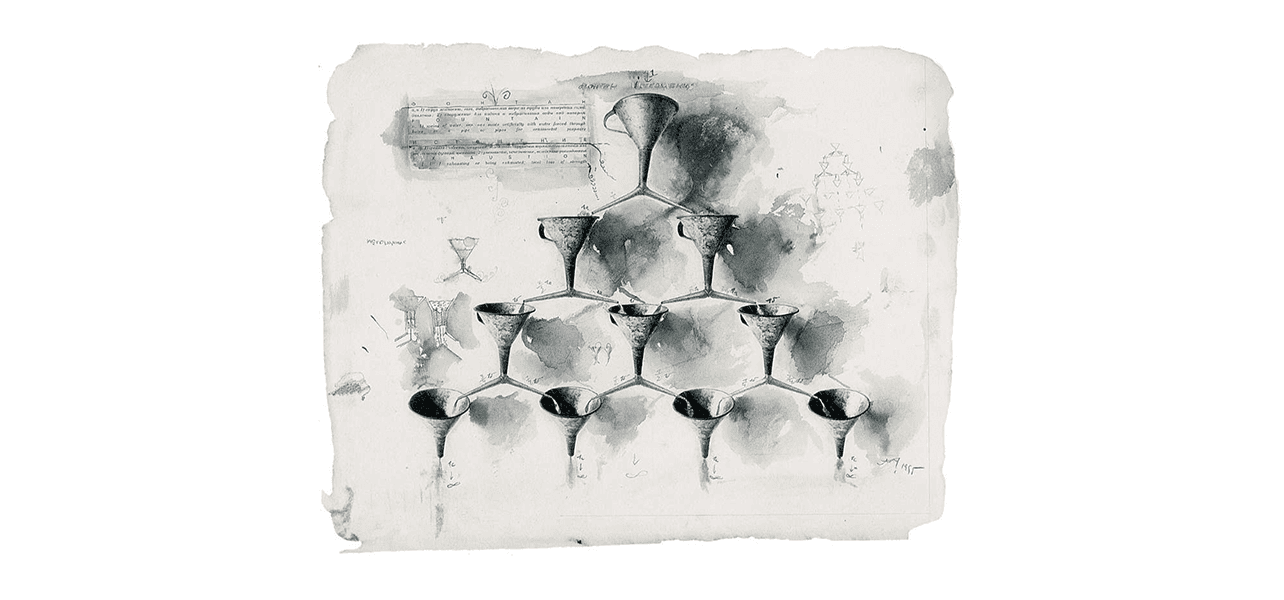
Ukrainian Pavilion2nd Floor Fountain of Exhaustion: Acqua Alta is an exhibition project. It presents a new 3.5-meter (10 ft) version of Pavlo Makov's fountain and reveals its 27-year history through archival materials. Fountain of exhaustion is an object consisting of a system of funnels, each of which has two exits and splits the water flow into two. Arranged one under the others, 12 rows of funnels direct the water from top to bottom, so that the water flow gradually diminishes. Unlike spurting fountains, the Makov's Fountain is exhausting itself. The history of Fountain of Exhaustion dates back to the mid-1990s. Back then the artist worked with the theme of a Place: he printed etchings with a panorama of Kharkiv and produced art books and photo documents. The main motives of these works were waters bodies, rivers and fountains. Kharkiv at the time has been experiencing significant transformations in the urban landscape and social relations. Abandoned fountains, infrastructural accidents and water supply disruptions served as a background and sometimes additional confirmation of Makov's practices. The place of confluence of the Lopan' and Kharkiv rivers, which has appeared in his etchings since 1993, gradually led the artist to the image of a funnel that splits water flow into two and makes it lose its strength. Assembled into a large multi-level structure, the funnels formed Fountain of Exhaustion — an art object, a paradoxical symbol of life in the place of Makov's exploration. Despite the artist's attempts, the fountain has never been installed in the urban space of Kharkiv. "That's when I saw that the society was not able to comprehend this work, unable to diagnose itself," Makov explained the situation. Since then, Fountain of Exhaustion has been appearing in the artist's practices in a variety of versions, materials, scales, and contexts. After a quarter of a century, it went from a local statement about the state of the place where it was created and turned towards the general agenda – the exhaustion of resources at the personal and global levels. In April 2022, for the first time, the Fountain will take its original form at La Biennale Arte in Venice – a city that is annually experiencing high water cataclysms and canal droughts and is lively discussing the problem of exhaustion. "Fountain of Exhaustion: Acqua Alta" is an attempt to talk about global modernity within the Ukrainian context. One of the curators' plans is to show how the local agenda has become consistent with the rest of the world, exhausted by the pandemic, environmental issues and military conflicts. Pavlo Makov is, without a doubt, one of the greatest Ukrainian artists of our time. However, the restless nature of his artistic practice rescues him from a recognizable and established image of a "classic". Pavlo Makov was born in 1958 in St. Petersburg. He studied at the Academy of Arts in St. Petersburg and the Samokish Crimean Art School, and graduated from the Kharkiv Art and Industrial Institute at the Faculty of Graphics. He lives and works in Kharkiv. Makov's works are housed in the National Art Museum (Kyiv), the Center for Contemporary Art (Osaka), the Victoria and Albert Museum (London), the National Gallery (Washington) and the Library of Congress (Washington). He is a member of the Royal Society of Painter-Printmakers in London, the Funen Graphic Workshop in Denmark and the Artist's Union of Ukraine. Makov's works have been repeatedly exhibited at auctions and major national and international exhibitions. He is a laureate of the Silver Medal of the National Academy of Arts of Ukraine (2009) and the Shevchenko Prize (2018). In 2022, his work Fountain of Exhaustion: Aqua Alta curated by Maria Lanko, Lizaveta Herman and Borys Filonenko will represent the National Pavilion of Ukraine at the 59th International Art Exhibition—La Biennale di Venezia. The project for the pavilion in Venice will become a culmination of the "fountain of exhaustion" image development that has been proceeding since the '90s. In Venice, the work will be for the first time embodied as a full-fledged kinetic object—a working fountain. The National Pavilion of Ukraine at the 59th International Art Exhibition—La Biennale di Venezia is the result of a collaboration of three independent curators: Maria Lanko, Lizaveta German and Borys Filonenko. They were united by the desire to represent Ukraine at the Biennale Arte 2022 and to reintroduce the practice of Ukrainian artist Pavlo Makov to the world. Maria Lanko and Lizaveta German have produced more than 30 joint projects in 10 years of cooperation. Among them are Powerful verticals, plywood colonnades commissioned by the Ministry of Foreign Affairs, and the Young Artists Festival at Mystetskyi Arsenal (now named the Young Art Biennale) entitled Today, that never happened. In 2013, Lizaveta and Maria launched the Open Archive — an online archive of contemporary Ukrainian art. In 2018, they founded The Naked Room gallery, which quickly became one of the most dynamic and visible spaces of the contemporary art scene in Kyiv. The curators consider it their goal to create a transparent art market system in Ukraine and build relationships between artists and various audiences. Borys Filonenko is an independent curator, art critic, lecturer, and editor-in-chief of IST Publishing (Kharkiv). Since 2011, Borys has been researching the artistic practices of Pavlo Makov. In 2018, together they co-authored a book — Do Po. He was a co-curator of the Second National Biennial of Young Art (Kharkiv, 2019), Aeneas Path. Artists of the Present Face to Face with the Past (Kharkiv, 2019) and Shadows of Forgotten Ancestors (Kyiv, Lviv, 2016) exhibitions. In 2015—2018 he was the curator of the Kharkiv Come in gallery. During 2017—2021 — tutor and curator of the Humanities Department at the Kharkiv School of Architecture. In 2021, the project of the Ukrainian national pavilion proposed by the curators won a competition organized by the Ministry of Culture and Information Policy of Ukraine. The project Commissioner is Kateryna Chuyeva, the Deputy Minister of Culture and Information Policy. Commissioner: Kateryna Chuyeva, Deputy Minister for European Integration of the Ministry of Culture and Information Policy of Ukraine Curators: Lizaveta German, Maria Lanko, Borys Filonenko