
Charlottenburg, Berlin
Günter Haese
Günter Haese
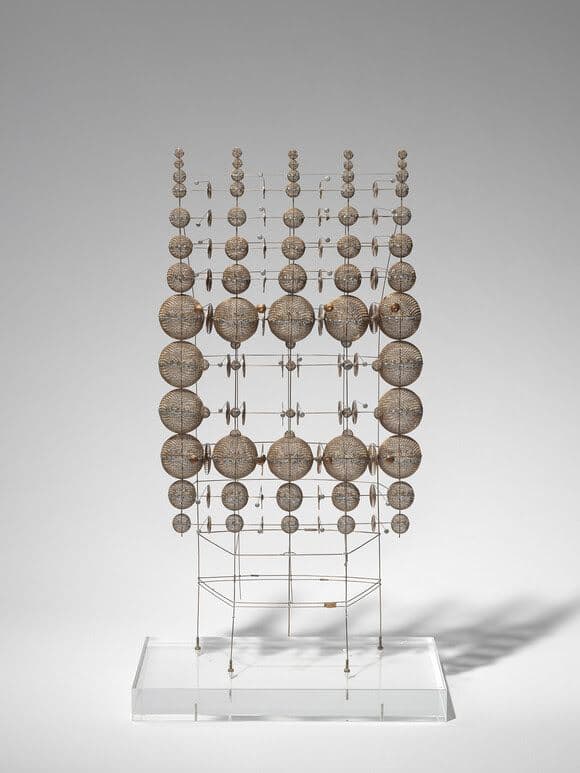
Michael Haas[Please scroll down for German version / Für Deutsch bitte scrollen Sie nach unten] The German sculptor Günter Haese (1924-2016) had already been active for some time before he achieved a rocket-like breakthrough as an artist. In the winter of 1960/61, he dismantled a clock - and discovered a fascinating new material inside it. From 1962 onwards, he used these watchmaking materials - delicate metal plates, parts and wires, fragile springs - for his sculptures. He joins and solders together delicate towers, spheres and cubes and other fantastic shapes with extreme care. Although Haese himself did not conceive them as kinetic works, the pieces react sensitively to external influences. Even a light breeze sets them into subtle vibration. His choice of materials is not only an absolutely unique selling point, Haese's work hits a nerve. His first exhibition at the Museum Ulm was followed in 1964 by an invitation to participate in documenta III in Kassel and the leap to America: a solo exhibition at the Museum of Modern Art (MoMA) in New York, which also immediately purchased several works for its own collection. Further stops on his extraordinary journey through the world's most important exhibitions include the Biennale in Venice and São Paulo, the World Exhibition in Montreal, Canada, several appearances at the Triennale in Fellbach as well as participation in the 20th Exhibition of Metal Sculptors of Japan and numerous other presentations in renowned national and international museums. The Marlborough Gallery has represented him since 1965. Haese cannot and does not want to follow the shift in the art market in the 1980s towards the mass production of artworks in well-staffed studios. He worked alone on his sculptures and created an œuvre of an estimated 400 to 500 works before his death. He received numerous prizes and an honorary professorship from the state of Schleswig-Holstein. ***** Der deutsche Bildhauer Günter Haese (1924-2016) ist bereits seit einiger Zeit künstlerisch aktiv, bevor ihm ein raketenhafter Durchbruch gelingt. Im Winter 1960/61 zerlegt er eine Uhr – und entdeckt in ihrem Inneren einen für ihn neuen, faszinierenden Werkstoff. Ab 1962 nutzt er diese Uhrmachermaterialien, zarte Metallplättchen, -teile und -drähte, fragile Sprungfedern, für seine Skulpturen. Äußerst sorgfältig fügt und lötet er zarte Türme, Kugeln und Würfel und andere fantastische Gebilde zusammen. Obgleich von Haese selbst nicht als kinetisches Werk gedacht, so reagieren die Arbeiten sensibel auf äußere Einflüsse. Schon ein leichter Hauch versetzt sie in dezente Schwingungen. Seine Wahl der Materialien ist nicht nur ein absolutes Alleinstellungsmerkmal, Haeses Werk trifft einen Nerv. Auf seine erste Ausstellung im Museum Ulm folgen noch im selben Jahr 1964 die Einladung zur Teilnahme an der documenta III in Kassel und der Sprung nach Amerika: eine Einzelausstellung im Museum of Modern Art (MoMA) in New York, das auch direkt einige Werke für die eigene Sammlung ankauft. Weitere Stationen auf seinem außergewöhnlichen Weg durch die wichtigsten Ausstellungen der Welt sind die Biennale in Venedig und São Paulo, die Weltausstellung in Montreal, Kanada, mehrere Auftritte bei der Triennale in Fellbach sowie die Teilnahme an der 20. Ausstellung der Metallbildner Japans und zahlreiche weitere Präsentationen in namhaften nationalen und internationalen Museen. Seit 1965 vertritt ihn die Marlborough Gallery. Dem Wandel des Kunstmarktes in den 80er Jahren hin zur massenhaften Produktion von Kunstwerken in großen Studios kann und will Haese nicht folgen. Er arbeitet allein an seinen Skulpturen und erschafft bis zu seinem Tod ein Œuvre von schätzungsweise 400 bis 500 Arbeiten. Er erhält zahlreiche Preise und eine Ehrenprofessur des Landes Schleswig-Holstein.