

Marais, Paris
André Butzer
Frau am Tisch mit Fruchten
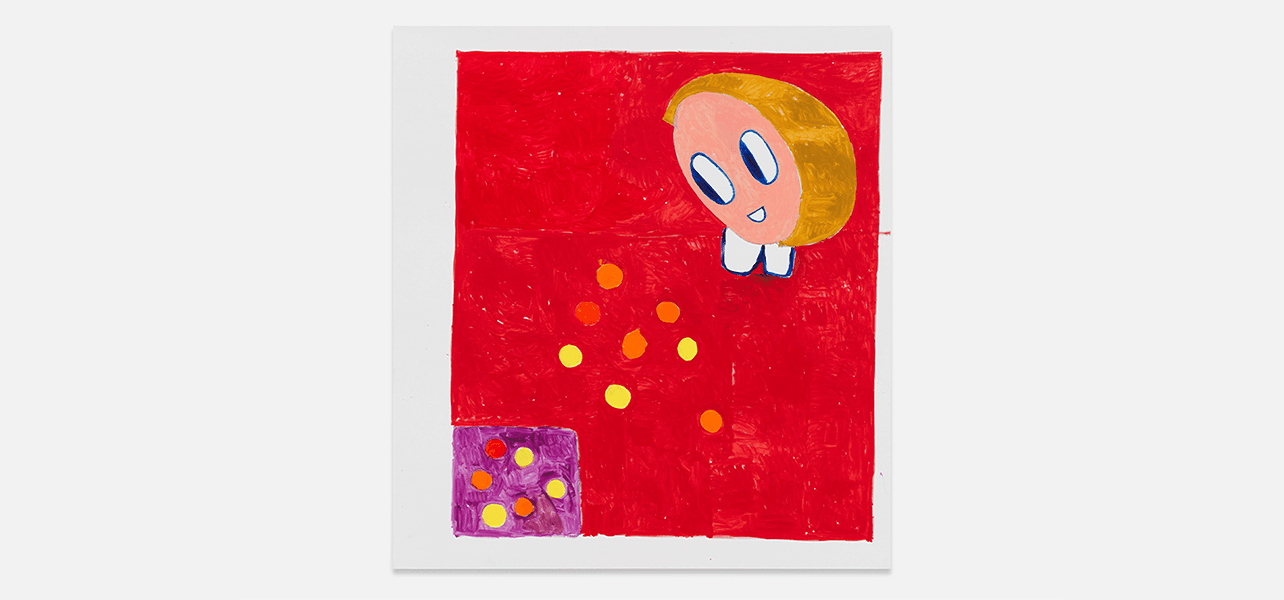
Max Hetzler[Scroll down for French version / Veuillez trouver ci-dessous la version française] Galerie Max Hetzler is pleased to present Frau am Tisch mit Fruchten, André Butzer's third solo exhibition with the Paris gallery. Andre Butzer envisions things astutely and in earnest with shocking clarity: table, fruit, woman. In four monumental paintings, created for the main hall of the gallery, he intertwines them in a planarly whole: Frau am Tisch mit Fruchten (1-4), 2024-2025. With each painting, Butzer leads us onto the same threshold. A red plane, hemmed in by the white of the canvas, opens up an enormous interior space within the image. The abundant red hue not only constitutes the surrounding ambient color, it is the site of the painting itself. Butzer merges all spatial properties in total flatness. The entire image is a color field, a room, a wall, a floor, a tableau, a table, and even a tablecloth. With light and transparent strokes, Butzer lets the plane sway into the depths. The image sways in the plane and in the depths of the chromatic expanse, being both flat and infinitely deep. Closeness and distance, plane and space, ground and figure are inextricably connected. Palpably withdrawn, yet equally close and tangible. Painterly, this is felt so simply and vastly that each image can unite these opposites within itself. The red is radiant and agitated, yet it is repeatedly traversed by fine horizontal and vertical seams and joints—the fundamental orientations of the pictorial fabric. Along these axes or hinges, the picture plans join together like wall panels, planks, and floorboards. Butzer places a dark purple block directly into the red or, in Frau am Tisch mit Fruchten (3), a slightly truncated light blue round. Sparse furnishings. On and around these "tables" or on the table-like images are bright, probably Mediterranean fruits: peaches, oranges, apples, and lemons. Laid out and scattered, descending and ascending, floating about—but always firmly in their own place. And above it all, a single woman's head appears, embedded and set in red like a medallion on a wall. None of these interiors have a clear center. The forms, planes, things, and figures are placed asymmetrically, standing out from each other as if cut out with scissors. Only in his masterful command of the elementarily relational nature of the primary colors red, yellow, blue, of flesh color as the embodiment of human presence, and of a few complementary contrasts, does Butzer achieve a coloristic solidity that gives the image a secure hold. In some paintings, doors or windows are hinted at. But these passages, painted red in red, are veiled and lead immediately back onto the plane. Self-referentially, the pictures confidently expose their own pictoriality. And yet everything that appears is light and bright. Each color radiates mildly in its own intrinsic light. The pictorial field itself is a clearing, a place of sheer appearance, a revelation. The woman with light blue eyes and golden hair is simply there. For if the canvas is the place of color and color is the place of appearance, Butzer's women appear in and of themselves. In their apparent seriality, each of them is unique, as a young girl, as a woman. Almost festive in mood and gesture, the woman is empathetically integrated into the tenderly shimmering red color field. Is she decorating the table and the image with fruit? Does she gather them, or does she give them away freely? Does she grant or take life? As if dwelling in her own possibilities, with a gentle smile and cheerful serenity, the woman gazes beyond the merely visible. But where is she looking? Whose appearance is she waiting for? 'She is looking somewhere else. Her gaze,' says Butzer, 'is pure. It's connected to the truth. It's interesting to follow what her eyes allude to.'[1] The dark blue eyes and the azure of the table, for instance, are mutually related in Frau am Tisch mit Fruchten (3). Or is it the sky that is reflected on the table from outside, as in water or a bowl? Maybe the table itself is the sky, whose blue shimmer we see from an even higher sphere? The colors and tables, the fruits and women come in and out of appearance, and in this cyclical process of passing and returning, the painting is fulfilled and realized for Butzer. Nothing is lost. Everything is accommodated in the complete existence of the image, in which time is also planar. Temporality is a plane upon which everything that was, is and will be, is present at the same time. Again and again and anew. Remaining and standing firm. Even the fruits are part of this temporal coherence. They are cyclically rounded in themselves and embody beginning, birth and life, maturity, decay, and death, new beginnings, rebirth, and renewed ripening. Their colorful appearance contains what has been and what is to come, is both a decorative ornament and protective peel, the completion of an old life and the vessel for a new one. Butzer sees all this as one. Even when, as in Tisch mit Fruchten, 2025, the figure is abruptly absent. The human contiguity, however, is still there. By making the world palpable in a still life, even if only for a moment, Butzer gives lived experiences a place that affects and involves us all. A brief stay, an abode, perhaps even a dwelling in the light of an image that allows us to recognize the concealed possibilities of being, allotted only to us. Andre Butzer's paintings are filled with the world, because they are truthful and whole. Truth dwells in the intrinsic light of color, upon a face, in a garland of fruit, on a chair with a yellow backrest, in body and soul, in the deepest blackness and certainly in the kitchen stove. He places the experience inherent to his paintings before us, brought to full fruition in a preserving and giving way: 'making legible the path of life and / making it walkable - / that is, knowingly living and / dying towards death / living dyingly … / and thus: / being gratefully grateful.'[2] —Christian Malycha André Butzer (b. 1973, Stuttgart) lives in Berlin. Solo exhibitions of his work have been held in international institutions including Gesellschaft fur Gegenwartskunst, Augsburg; Museo Novecento, Florence; Museo Stefano Bardini, Florence; St. Nikolaus, Innsbruck; nw9 Kunstraum der Stiftung Kunstwissenschaft, Cologne (all 2024); Museo Nacional Thyssen-Bornemisza, Madrid; Kebbel Villa | Oberpfalzer Kunstlerhaus, Schwandorf; Miettinen Collection, Berlin; Kunstverein Friedrichshafen (all 2023); Friedrichs Foundation, Weidingen (2022); Yuz Museum, Shanghai; Museum of the Light, Hokuto (both 2020); IKOB Musee d'Art Contemporain, Eupen (2018); Vaxjo Konsthall, Vaxjo (2017); Bayerisches Armeemuseum, Ingolstadt; Neue Galerie Gladbeck (both 2016); Kunstverein Reutlingen (2015); Halle fur Kunst, Graz (2014); Kestnergesellschaft, Hanover; Kunsthistorisches Museum / Theseustempel, Vienna (both 2011); Kunsthalle Nuremberg (2009); Kunstverein Ulm (2005); and Kunstverein Heilbronn (2004), among others. Butzer's works are in the collections of Aishti Foundation, Beirut; Art Institute of Chicago; Aurora Museum, Shanghai; Carre d'Art, Nimes; Children's Museum of the Arts, New York; CICA Center of International Contemporary Art, Vancouver; Contemporary Art Collection of the Federal Republic of Germany, Bonn; Deichtorhallen, Hamburg; Friedrichs Foundation, Weidingen / Bonn; Galerie moderniho uměni, Hradci Kralove; Galerie Stadt Sindelfingen; Hall Art Foundation, Reading / VT | Derneburg; Hamburger Bahnhof - Nationalgalerie der Gegenwart, Berlin; Holderlinturm, Tubingen; IKOB Musee d'Art Contemporain, Eupen; Kupferstichkabinett / Staatliche Museen zu Berlin, Berlin; LACMA Los Angeles County Museum of Art; Marciano Art Collection, Los Angeles; MARe Museum, Bucharest; MOCA Museum of Contemporary Art, Los Angeles; Musee d'art Moderne de Paris; Museo Nacional Thyssen-Bornemisza, Madrid; Museo Novecento, Florence; Museum Reinhard Ernst, Wiesbaden; Paula Modersohn-Becker Museum, Bremen; Pinakothek der Moderne, Munich; Rubell Museum, Miami; Sammlung Goetz, Munich; Space K, Seoul; Stahl Collection, Norrkoping; Stadtische Galerie im Lenbachhaus / Gabriele Munter- und Johannes Eichner-Stiftung, Munich; Tiroler Landesmuseum Ferdinandeum, Innsbruck; University of Washington, Seattle; Wooyang Museum of Contemporary Art, Gyeongju-si; and Yuz Museum, Shanghai, among others. 1 - André Butzer in conversation with H. Hwang and G. Ahn, ‘Why André Butzer did not smile?’, in: Vogue Korea, December 2023. 2 - André Butzer from ‘Instinkt und Schicksal’ (15 October 2024), in: André Butzer: Pressemitteilungen, Briefe, Gespräche, Texte, Gedichte. Band 4: 1983–2025, Vienna: Verlag für moderne Kunst, 2025. **** Galerie Max Hetzler a le plaisir d’annoncer Frau am Tisch mit Früchten, la troisième exposition personnelle d’André Butzer à la galerie de Paris. André Butzer saisit les choses gravement, et les met en image avec une clarté bouleversante : table, fruits, femme. Dans les quatre peintures monumentales Frau am Tisch mit Früchten (1–4), 2024–2025, créées spécialement pour la salle principale de la galerie, il les assemble dans une planéité totale. Avec chacune de ces peintures, Butzer nous amène à atteindre un même seuil. Un aplat rouge, bordé par le blanc de la toile, déploie un intérieur immense. Ce rouge opulent, n’est pas seulement une couleur d’ambiance, il est le lieu même de l’image. Butzer rassemble toutes les références spatiales dans une unique surface. L’image dans son ensemble est un champ de couleurs, une chambre, un mur, un plancher, un tableau, une table et même une nappe. À la faveur de coups de pinceau agiles et transparents, il fait vaciller le plan en profondeur. L’image oscille dans le plan et la profondeur de l’étendue chromatique, elle est à la fois plate et abyssale. Proximité et éloignement, plan et espace, fond et figure sont indissociables. Manifestement détaché et, pour autant tout aussi proche et tangible. Dans sa peinture, cela est ressenti de manière si simple et si grande que chaque tableau peut contenir en lui-même ces antagonismes. Le rouge est radieux et exalté, mais il est sans cesse traversé par de fines jointures horizontales et verticales – les directions fondamentaux du tissu pictural. Le long de ces axes ou charnières, les plans des tableaux s’assemblent comme des panneaux muraux et des planches. Directement dans le rouge, Butzer place un bloc violet foncé ou, dans Frau am Tisch mit Früchten (3), un rond bleu clair légèrement tronqué. Un ameublement austère. Sur et autour de ces « tables » ou sur les champs picturaux en forme de table se trouvent des fruits rayonnants, probablement méditerranéens : pêches, oranges, pommes et citrons. Essaimées et dispersées, descendant et montant, flottant ici et là – mais résolument à leur place. Et au-dessus de tout cela, une seule tête de femme apparaît, encastrée dans le rouge comme un médaillon sur un mur. Aucun de ces intérieurs ne possède un centre bien défini. Les formes, les plans, les choses et les figures sont répartis de manière asymétrique et se détachent les uns des autres comme s’ils avaient été coupés avec des ciseaux. Ce n’est que dans sa maîtrise de la relation élémentaire entre les couleurs primaires rouge, jaune, bleu, la couleur chair en tant qu’incarnation de la présence humaine et quelques contrastes complémentaires que Butzer atteint une solidité coloristique qui confère aux tableaux une assise sûre et incontestable. Dans certains tableaux, on devine des portes ou des fenêtres. Mais ces passages, peints rouge sur rouge, sont voilés et renvoient au plan pictural. Tournés vers elles-mêmes, les images révèlent avec conviction leur propre picturalité. Et pourtant, tout ce qui apparaît est clair et lumineux. Chaque couleur rayonne avec douceur dans sa lumière intrinsèque. Le champ pictural est lui-même une clairière, un lieu de pure apparition, une révélation. La femme aux yeux bleu clair et aux cheveux dorés est simplement là. Car, si la toile est le lieu de la couleur et la couleur le lieu de l’apparition, les femmes de Butzer apparaissent en elles-mêmes et à elles-mêmes. Dans leur supposée sérialité, chacune d’entre elles est unique, en tant que jeune fille, en tant que femme. Dans son attitude et d’une gestuelle presque festive, la femme est intégrée avec sensibilité dans le champ des couleurs rouges délicatement irisé. Décore-t-elle la table et le tableau avec des fruits ? Les rassemble-t-elle ou les offre-t-elle gracieusement ? Donne-t-elle ou prend-elle vie ? Comme si elle habitait dans son possible avec un sourire tendre et une sérénité tranquille, la femme regarde au-delà du visible. Mais où regarde-t-elle ? Quelle apparition attend-elle ? « Elle regarde vers l’ailleurs. Son regard », dit Butzer, « est pur. Il est relié à la vérité. Il est intéressant de voir ce que ses yeux indiquent ».[1] Le bleu foncé des yeux et l’azur de la table forment un rapport relationnel dans Frau am Tisch mit Früchten (3). Ou est-ce le ciel qui se reflète de l’extérieur dans la table, comme dans l’eau ou dans un bol ? Mais peut-être la table est elle-même le ciel, dont nous apercevons le reflet bleu en regardant vers le bas depuis une sphère céleste encore plus élevée ? Les couleurs et les tables, les fruits et les femmes entrent et sortent de leurs apparitions et c’est dans cette disparition et ce retour cycliques que se réalise l’image pour Butzer. Rien ne se perd. Tout est intégré dans l’existence complète de l’image, dans laquelle le temps est également plat. La temporalité comme un plan sur lequel tout ce qui a été, est et sera, est simultanément présent. Encore et toujours. Rester et tenir bon. Les fruits sont impliqués dans cette relation temporelle. Ils sont eux-mêmes cycliquement arrondis et incarnent le début, la naissance et la vie, la maturité, la déliquescence et la mort, un nouveau départ, une réincarnation et une nouvelle maturation. Leur apparence en couleur enferme ce qui a été et ce qui sera, elle est un ornement décoratif et une peau protectrice, l’achèvement de la vie mûre et le réceptacle de la vie nouvelle. Butzer voit bien que tout cela est lié. Même lorsque, comme sur Tisch mit Früchten, 2025, la figure manque soudainement. Mais la relation humaine est toujours là. En rendant le monde tangible dans la nature morte, même si ce n’est que pour quelques instants, Butzer donne aux expériences vécues un lieu qui nous concerne et nous enveloppe. Une résidence, une brève halte, peut-être même une habitation à la lueur d’une image qui nous permet de reconnaître les possibilités d’existence cachées qui ne sont attribuées qu’à nous. Les tableaux d’André Butzer sont emplis du monde parce qu’ils sont vrais et entiers. La vérité habite dans la lumière intrinsèque de la couleur, un visage, une guirlande de fruits, une chaise au dossier jaune, le corps et l’âme, le noir le plus profond et certainement le four de la cuisine. Il place devant nous l’expérience inhérente à ses tableaux et qui s’exprime pleinement, en la préservant et en l’offrant : « rendant lisible le chemin de la vie et / rendant accessible – / c’est-à-dire vivre en conscience vers la mort / vivant et mortel / être mortel … / et ainsi : / être reconnaissant en disant merci ».[2] —Christian Malycha André Butzer (né en 1973, Stuttgart) vit à Berlin. Des expositions personnelles ont eu lieu dans des institutions internationales, notamment au Gesellschaft für Gegenwartskunst, Augsburg; Museo Novecento, Florence; Museo Stefano Bardini, Florence; St. Nikolaus, Innsbruck; nw9 Kunstraum der Stiftung Kunstwissenschaft, Cologne (tous en 2024); Museo Nacional Thyssen-Bornemisza, Madrid; Kebbel Villa | Oberpfälzer Künstlerhaus, Schwandorf; Miettinen Collection, Berlin; Kunstverein Friedrichshafen (tous en 2023); Friedrichs Foundation, Weidingen (2022); Yuz Museum, Shanghai; Museum of the Light, Hokuto (tous deux en 2020); IKOB Musée d’Art Contemporain, Eupen (2018); Växjö Konsthall, Växjö (2017); Bayerisches Armeemuseum, Ingolstadt; Neue Galerie Gladbeck (tous deux en 2016); Kunstverein Reutlingen (2015); Halle für Kunst, Graz (2014); Kestnergesellschaft, Hanovre; Kunsthistorisches Museum / Theseustempel, Vienne (tous deux en 2011); Kunsthalle Nuremberg (2009); Kunstverein Ulm (2005); et Kunstverein Heilbronn (2004), entre autres. Le travail de Butzer fait partie de collections de l’Aïshti Foundation, Beyrouth; Art Institute of Chicago; Aurora Museum, Shanghai; Carré d’Art, Nîmes; Children’s Museum of the Arts, New York; CICA Center of International Contemporary Art, Vancouver; Contemporary Art Collection of the Federal Republic of Germany, Bonn; Deichtorhallen, Hambourg; Friedrichs Foundation, Weidingen / Bonn; Galerie moderního umění, Hradci Králové; Galerie Stadt Sindelfingen; Hall Art Foundation, Reading / VT | Derneburg; Hamburger Bahnhof – Nationalgalerie der Gegenwart, Berlin; Hölderlinturm, Tübingen; IKOB Musée d’Art Contemporain, Eupen; Kupferstichkabinett / Staatliche Museen zu Berlin, Berlin; LACMA Los Angeles County Museum of Art; Marciano Art Collection, Los Angeles; MARe Museum, Bucarest; MoCA Museum of Contemporary Art, Los Angeles; Musée d’art moderne de Paris; Museo Nacional Thyssen-Bornemisza, Madrid; Museo Novecento, Florence; Museum Reinhard Ernst, Wiesbaden; Paula Modersohn-Becker Museum, Brême; Pinakothek der Moderne, Munich; Rubell Museum, Miami; Collection Goetz, Munich; Space K, Séoul; Ståhl Collection, Norrköping; Städtische Galerie im Lenbachhaus / Gabriele Münter- und Johannes Eichner-Stiftung, Munich; Tiroler Landesmuseum Ferdinandeum, Innsbruck; University of Washington, Seattle; Wooyang Museum of Contemporary Art, Gyeongju-si; et Yuz Museum, Shanghai, entre autres. 1 - André Butzer en conversation avec H. Hwang et G. Ahn, « Pourquoi André Butzer n’a-t-il pas souri ? », dans : Vogue Korea, décembre 2023. 2 - André Butzer du « Instinkt und Schicksal » (15 octobre 2024), dans : André Butzer: Pressemitteilungen, Briefe, Gespräche, Texte, Gedichte. Band 4: 1983–2025, Vienne : Verlag für moderne Kunst, 2025.